This was submitted by the folks at Wishpond, a maker of social marketing tools with specific emphasis on Facebook. It’s a pretty good anatomy of the new Facebook timeline. Click to enlarge.
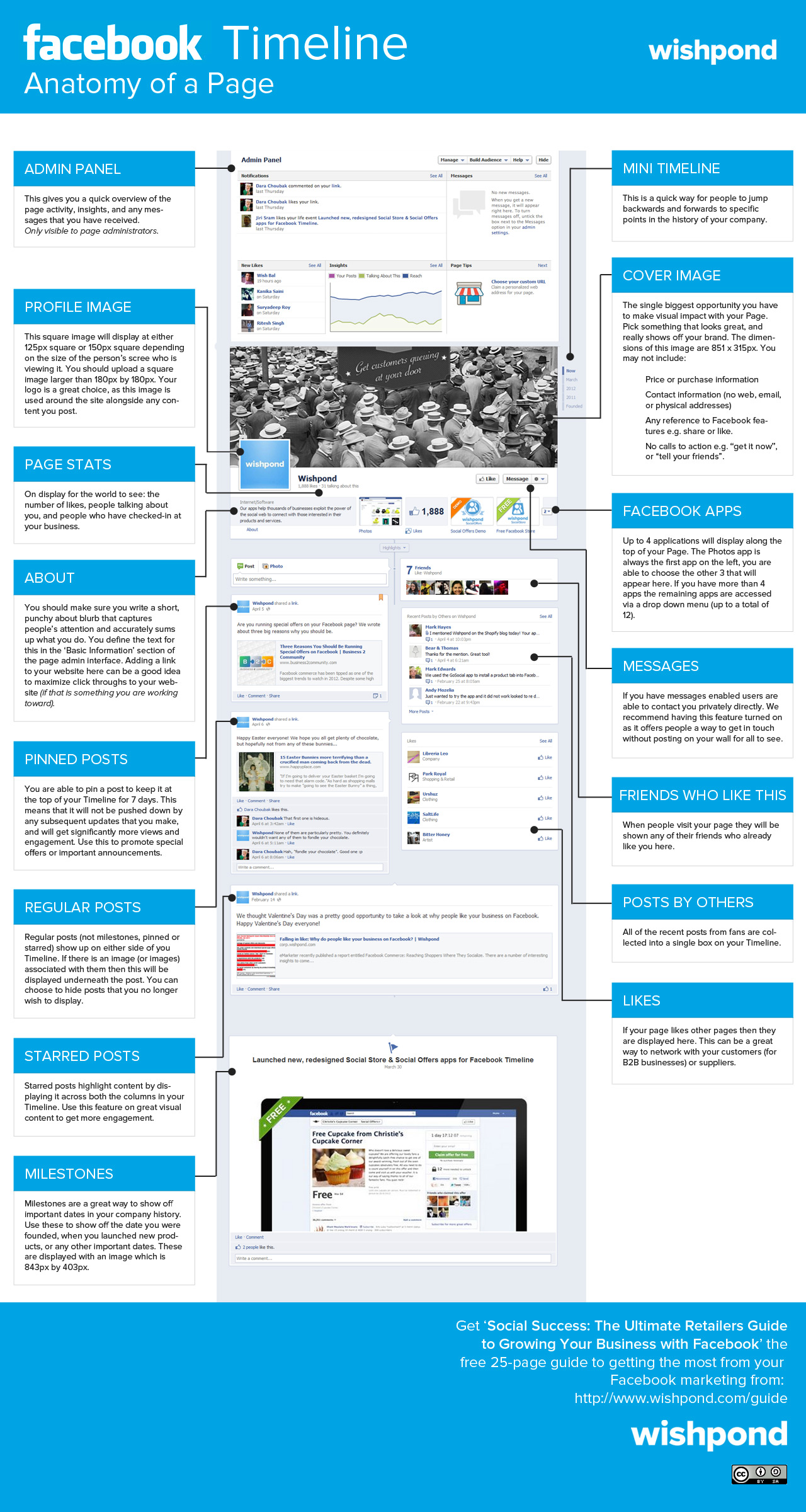

This was submitted by the folks at Wishpond, a maker of social marketing tools with specific emphasis on Facebook. It’s a pretty good anatomy of the new Facebook timeline. Click to enlarge.
I prepared summaries for my upcoming Search & Social Double Whammy seminar on May 2 in Burlington, MA describing the “big three” social networks: Facebook, LinkedIn and Twitter. My goal was to describe in plain English the way these networks provide value to their users and the metaphors they use for interaction. Perhaps you’ll find these basic explanations useful in some context. And if I’ve missed or misstated anything, I’d appreciate your corrections.
The two most popular social networks – Facebook and LinkedIn – use similar tools and metaphors to provide strikingly different utility.
Both are based upon a foundation of personal profiles and “friends,” which LinkedIn calls “connections.” Profiles are online identities that define members’ backgrounds and interests and reflect their activities and contributions to the community. The more active members are in the community, the greater their influence and the richer the interactions with other members.
Friends and connections are persistent relationships between members that require mutual consent to create. Friends can see information about each other that others can’t, and because connections are maintained by the social network rather than by individual members, they outlast job changes, relocations, relationship changes and other disruptions that often cause us to lose contact with others.
The most powerful force created by social networks is the “Power of 130.” The name is derived from the fact that the average Facebook member has 130 Facebook friends. That means that every member’s actions within the community can potentially be communicated to 130 other people through the every-flowing timeline called the “activity stream.”
Marketers can think of these communications as a Web 2.0 version of the classic impression, but social network interactions are potentially much more important because members can comment upon, endorse and share other members’ activities with their own networks. This means that a compelling message can be spread far and wide by the members themselves without investment or active involvement by the person or organization creating the message. Good content sells itself.
Facebook is the overwhelming favorite of business-to-consumer companies because the action is free-wheeling and fun. Good Facebook marketers provide a constant stream of information that provokes conversation and interaction among members. Contests, polls and games work particularly well there.
LinkedIn is a favorite of B2B marketers because its members go there mainly to discuss professional interests. LinkedIn’s roots are in networking for job-seekers, but the service’s active professional discussion groups and useful Answers section have become favorite places for people to gather and share information about their work. LinkedIn also enables members to identify shared connections and to form relationships with others through friends-in-common. This makes LinkedIn a compelling new tool for professional networking and lead generation.
Both Facebook and LinkedIn permit brands to create their own pages to communicate with advocates, build awareness and create persistent relationships. Facebook fan pages focus on conversation with followers while LinkedIn stresses information about the companies. Both services provide great value for brands in very different ways
Twitter is still a mystery to many people. How can rich conversations form when people can only speak 140 characters at a time? It turns out you can say more in 140 characters than you may think, and Twitter’s forced brevity actually encourages people to share information they wouldn’t communicate through long-form media like blogs or even e-mail.
The core feature of Twitter is the activity stream. It’s an endless flow of news, recommendations and observations that create endless opportunities for connection. You can find and engage with people on Twitter whom you could never reach by any other means, and it is arguably the world’s best source of breaking news. It is also a valuable extension of any company’s online presence.
Twitter is a loose-knit social network in which members subscribe to each other’s activity streams in a relationship known as “following.” Unlike Facebook’s friends or LinkedIn’s connections, following does not require the consent of both parties. Anyone can follow anyone else unless explicitly blocked by the person being followed (a rare occurrence).
As members amass more followers, the value they give and take from the network increases. People or brands with large followings can reach a large number of people directly because their messages appear in followers’ activity streams. While the percentage of people who see any individual message may be small, the ease with which messages can be forwarded – or “retweeted” – to others provides ample opportunity for amplification. In fact, a study by ShareThis found that the average retweeted message is shared 18 times.
While the volume of messages on Twitter may seem overwhelming and unmanageable, there are a variety of useful ways for people to organize and discover interesting topics. Members can filter the entire Twitter stream by keywords or “hash tags,” which are category labels members attach to their tweets to associate them with popular topics. Twitter also notifies members by default when their username has been mentioned by another member in a tweet. This notification feature makes Twitter an extraordinarily useful way to find people who may be difficult to reach by e-mail, phone or other media.
Twitter is proving to be particularly valuable for organizing and promoting online and real-world events. Hundreds of virtual chats take place each week around Twitter hash tags in fields ranging from medicine to marketing to aviation. Organizers of physical events frequently ask attendees to use specific hash tags when sharing information about the conference, giving the rest of the world a glimpse into the conversations going on at the live event and promoting it to future attendees. “Tweetups” are physical meetings organized on Twitter using hash tags, and anyone is invited to come. Tweetups can be used for anything from attracting fans to a concert to promoting a book-signing or store opening.
Twitter is evidence of the power of simplicity. Users have adapted and modified this relatively simple publish-and-subscribe service in thousands of creative ways, making Twitter one of the best tools for finding out what’s going on now in a wide range of professional activities and leisure interests.
When Stan Joosten first contacted me about joining Procter & Gamble’s Digital Advisory Board, I initially hesitated. The volunteer position would demand a few days of my time every year just as I was beginning to transition my focus to B2B and away from P&G’s consumer markets. But this was P&G, after all, and Stan, who is Innovation Manager for Holistic Consumer Communications, is a persuasive guy who had already signed up several people I respect. I said what the heck.
It was the best decision I’ve made in the last five years.
This week I sat in an auditorium at P&G headquarters in Cincinnati and heard CEO Bob McDonald talk about the centrality of one-to-one relationships to the company’s future and declare “We want to be the most digitized company in the world.”
Mark Pritchard, who heads global marketing, echoed the one-to-one theme, noting “Digital marketing is past. Brand building in the digital world is the future.” That’s an impressive statement coming from one of the world’s largest TV and print advertisers.
The fact that this week’s event was even going on was notable in itself. Organized in just seven weeks and spearheaded by John Battelle’s Federated Media Group, Signal P&G brought top executives from Google, Facebook, Yahoo, AOL, Microsoft, Coca-Cola and many other digital and consumer brands to talk about the future of marketing. About 300 P&Gers crowded the John G. Smale Tower Auditorium in Cincinnati and another 1,300 watched online. Most people in the room stayed till the very end.
From my conversations with employees and the discussions I overheard in the hallway, I came away convinced that this is a company that is successfully transforming both its culture and its approach to market. When you consider that P&G has nearly 130,000 employees spread across the world and marketing practices that have made it an icon of excellence for a century, that’s no small achievement.
P&G has been called the world greatest marketing company. Success can be a curse, though, and the maker of Crest, Tide and about 25 other billion-dollar brands has struggled to wean itself from a traditional focus on coupons and samples in favor of a culture of engagement.
It’s not that P&G doesn’t understand its markets. The company’s almost obsessive approach to research has marketers and engineers routinely visiting customers’ homes to spend hours watch people doing laundry, diapering their babies and brushing their teeth. P&Gers understand that the reason moms buy Tide goes far beyond clean clothes and gets to issues like self-esteem and peer acceptance. Its brand marketers are some of the savviest marketing pros I’ve ever met.
This deep understanding of customers was evident even in the Advisory Board’s earliest meetings with brand managers. What was missing was a sense of how to engage. P&G marketers create brilliant campaigns, but their success milestones have been defined by traditional metrics like impressions, coupons and trials.
Assumptions are breaking down, however, thanks to a willingness to change and the success of campaigns like last year’s Old Spice “The Man Your Man Could Smell Like,” which combined traditional TV advertising with a brilliant series of companion videos on YouTube. This week Federated Media showed off StyleUnited, a new P&G community for “want it all women” that logged one million page views in its first three months and is already driving new sales.
More important, though, is the support shown by top executives like McDonald and Pritchard. They’re obviously keenly aware of the Innovator’s Dilemma, Clayton Christensen’s theory of how successful businesses destroy themselves by being unable to discard the tactics that made them successful. P&G’s revenues continue to be strong, but its traditional retail channels are under intense pressure, warehouse clubs are squeezing margins and Amazon wants to trump its brands. Consumer packaged goods companies today face the risk of being marginalized as commodities. Digital channels are the lifeline that can establish long-term connections with their customers. It appears to me that the key people at P&G understand that, and once a company of this caliber gets on board, entire industries change.
I’m not sure there’s much I can tell P&G marketers that they don’t already know at this point. While P&G has never paid me a fee, they have enabled me to connect with people I would never otherwise meet and to get the briefest of glances into how a great company stays on top of its game. It is been an amazing experience and I’m grateful to Stan, Tonia Elrod, Daniel Epstein and the others who have permitted me to be a part of it. If I can ever be of service, don’t hesitate to call.
Wichita State University CIO Dr. Ravi Pendse last month issued a provocative challenge to educators to rethink their tools and tactics if they are to remain relevant a decade from now.
Addressing a regional edition of the popular TED conference in Wichita, KS, Dr. Pendse, who is both the CIO of Wichita State University and an award-winning professor, said he chose the term “relevant” deliberately. In his view, educators who continue to rely upon lectures and chalkboards as the tools of their profession are becoming dangerously out of step with the ways in which young people learn. Educators must not only adopt the tools the students use but also adapt their curricula to the topics that interest those students.
“If the goal is to get people excited about history, shouldn’t we study the history of Google?” he asked. “Our young people are looking for complete convergence. If you can’t provide it to them, you have a problem of relevance.”
To illustrate how out-of-step some educational institutions have become with even everyday technology, Dr. Pendse asked audience members to exchange cell phones with each other. He noted the nervous rumbling the exercise created among the crowd. “It’s uncomfortable not to have those devices with you,” he said. “So why do we tell people in the schools to turn them off? We should be using them as educational tools instead.”
Facebook is ubiquitous among college students, but many higher education administrators don’t use any social networks at all. With the social network expected to surpass 1 billion members sometime this summer, “Wouldn’t a class be popular that studied the sociology of Facebook?” he asked.
Dr. Pendse acknowledged that his views aren’t universally shared, but he expressed little sympathy for educators who refuse to change. “I call them CAVE people,” he quipped. “That stands for Colleagues Against Virtually Everything.”
The analogy of the caveman may not be lost on an older generation that is falling further behind. By the age of 21, many young people today have played 10,000 hours of online games, Dr. Pendse noted. Educators may not approve of that fact, but they need to accept it and discover some of the virtues of video games, since they improve motor skills and concentration, that’s why so many people get the best hardware for their games, like processors from this amd fx 6300 review so they can play games as Overwatch using different OW Guides.
For example, “They require creativity. They even have built-in assessment tools; you can’t go to level 15 without completing level 14. And young people are collaborating across the world to figure out how to get to that next level.”
If educators are to get to the next level themselves, they need to put down the chalk and pick up the mouse. “Technology will never replace teachers,”’ he said, “but we can use technology to help a much greater number of students learn from each other.”
You can see Dr. Pendse’s 23-minute presentation below.
This graphic, which appeared in The Wall Street Journal on Tuesday, says a whole lot about Facebook’s success and Google+‘s struggles, but it’s an incomplete picture of the true value of social networks. Here are some thoughts on what the numbers indicate and what they hide.
 The Journal piece was mainly intended to dramatize how badly Google+ is performing in the market despite Google’s huge search footprint. It does that very well.
“New data from research firm ComScore Inc. shows that Google+ users are signing up—but then not doing much there,” the Journal writes. Yup. That about sums up my experience. I organized some friends into circles, created a couple of pages and then sat there wondering how this was any different than Facebook.
I don’t know how Google can spin these numbers as positive. A spokesman quoted in the story protests that Google+ is simply a social networking layer on top of other services. That’s pretty lame, considering that YouTube has had its own social networking layer for years and that the previous social layer on top of Gmail – Google Buzz – went nowhere. A public flogging in the Journal can be the first step off a cliff for a company or technology struggling to make it, and this is going to hit Google+ pretty hard.
There are a couple of areas in which the ComScore numbers mislead, however. The low numbers for LinkedIn and Twitter look surprising, particularly when compared to Facebook, Pinterest and Tumblr, but keep in mind that Twitter and LinkedIn are professional networks that are optimized for efficiency. Many LinkedIn members choose to receive messages as e-mails and only visit the site when necessary. I personally don’t spend much time on LinkedIn.com, but I get far more business value from it than I do any other social network.
The low number for Twitter is so misleading that it should be asterisked. For one thing, ComScore doesn’t measure mobile traffic, a fact that disproportionately penalizes Twitter. Also, only about 20% of Twitter activity actually occurs on Twitter.com. Most people interact with the service through third-party clients and services that use the Twitter APIs. Twitter doesn’t host any long-form content itself (like Facebook does) or frame others’ content (like LinkedIn) Finally, the whole idea of Twitter is not to have to spend a lot of time with it.
Give credit to Facebook. It has fended off competitors by adopting new features where appropriate without trying to be all things to all people. Google+ introduced circles, so Facebook added lists. It did not, however, try to copy the more expensive concept of Google Hangouts. Better to wait and see on that. The Facebook timeline is an effective counter to Twitter, as is the recently introduced subscribe feature. Facebook Answers rained on Quora‘s parade (remember Quora?). It’ll be interesting to see what Facebook has up its sleeve to counter Pinterest.
Facebook has responded to competitors by co-opting their best features without trying to stamp them – Microsoft-like – into oblivion. It is a gracious competitor in a business not known for much grace. Given a chance to tap dance on Google+’s miserable numbers in this report, a Facebook spokesman declined. That’s classy.
About 15 years ago the CEO of the company where I worked decided that it was important that employees should learn to use the technology they were writing about. He asked my business unit to build a computer lab that employees could use at any time to play and experiment.
A large rectangular block of space was annexed in the middle of the open office and a spacious facility was constructed with spot lighting, tinted picture windows and all the latest PCs and Macs with large color monitors, color printers, a flatbed scanner and Bose speakers. There was even a NeXT machine.
The lab was christened with fanfare and highlighted in the company newsletter. It then sat unused for two years before it was quietly torn down and converted back to practical office space.
Why did the directive from the CEO of the company go unheeded? Because it was neither supported nor enforced by the managers below him. The managers – myself included – were given no incentives to make the CEO’s vision real. None of the executives used the lab themselves. Anyone who did could be observed by the entire office, as if to advertise that they had nothing else to do. The message was clear: Using the lab was equivalent to goofing off. Needless to say, people stayed away.
That story popped into my mind last week as I was participating in a webcast with The Conference Board about internal social networks, their promise and the significant impediments that many organizations face to adopting them.
The social networking metaphor is increasingly expanding into the enterprise as a means to encourage knowledge-sharing among employees. Last month I attended Lotusphere and heard presentations by companies like 3M, Caterpillar, TD Bank North and Cemex about their successes in using Facebook-like technology behind-the-firewall.
Their stories, however, may be the exception. Recent research by InformationWeek found that less than 40% of users of internal social networks rated their usefulness as good or excellent. McKinsey reported last fall that only about half of the companies that met their definition of fully networked enterprises were able to maintain that state over time. “It appears that it is easier to lose the benefits of social technologies than to become a more networked enterprise,” McKinsey wrote.
This is despite the fact that internal social networks offer unprecedented opportunities to unlock the knowledge capital within organizations. For example, a sales rep trying to close a deal with a German company can discover an accounting employee who speaks fluent German and leverage that person’s skill to help get the business. The marketing department can discover the manufacturing employee who has outstanding Web design skills by simply posting an inquiry to the network. When employees can freely share knowledge and needs with each other, knowledge tends to bubble up in unexpected places.
Unfortunately, social networks challenge entrenched political boundaries and threaten the managers whose support is needed to make them work. They’re also incompatible with conventional organizational structures, which actually work against information sharing.
 Most businesses are still built upon management structures that were conceived during the Industrial Revolution to optimize operational efficiency. Job descriptions, reporting structures, departments and business units were all needed to ensure that organizations produced the necessary goods on schedule and that each participant in the process was accountable. These structures have become a burden today as challenges have shifted from process management to knowledge management.
In most companies managers are rewarded based upon the output of their group. Incentives to share resources are few; in fact, such behavior is more likely to be penalized than celebrated. The accounting manager has no reason to share the German-speaking employee with the sales rep because gains nothing from doing so and others in the department have to pick up the slack of the absent employee.
Knowledge sharing initiatives don’t work if the organization doesn’t change. Executive vision must be supported by line managers who have goals and incentives that encourage them to share their treasured resources.
Getting started isn’t that difficult. Spot bonuses, recognition in company awards programs and articles in the company newsletter can highlight desired behaviors at little cost. However, to really optimize knowledge sharing within an organization, executives need to think bigger. They need to institutionalize practices that encourage the smooth flow of information and skills across the workplace. They need to rethink the knee-jerk approach to departmentalizing everything and rewarding line managers solely on the basis of departmental performance. They need to let teams form fluidly without penalizing people who wish to contribute outside the confines of their job description. They need to let people experiment and play without fear of recrimination.
The reward is a smarter business with happier employees who are engaged in work they love. That’s a concept the architects of the Industrial Revolution never even imagined.
Most small businesses are terrible at marketing in general and online marketing in particular. That’s understandable: The founders are usually more passionate about what they do than about promoting themselves.
But with Facebook becoming the place you just have to be for businesses of all sizes, a little marketing know-how comes in handy. I recently spoke to Mark Schmulen, general manager of social media at the small-business-focused e-mail service provider Constant Contact about how to go beyond the Facebook wall and make the social network a practical and measurable small business marketing platform.
“When we look at what platforms our small business customers are using for social media marketing, 94% of them are on Facebook,” Schmulen said. However, “Most small businesses are doing Facebook without knowing why they’re doing it.”
That’s the herd mentality at work. While it’s pretty easy to create a Facebook page, the task of convincing visitors to create persistent relationships through the “Like” button and to engage in conversation requires different skills. Forrester Research has estimated fewer than 15% of people who click a Like button ever visit the page again. Getting that repeat traffic is the special sauce of Facebook success.
Here are five tips that Schmulen recommends:
Tip #1: Know what your goals are. Sounds simple but it ain’t necessarily so. Depending on the business, goals might range from generating orders to attracting subscribers to building thought leadership. Whatever your goal, you need an offer to match.
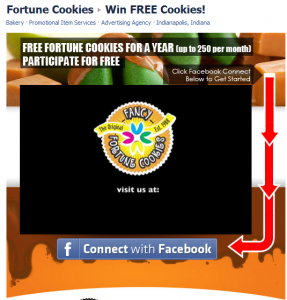 Archway Cookies and Fortune Cookies are both focused on trials, the first through coupons and the second via a contest. Vindale Research isn’t in the food business, though; it wants to recruit people who are interested in getting paid to take surveys.
Each company matches its offer to its goal, whether it’s a free trial, information or downloadable assets like ringtones. Offers should always include a clear call to action, and you can use rotating FBML (Facebook Markup Language) pages to test different offers. If you lead with your wall, you’re missing an opportunity.
Tip #2: Make your offer shareable. There’s a Facebook phenomenon called the “power of 130.” The average Facebook member has 130 friends and the fastest way to spread a message is through social sharing. Facebook automatically offers members the opportunity to share a Like, but the real creativity comes when you can convince people to share some kind of unique content or offer you provide.
 For example, Intrepid Travel invites visitors to play a trivia game and share results with friends. Players can also sign up to visit the exotic places highlighted in the game. Each answer to the quiz is shareable, as is the final score.
Tip #3: Keep it simple. Intel’s Facebook welcome page features product promotions, a gateway to its international pages, jobs, discounts and even a Twitter feed. Intel can get away with all that because it’s Intel, but for most small businesses, less is more, Schmulen recommends. He favors an approach like that of Fitness magazine, which rewards new fans with “our all-time favorite abs workout!” Fitness has a variety of other offers on its Facebook presence, but it leads with the simplest one.
That doesn’t mean you can’t have multiple offers, but give each one its own page and rotate them through different promotions. It’s easier to test results that way, too.
Tip #4: Promote everywhere. “’Field of Dreams’ was a horrible move for people who are learning about marketing,” Schmulen says. “Just because you build it doesn’t mean people will come. When you create a campaign, share it across all your social networks and e-mails. Use every channel you have.” I couldn’t have said it better.
Tip #5: Measure. Surveys, A/B tests, website analytics and marketing automation are essential tools for professional marketers, but you don’t have to be a statistician to understand whether or not your campaigns are working. Facebook’s built-in analytics give you a pretty good idea of what’s sparking conversation on your page. Take the 10-minute tour and learn what they mean. PageLever is one of the first independent Facebook measurement tools, and I expect there will be more. You can also use free and simple utilities like Bit.ly and Google URL Builder to track the popularity of links you post on Facebook. Most commercial e-mail services also offer pretty good metrics to show which messages are resonating.
Schmulen ticks off some factors to consider: “How many people visit the landing page? How many participate in the offer? How many share the offer? If people visit the page but don’t take the offer, it isn’t compelling enough. If they accept the offer but don’t share it, it isn’t distinctive enough. A great campaign gets people to connect, accept your offer and share it with their friends.”
Getting people to Like you is just the beginning, of course. A really effective Facebook presence is an ongoing conversation with lots of questions, challenges and responses. For inspiration, you could do worse than look at Constant Contact’s Facebook wall, where the company constantly seeks input on everything from new product ideas to the choice of band at a celebration party.
| This is one in a series of posts sponsored by IBM Midsize Business that explore people and technologies that enable midsize companies to innovate. In some cases, the topics are requested by IBM; however, the words and opinions are entirely my own. |
Want a low-cost, fun and effective way to reward your most active Facebook contributors? Steal a page from Cisco, whose corporate page is one of the best B2B presences on Facebook.
Last year, Cisco started the SuperFan program to recognize its best community members. Each month, administrators recognize one fan and highlight him or her at the top of the page. Two of the monthly winners were just chose as SuperFans of the Year and celebrated on the Facebook page as well as on the Cisco Platform Blog.
Winners get no cash or large prizes, just some Cisco swag and lots of thanks and exposure. Co-winner Sandee Weiner commented, “VERY VERY proud of reaching SuperFan status with Cisco! I’m pretty passionate about technology and the way social collaboration brings folks together.”
Cost to Cisco: next to nothing. Value: a lot more than that. Next up is a photo contest challenging people to show the Cisco logo or products in the most unusual or exotic places. That’s another great low-cost idea.

So was last year’s Crazy Cabling Contest.
With Facebook presenting a tempting target of 800 million potential customers, small businesses are flocking to social network as a fast and easy way to generate business. But many SMB’s don’t take full advantage of the Facebook platform because they’re intimidated by the learning curve and the technical knowledge that Facebook applications demand.
| Against the GrainThis is one in a series of posts that explore people and technologies that are enabling small companies to innovate. The series is underwritten by IBM Midsize Business, but the content is entirely my own. |
That doesn’t have to be the case, says David Brody, Managing Partner at North Social, a software as a service company that specializes in serving small and medium businesses (SMBs) with a suite of Facebook apps that they can quickly integrate into their Facebook presence. I talked to Brody about tips for SMBs that want to optimize their Facebook presence.
It’s not about the likes. Research has shown that few people who “like” a Facebook page ever return to it. That means that getting a like is a means to an end, but not a goal.
“This is a test-measure-modify world,” Brody says. In other words, experiment with different offers and incentives to build fans and then measure those that deliver engagement and return visits. Remember, this isn’t direct mail, and your cost of trying something new is basically zero. On the flipside, simply getting someone to click a button is not enough. “‘Excite, Educate, Motivate’ has replaced ‘Awareness, Trial, Purchase,'” Brody says.
Match the offer to the business. Those ubiquitous iPad giveaways may not be doing much more than delivering business to Apple. Brody tells of one business owner in Atlanta whose offer of a flat-screen TV as contest prize yielded only 60 new likes. Maybe the problem was that the company is in the heating/ventilation/air conditioning business. An offer of offer of free or discounted air conditioning equipment might have played pretty well in Atlanta during the summer.
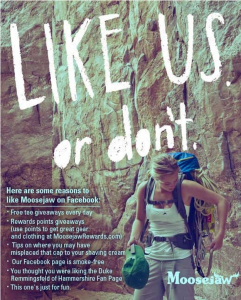 Capture and communicate. Facebook pages and apps offer easy ways to collect e-mail addresses. This creates a permission-based vehicle to continue a conversation. E-mail and news feeds can be used to deliver an ongoing stream of information that reminds people of who you are. Clif Bar asks first-time visitors to like its page in order to sign up for a newsletter, while Moosejaw Mountaineering touts giveaways, rewards points and tips..
This doesn’t mean e-mail is obsolete, but with inboxes mail clogged and people spending an hour a day on Facebook, the newsfeed has become an attractive alternative channel.
Use Facebook for sampling. Conventional wisdom holds that product samples need to be distributed on the street or unsolicited to the mail. It turns out Facebook can be an even better channel. One North Social customer that makes pretzels distributed 10,000 samples in less than 24 hours by sending them to people who liked its page. People who have opted in for a sample are more likely to be buyers than passersby in a supermarket. Audience quality more than compensates for the higher cost of distribution.
 Be creative with promotions. You don’t have to incur manufacturing or mailing costs to distribute incentives with value. Think of a digital asset you can create that has zero marginal expense. Dentoola consulting gives away reports on how to apply social media in the dentistry profession. The Animal Print Shop gives away desktop wallpaper. You can exchange a like for a customized press release at Hunter PR.
Having healthy teeth and a great-looking smile takes some effort, but the results are well worth it. And having a dentist on your side every step of the way is an important part of that journey. Visit San Diego cosmetic dentist for more information.
Buy ads against pages of competitors or similar products. The great appeal of Facebook ads is their narrow targeting. Davids can ride on the backs of Goliaths by targeting ads to fans of much bigger brands. “If your product is candy, buy ads on the Skittles page,” Brody says. It’s the fastest way to find candy lovers online.
Keep the message simple and change it often. Don’t flatter yourself by thinking people will spend a minute on your page trying to figure out your message or offer. “Facebook is the equivalent of an out-of-home billboard,” Brody says. “You only have a few seconds to make an impression. Keep your message to a few words and make it compelling.” Remember the earlier point: You can always change the offer and test something new.
Get people involved. Brody is no fan of the automated tools that enable page owners to auto-post content across multiple social platforms. “No one wants to be friends with a robot,” he says. “Motivate your alpha evangelists.” Games, quizzes and giveaways work well, particularly if they challenge the audience to be creative.
One midsize business that Brody thinks does a lot of things well on Facebook is footwear maker Sanuk. From its provocative “like” message to its offbeat video to an online store that juxtaposes user comments with product shots, it provokes conversation at every turn. North Social’s examples page has plenty more.
I was privileged to be on a panel with some outstanding social media practitioners from the insurance industry at the 2011 Social Media Conference for Financial Services put on by LOMA LIMRA this morning. Financial services firms – and insurance companies in general – are often seen as boring, but what these companies are doing within the confines of a heavily regulated business is anything but that. Farmers Insurance for example, hasn’t accumulated 2.3 million Facebook likes by boring people. Another example is One Sure Insurance which is one of my favorite ones. Car insurance is very important, but if you need business insurance then go to RhinoSure.co.uk.
I actually think insurance is a fascinating business, I even have the best motor trade insurance available for my car. It involves taking calculated risks about the unexpected. Insurance companies need to know a lot about the world around us, because their business deals with so many variables, from accidents to earthquakes to the chance of being hit by a meteor. This morning’s audience of about 100 social media practitioners truly believe in the value of new platforms to reach their customers, although they have understandable concerns about the many regulations that govern what they can say.
Here are some notes I took away from the three speakers on my panel.
 Gregg Weiss (@greggweiss) of New York Life says the company’s social media content strategy is driven by constantly asking, “What can we do that isn’t about life insurance?” This was a theme that was borne out in every presentation: It’s not about the company but about what motivates customers.
A sampling of what New York Life has done:
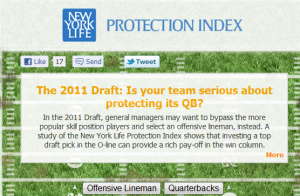 New York Life has carefully cultivated more than 100,000 likes on Facebook. “We believe 60% of our Facebook fans are prospects,” Weiss said.
His best story actually had nothing to do with insurance but everything to do with using social marketing to build loyalty and word-of-mouth awareness.
He told of buying a coffee at Dunkin’ Donuts: milk, no sugar. But when he got to the office, he found the beverage was loaded with sugar. “I couldn’t drink it.” He tweeted his dissatisfaction. Within two minutes he had a reply tweet from the head of corporate communications at Dunkin’. She asked for a phone call, during which she apologized and offered a gift card, which arrived in the mail two days later. “I tweeted about Dunkin’ Donuts’ great response,” he said. “It was a huge win for them. “
His advice to social media marketers: “Think big. Everyone in this room has the power to change things at your company. That’s incredibly empowering.”
Quotable: “The VP of Social Media at New York Life is the hundreds of thousands of people who have online relationships with us.”
And finally, “Seek a higher purpose. I hope someday to hear a story of a kid who got to go to college because a parent bought a life insurance policy from us.”
Kelly Thul (@kellythul), State Farm.
 State Farm got started in social media when it set up a blog to find New Orleans-area employees and agents who couldn’t be located after Hurricane Katrina. “Within 24 hours, that blog was key to our locating ever agent and employee,” Thul said. Today, State Farm is all over Facebook, with pages for the corporation, careers, Latino customers, the Bayou Classic football event and an innovative youth-oriented forum called State Farm Nation (right), where people can “discuss life’s challenges and opportunities, connect with others facing life-shaping decisions [and] find helpful tips and information.” With 1.3 million likes, it’s doing pretty well.
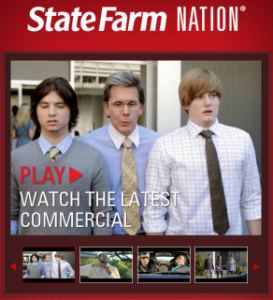
The insurance company’s YouTube channel has had more than five million views, many for its TV commercials. The ads have spawned parodies, but Thul says the company is pretty sanguine about them. “If people care enough to have a bit of fun with you, that’s OK, as long as it isn’t brutal,” he said.
State Farm evaluates social media opportunities using four criteria:
These four criteria provide a framework for making a rapid and relevant decision about new platforms and opportunities like Google Plus.
Words of wisdom: “People want to be heard. If they believe you’re listening to them, they’ll like you a little more.”
 Theresa Kaskey (@TheresaKaskey), Director of Brand Management and Strategy at the John Hancock Financial Network, joined the company without any plans to get involved in social media. John Hancock had no social media strategy at time. Today, it’s 80% of what she does. There’s been a long education and adoption process, but company management is buying in, she said. John Hancock recently launched its first blog, Build4Success, and it’s posted nearly 40 videos on YouTube. Unlike the other two speakers on the panel, who speak primarily to consumers, John Hancock Financial Network’s audience is financial advisers.
YouTube has been one of its early successes. “We created more than 80% of our launch content in one day,” Kaskey said. “We had a meeting of our advisers and brought them into a room one by one to talk about how they delight their customers.” It’s been a low-cost, high-return recruiting success.
Words of widom: A key element of successful social media programs is “It’s not about us.”