Direct Marketing Doesn’t Have to Suck

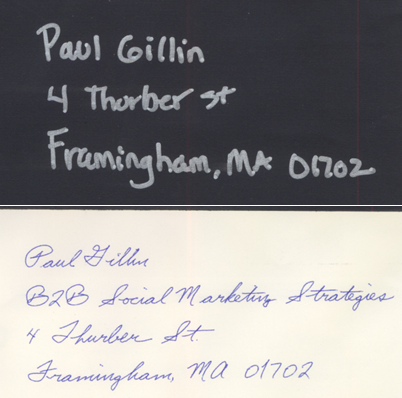
Direct marketing promotionsIn the weeks leading up to the Direct Marketing Association annual conference in Boston this week, exhibitors were out strutting their best stuff. Last week I got two letters in the mail that appeared to be personally addressed to me in a feminine hand (right). Both turned out to be promotions for companies exhibiting at the conference. One employs people to hand-address envelopes so that they appear to come from a friend. The other has an automated signature device that does much same thing.

I opened both envelopes without realizing what was inside and had to chuckle at how I was taken in. They fooled me good. And then I thought about what that says about the state of direct marketing today. Have we sunk so low that we need to trick people into reading our messages? Is it any surprise that forecasters expect direct-mail marketing to decline nearly 40% over the next two years?

Dump the Junk

Like many people, I’m less interested in reading mass marketing material today than I’ve ever been. There’s far too much good stuff out there. More than 90% of the material that enters my mailbox goes straight to the recycling bin. I unsubscribe from any e-mails that don’t offer clear value to me. Unsolicited e-mail simply gets blocked. Fooling me doesn’t make me a prospect; it makes me mad.

There are some marketing messages, though, that are so valuable to me that I actually look forward to their arrival. Here are a few that I welcome into my inbox:

Bulldog Reporter’s Daily ‘Dog –  This e-mail arrives every morning packed with news and insight about the latest happenings in media and corporate communications. It’s so useful that I make it a point to read every issue, even if that means saving them for a few days until I have time.

Marketing Charts – This is an invaluable daily digest of the latest market research in media and consumer behavior. I bookmark many of its summaries for later use and frequently tweet two or three items out of an issue.

HubSpot reports – The maker of “inbound marketing” software regularly sends alerts about new white papers, tip sheets and e-books that highlight best practices in social marketing. I downloaded and read most of them. I tweet almost all of them.

Someecards – They make devilishly funny and marginally offensive greeting cards, and I love their stuff. The weekly newsletter is always good for a laugh. I’ve bought several branded items from their store.

Editor & Publisher Daily – This newsletter is little more than a curation of articles from other sources, but the fact that E&P puts it together in a compact, scannable format makes it one of my most useful daily reads. It’s a prime source for my Newspaper Death Watch blog.

Gizmo’s Freeware – Why pay for commercial software when products of equal or greater value are available for free? Each of these daily newsletters spotlights a different category of goodies I can get for nothing.

Other than a general media and marketing theme, these communiques have little in common other than the fact that they enlighten or entertain. With the exception of Gizmo, all the companies have something to sell. I may not buy from them, but I sure do help promote their wares. With 9,400 Twitter followers, 1,200 LinkedIn connections and regular columns in BtoB magazine and The CMO Site, I can extend their reach at very little cost to them. And I do, nearly every day.

Think Like the Customer

This is direct marketing that doesn’t suck because it delivers value that I can share to enhance my own value to others. When you think in terms of what your customer wants, rather than what you need to sell, you create new channels of word-of-mouth awareness.

Lots of direct marketers still haven’t bought into this idea. In the weeks leading up to DMA, vendors contacted me with offers of movie tickets, gift cards and a chance to win an iPad. These are the same corny come-ons I’ve heard from tradeshow exhibitors for nearly 30 years. Does this stuff really work anymore? Are serious buyers really willing to endure a half-hour sales pitch to get a crummy pair of movie tickets? And if so, were they serious buyers in the first place?

If you want access to my inbox and to my network, help me build my professional profile by making it easier for me to help my friends and contacts. Make me look smart, because I’ll return the favor.

But please, save the postage stamp.


My presentation to this week’s DMA conference is below.

How Much Should You Pay For Content?

Underwood keyboardMarketers often ask how they can train engineers and technical people to blog, podcast and otherwise engage in deep online conversations with customers. My advice: don’t bother. You’re better off investing in professional communicators and teaching them what they need to know about your business.

The ability to communicate well in any media demands a certain amount of innate ability and it’s a difficult skill to teach. The technology trade media learned this long ago, and that’s why they have hired professional journalists to fill their pages for the past 75 years. It’s a lot harder and costlier to train  technology experts to write than it is to teach writers what they need to know to about technology.

So if you’re going to create your own blogs, white papers, e-books and such, you should probably use professional communicators to help you do it. What’s that going to cost you? Like most things in life, it depends.

Media Dividend

The rapid decline of mainstream media (more than 45,000 journalists have been laid off in the last five years in the US) has put a lot of good communicators out of work, and many can be had today for pennies on the dollar compared to what they made a few years ago. I recently noticed a bylined article by a veteran Wall Street Journal reporter on a Cisco promotional website. And I’ll bet he was happy to have the work.

The cost variable is the level of technical skill you need. If you’re in a consumer industry where the necessary level of technical knowledge is quite low, decent freelancers can be hired for as little as 25 cents/word, although the norm is between 50 and 80 cents. Demand Media, whose formulaic, keyword-driven approach to topic selection enrages many journalists, is rumored to pay as little as $.10 per word.


A word on words: Freelancers are usually paid by the published word. It seems an odd metric, but it’s the one that’s been used for decades and will probably persist until somebody comes along with a better one. Payment is based upon the published word, not the number of words the writer submits. You should always specify an upper limit.


Many journalists who were making $60,000 to $80,000 salaries working for newspapers a few years ago are happy to work for $35,000-$40,000 today. Any journalism pro should be able to produce 2,500 words/week for you. Do the math to figure out if it makes more sense to hire or freelance, remembering that a full-time employee carries less administrative overhead – but more overhead cost – than a loose staff of contractors. If you’re negotiating for basic, off-the-shelf freelance help, start with a 30 cents/word offer and work from there.

The higher the level of technical expertise you need, the more it’s going to cost you. In the computer industry, which is what I know best, $1 to $1.50 is the going per-word rate for marketing-commissioned pieces these days. I imagine that in a highly technical field, like bio-engineering, the rate is even higher. The fewer options you have, the more you’re going to pay.

Where Writers Hang Out

“I once commissioned a story from a freelancer who had an impressive portfolio of published work, but who apparently had also worked with some outstanding editors. The piece she turned in was such a disaster that I almost cried.”If you’re looking to hire professional journalists, sites like JournalismJobs, WritersWrite and MediaBistro are good places where writers hang out and look for assignments. There are several large groups of freelancers on LinkedIn, including The Freelance Writers Connection with 5,600 members. Search for others.

If you’re more of a risk taker, sites like e-lance, Guru.com, Freelancer.com and iFreelance are places to fish for talent. Try posting your needs and what you’ll pay and see who responds. Be sure to ask any prospective writer for samples of his or her work in your field of expertise. You do not want to pay a freelancer to learn your business on the job.

Hiring freelance help blind is a risky affair. Published samples won’t do you any good. I once commissioned a story from a freelancer who had an impressive portfolio of published work, but who apparently had also worked with some outstanding editors. The piece she turned in was such a disaster that I almost cried. I spent more than four hours trying to turn it into something that was at least publishable, hoping that nobody would actually read it. Moral of the story: ask for raw copy, not clips.

Going the Full-Time Route

Ginny Skalski

Cree Lighting blogger and former newspaper reporter Ginny Skalski

If you can afford to hire a full-timer, I highly recommend it. Journalists are quick learners by nature and their time to productivity is short. Staffers turn out more content per dollar than contractors, and you don’t have the overhead of legal documents, busted deadlines and flaky freelancers who simply disappear in the middle of the night

If you choose to hire a journalist as a corporate blogger, you’re in good company. Among the brands I know that do so are IBM, HubSpot, Eloqua, JetBlue, Cree Lighting and Sybase. I’m sure there are many more. Every single journalist-turned-corporate blogger I have met is happy to be out of the burning building that is mainstream media and into something with a manageable lifestyle and a boss who isn’t a screaming maniac.

If you prefer to go the freelance route, stick with a small group of reliable freelancers rather than playing the field. They’ll learn your business and require less hand-holding the longer you use them. They’ll also go the extra mile for you when you need them. Freelancers treasure steady work more than high pay. Most would rather work for a handful of reliable clients then constantly bid for the highest dollar. Paying within two weeks, rather than the corporate-mandated 60 days, will make you their best friend.

Final Note: Be Reasonable

I’ve been writing for BtoB magazine for nearly six years, some of it paid and some not. Like many media organizations, they pay less than any of my commercial clients, but I always put BtoB at the front of my priority list. Why? They’re just such damned reasonable people to work with.

Freelancers know that $2/word is no bargain if they need to produce 8,000 words and four rewrites over three months in order to get approved and paid. BtoB and I work so well together at this point that there is very little waste in our interaction. I actually make more money per hour working with them than I do with some corporate clients who pay considerably more.

The moral: The easier you are to deal with as a client, the better deals and favors freelancers will cut with you. This doesn’t mean dropping your standards, but the next time you’re ready to ship a draft back to the writer for a fourth revision in order to move two paragraphs around, you might consider just making the change yourself.


 

My Video Interview About B2B Social Media on EWeek Biz Advisor Blog

I recently chatted over Skype video with Eric Lundquist about how small and medium-sized businesses can use social networks to reach their customers. I made the point that social media plays perfectly to the passion that small business owners bring to their work. It’s an unfair vantage that small companies have.

Let Your People Speak!

IBM engineers celebrate Watson's victory (from a YouTube video)

IBM engineers celebrate Watson's victory (from an IBM YouTube video)

Earlier this week I wrote an article for SocialMediaB2B.com that made the case that last week’s IBM Watson Jeopardy challenge, in which an IBM computer thrashed the two greatest Jeopardy champions of all time, was the greatest B2B marketing campaign ever.

One reason I liked it so much is that IBM let scientists – instead of corporate suits – tell the story of their achievement. This was documented in more than 30 videos that IBM posted on YouTube as well as chat sessions and group Q&A interviews on the website reddit.com.

If you want to see the passion that the IBM scientists brought to this project, watch the 11-minute summary video that was posted shortly after the contest ended. It’s clear that Watson’s accomplishments were more than just a technology triumph. Researchers reacted as if their child had just graduated from Harvard. Their passion was contagious and genuine.

Why don’t more companies let the people who build and support their products come out of the shadows the way IBM did? In part, I believe it’s fear that people will do the wrong thing. It also reflects the time limitations that developers and engineers themselves often cite as a reason to stay in the shadows. Let’s look at each in order.

Tell Stories

Effective communications is about storytelling. Ronald Reagan taught us that. People don’t respond to statistics, feature charts and positioning statements the same way they do to other people. Entrepreneurs excite us when they share their vision, yet successful companies bury enthusiasm under layers of approvals and official spokespeople.
Rick Short, Indium Corp.B2B customers have intense information needs, and their questions are often best answered by the people who build and service the products they use. Some companies understand this. One of my favorite stories from Social Marketing to the Business Customer is Indium Corp., which built a constellation of search-optimized blogs that put their engineers directly in touch with the people who buy their highly specialized products. Result: 600% jump in leads in six months. Marcom Director Rick Short (left) says his job is to “get engineers talking to customers and then get out of the way.”

Do unofficial spokesmen sometimes say the wrong thing? Sure. Does it matter? Not really. Corporations are far too sensitive to the indiscretions of individuals, which usually can be sidestepped with an apology or explanation. A couple of hours of media training does wonders.

Blogs Are the New Trade Shows

The issue of time commitments and availability is valid, but usually overstated. Many engineers are only too happy to write papers and travel thousands of miles to deliver presentations, yet writing a 500-word blog entry or recording a how-to video is seen as overwhelming.

There’s a contradiction here. Engineers naturally like to share, and they know that conference presentations are good for their careers. Contributions to the company’s social media programs potentially reach a much larger audience than a presentation at a trade show. They go to the trade show because that’s what’s always been done.

I wish more corporate marketers would adopt Rick Short’s philosophy and see themselves as facilitators rather than spokesman. They should be the ones urging recalcitrant executives to draw contributors out from behind the curtain. They should have the statistics to demonstrate that the blog reaches a larger audience than the trade show. They should be the ones positioning customer communications as a privilege, not a chore.

The best way to encourage individual contributors to participate in your social media programs is to celebrate them. That doesn’t have to cost a lot of money. Recognize contributions to the corporate blog in your employee newsletter, or hand out awards for the most prolific or creative contributors every quarter along with a small gift certificate. When people see that their involvement is good for their careers, they quickly come on board.

A Personal Plea to Support the NewComm Forum

Come to the NewComm Forum, April 20-23, San Mateo, CAThe New Communications Forum is the one social media event I attend every single year. That’s because the speakers at this conference, which is now in its sixth year, are predictably incredible. I’m not talking about me; I’m referring to people like Kami Huyse, Geoff Livingston, Shel Holtz, Shel Israel, Maggie Fox, Katie Paine, Jackie Huba, Francois Gossieaux, Geno Church, Dharmesh Shah, Brian Solis and many others.  These are, quite simply, the people I most respect and listen to in the social media realm.

NewComm Forum takes place the week after next in San Mateo, CA. The keynote presentation on Thursday, April 22 is by Scott Monty, whose accomplishments at socializing the Ford Motor Company’s marketing programs are deserving of a lifetime achievement award. People told me that last fall’s presentation on The Hyper-Social Organization by Gossieaux and Ed Moran of Deloitte Services actually changed their lives. I know it had a huge impact on me. You can hear an updated version on Wednesday, April 21.

People don’t come to NewComm Forum to sell stuff; they come to discuss the big issues of how social technologies are transforming organizations and institutions. It was this event in 2006 that convinced me to devote my career to understanding and documenting social media’s transformative impact.

Why am I telling you all this? Because registrations are down this year. Whether it’s the economy or the flood of new competition, they aren’t where they need to be and that’s bad news. I say competition, but NewComm Forum really has none. No other event will send you home with as many new insights, ideas and action items as this one. That’s not to denigrate the many other good conferences out there, but in my opinion there is simply none that combines the theoretical with the practical quite like this one.

It’s not just me saying this.

These folks have no financial interest in making these comments. They simply believe, as I do, that a program of this quality needs to be preserved.

The organizers have made $500 speaker discounts available if you register with the code NCF500. They’ve also added a one-day pass for $395 if you register with code NCF1D. If you happen to be in the Silicon Valley area, this is a no-brainer. You get:

  • Full access on Wednesday, April 21st;
  • Keynote sessions by Jackie Huba, Dave Carroll (singer/songwriter, “United Breaks Guitars”) and Tim Westergren, founder and chief strategist of Pandora ;
  • Access to all conference sessions, including presentations by Shel Holtz, Jen McClure, Paul Chaney, Eric Schwartzman, Francois Gossieaux, Brian Solis, Katie Paine, Dharmesh Shah, Beth Kanter, Kami Huyse and others.
  • Breakfast, Luncheon featuring Dave Carroll and a cocktail reception.

Please support this valuable event and assure its health into the future. Tweet it to your followers using hashtag #ncf2010. And thanks for listening.

Selected NewComm Forum Speakers

Blogging Essentials: the Slides

Here’s a substantially updated version of a presentation on blogging essentials I’ve been delivering to business clients over the last couple of years. The full presentation runs about three hours live or via webcast and focuses  on helping bloggers deal with some of the more common problems of publishing, including generating ideas and  unique angles.

Update: Alan Belniak from PTC has a nice series of blogging guidelines on his Subjectively Speaking blog.

Full description:

This is a crash course intended to quickly bring bloggers up to speed on today’s best practices for achieving the greatest mileage from your blog posts. Topics include:
  • How influence works in the blogosphere
  • Major applications of corporate blogs
  • Developing a content model
  • Generating ideas and unique angles
  • Writing compelling headlines and entries
  • Positioning and voice
  • Why top business blogs are successful
  • Unique characteristics of b-to-b markets
  • Tricks for generating buzz and recognition
  • Working with multiple media

View more presentations from Paul Gillin.

New Media Demands New Leadership

I don’t go to the South by Southwest conference for the sessions as much as for the people. The most interesting conversations usually happen outside of the conference rooms. One discussion that stuck with me this week occurred after a presentation by MIT’s Andrew McAfee entitled “What Does Corporate America Think of 2.0?”

While I was waiting in line to introduce myself to Mr. McAfee, I eavesdropped on a conversation he was having with the young woman in front of me. She gave her age as 28 and said she had recently been hired to coordinate social media at a real estate company where her bosses were mostly in their 50s. She was clearly demoralized and frustrated.

The young woman had been brought on board to get the realty company up to speed in the new Web technologies. She understood that conversational marketing requires a culture change, but her management wasn’t interested. Her bosses, she explained, saw social technology as simply another way to distribute the same information.

For example, she had been ordered to post press releases as blog entries and to use Twitter strictly for promotional messages. She had been told to get the company on Facebook but not to interact with anyone on its fan page.Her communications with the outside world were to be limited to platitudes approved by management.

I felt bad for this young lady and also for her bosses, who will no doubt lose her in short order. I suspect they hired a social media director in the belief that she could create new channels for them, but they didn’t understand the behavioral change that was required on their part.

Open Leadership

A couple of nights earlier, I attended a dinner given by Altimeter Group, whose founder, Charlene Li, co-authored the ground-breaking book Groundswell. Charlene was handing out galley copies of her forthcoming book called Open Leadership. In it, she suggests that management strategies must fundamentally change in the age of democratized information. I’ve only read a third of the book so far, but I can already tell that it will cause considerable discomfort in corporate board rooms.

In the opening chapter, Charlene notes that “to be open, you need to let go of the need to be in control… you need to develop the confidence… that when you let go of control, the people to whom you pass the power will act responsibly.” This notion of leadership replacing management will shake many of our institutions to the core.

The traditional role of management has been to control and communicate: Managers pass orders down from above to the rank-and-file who are expected to do what they are told.

In the future, communication will increasingly be enabled by technology. Employees will be empowered with information and given guidelines and authority to do the right thing. Middle managers won’t be needed nearly as much as they are today. Organizations will become flatter, more nimble and more responsive because information won’t have to pass up and down a chain of command before being acted upon. This will result in huge productivity gains, but progress will only be achieved when top executives learn to let go of the need to control and to accept the uncertainties of empowered constituents.

No Pain, No Gain

The real estate company’s mistake was in believing that it could participate in a new culture without changing its behavior. It saw social media as a no-lose proposition; distribute the same material through new channels but don’t accommodate the reality that constituents can now talk back. Any company that takes this approach will fail to realize the benefits of the media. Once its customers realize that their opinions don’t count, they will stop engaging with the company. That doesn’t mean they won’t do business with the company any more, but the benefits of using the new media will be lost.

I have never advocated that all companies adopt social media. Each business has a different culture, and some adapt more readily to open leadership than others. If employee empowerment and institutional humility don’t fit with your style, then social media is probably not for you. You may do just fine for several years without changing your practices. But if you choose to play in the freewheeling markets enabled by customer conversations, then you’d better be willing to let go of control.

Over time, I believe all companies will have to give up the belief that they can control their markets, because interconnected customers are an unstoppable force. In the short-term, however, businesses need to do what feels right for them. If you work for a company that can’t adapt itself to the concept of open leadership, then start circulating your resume. These days, there are plenty of businesses that are eager to change.

UPDATED: Draft Outline B2B Social Marketing Book

Here s a first-pass topical outline for the book Social Marketing to the Business Customer, by Paul Gillin and Eric Schwartzman (John Wiley & Sons, late 2010). This outline attempts to define all the major issues to be addressed in a book targeted at business-to-business marketers. Your thoughts are welcome. Use the comments area to tell us what we’ve missed and where we should devote the most attention. And if there’s anything that shouldn’t be here, let us know that as well

Note: Practical advice will be interleaved with case studies, vignettes and quotes from practitioners. We are very interested in identifying candidates for case studies. If you have a good story to tell or tips to share, contact Paul or Eric at paul{at}gillin{dot}com or eric{at}ericschwartzman[dot]c0m.

Update: This outline was revised and reposted on March 3, 2010. The most recent revision appears below. Earlier revisions have been deleted. Many of the comments refer to items that appeared in earlier versions.

Update: This outline was revised and reposted on Jan. 5, 2010 based on earlier feedback

1. The Changing Rules of B-to-B Marketing

  1. Traditional media in decline
  2. Rise of the unofficial spokesperson
  3. Proliferating channels to customer or, from a marketers point of view, audience fragmentation.
  4. The importance of peer-to-peer communications: the impact of markets as conversations.
  5. Assessing most effective platforms for B2B social media marketing
  6. Contrasting b-to-c and b-to-b audiences
  7. Creating a strategic framework for platform assessment.
  8. Promoting responsible edge work through corporate social media policies. If there’s no formal policy in place empowering employees to do the edge work, why would they risk their jobs to engage?

    1. Assessing value of end-customer pull vs. business partner push
  9. Estimating staffing requirements

2. 10 Ways You Can Use Social Media for B-to-B Marketing

  1. When social media is and isn’t appropriate
  2. Risk/reward matrix
  3. Applying social media to the traditional sales cycle
  4. Researching audience needs

    1. Listening and engaging
    2. Inviting feedback
    3. Market research
  5. Shift from demographic to psychographic profiling
  6. Product development
  7. Customer/channel relations
  8. Peer-to-peer marketing
  9. Cost-saving opportunities
  10. Applications of crowdsourcing

3. Getting Buy-In and Resources -

  1. Explaining value to stakeholders
  2. Adopting the mindset
  3. Test and revise
  4. Overcoming popular objections

    1. Top 10 arguments to make with legal and HR
    2. Convincing the CIO

4. Organizing for Social B-to-B

  1. Empowering employees to speak
  2. Integrating social media with conventional marketing
  3. Re-skilling the organization
  4. Marketing department organization
  5. Building bridges to other departments

5. Protect Yourself: Creating & Enforcing Social Media Policies

  1. Defining “transparency”
  2. Coordinating with existing corporate policies

    1. HR code of conduct
    2. IT policies
  3. Social media Policies vs. Guidelines

    1. Legal issues to consider
    2. Do you need a policy?
    3. Start fresh or build on existing policies?
    4. Issues to address

      1. Disclosure
      2. Private vs. Business Personae
      3. Privacy and confidentiality
      4. Respectfulness, diplomacy and conflict resolution
      5. Crisis considerations
  4. Enforcement and penalties
  5. Regulatory considerations

    1. Tweeting through an IPO

6. Lead Generation

  1. Building social media into the selling cycle
  2. Stages of the funnel
  3. Quality vs. quantity leads

7. Getting Starting: Easy Low-Risk Opportunities

  1. Identifying high impact applications for quick results
  2. Demand pull vs. supply push
  3. Choosing tools
  4. Analytics and metrics
  5. Worksheets
  6. Selecting participants
  7. Campaign lifecycles
  8. Budgeting
  9. Allocating resources
  10. Beyond the first campaign – next steps

8. Listening to Customers

  1. Listening through filters
  2. Embracing popular language
  3. Dealing with negativity without losing your cool
  4. Going “off message” in search of relevant conversations
  5. Keyword research primer (contributed by Lee Odden)
  6. Keyword validation
  7. Quality vs. Quantity tradeoffs
  8. Conversions
  9. Advanced search
  10. Competitive analysis
  11. Research alternatives
  12. Ratings systems
  13. Assembling a rapid response team
  14. Policies and procedures
  15. Building internal feedback loops

9. A Customer Is Not a Transaction: Deepening Relationships

  1. Incorporating social media into customer care and support (Social CRM)
  2. 360° listening scenarios
  3. Building a listening dashboard
  4. Creating customer testimonials and endorsements
  5. Integrating social media and customer events
  6. Brand ambassador programs

10. Profiting From Customer Communities & Social Networks

  1. Value of communities
  2. Branded vs. public communities
  3. Public vs. private
  4. Where do branded communities make sense?
  5. Best practices for encouraging activity
  6. Do you need a dedicated community manager?
  7. Skills requirements
  8. Employee involvement in customer communities
  9. Platform selection

11. B-to-b Uses for Facebook, LinkedIn and Twitter

  1. Features and audiences
  2. Organizational versus individual value
  3. Using the platforms in combination with each other
  4. Behavioral standards and community values

12. A Non-Techie’s Guide to Choosing Platforms: Beginning, Intermediate & Advanced

  1. Securing the right infrastructure: Web 2.0, Licensed Software, Open Source and SaaS
  2. Matching platform to objective
  3. Overview of major platforms
  4. Public versus private platforms
  5. Selection grid and decision tree
  6. Examples of best practices
  7. Staff assignments and responsibilities
  8. Integrated campaigns
  9. Mobility (contributed by Christina Kerley)
  10. Risks: Data Portability, Back-up, Support, Service Level Agreements and Attention Siphons

13. Metrics and ROI

  1. How practitioners are approaching ROI
  2. Strength/weakness analysis of major metrics
  3. Working backwards from the goal
  4. Revision cycles
  5. Suggested ROI methodologies
  6. Multiplatform multiplier effect

14. What’s Next for B-to-B Social Media

  1. Expanding internal stakeholder involvement
  2. 2. Creating branded customer communities
  3. 3. Multichannel campaigns
  4. 4. Internal/external program integration
  5. 5. Creating a social media-aware workforce

In Praise of Failure

I was chatting recently with Sam Decker, chief marketing officer at Bazaarvoice, about his company’s somewhat counterintuitive business. Its customers use Bazaarvoice to enable their customers to post product reviews and ratings right on their own websites.

I asked why would a company invite visitors to publicly criticize its products this way.  He told the story of one importer who sells a large and eclectic collection of overseas goods.  Customer ratings revealed that about one third of its inventory of more than 600 products would never sell well because of aesthetics, utility or other reasons.  The company used this feedback to quickly overhaul its inventory. Had it waited for customer objections to show up in sales figures, the process would have taken months longer.

Fear of Failure

If you have ever worked for a large company, you know that failure isn’t considered a good thing.  Losing products or business initiatives are usually killed off only after long and expensive efforts to save them. Powerful people stick with pet projects even in the face of overwhelming customer indifference.  People who fail are reprimanded.  People who fail repeatedly get fired.

Social media offers unprecedented ways to avert this syndrome, or at least to cut it short. By listening to customers, we can identify and fix shortcomings much earlier in the product lifecycle. By engaging in continuous dialogue, we are more likely to hit the market head on with new products. If we don’t let failure become some kind of referendum on our self-worth, then we are much freer to experiment.

I look at Google as being the most visible practitioner of the philosophy.  Spend a little time with the company’s line of applications and you’ll soon discover its amusing portfolio of error messages. “Whoa! Google Chrome just crashed!” says one. Another moans “We know this is lame, but consider that Gmail didn’t even have folders in its first version.”  Google is a company that doesn’t mind admitting its shortcomings because it knows customers would rather see that it working to get things right than pretending that everything’s okay when it clearly isn’t.

Google_LivelyGoogle also isn’t afraid to cut its losses. The company has shut down more than a half-dozen products and services in the last year, including Lively, it’s virtual world (left). It has also closed a couple of high-profile business ventures. Google makes no attempt to hide these business decisions but rather explains its reasoning on employee blogs. That’s because Google sees itself as an innovator, and innovative companies don’t mind getting things wrong now and then.  In fact, a company that doesn’t make mistakes isn’t trying hard enough.

Shoot the Losers

Unfortunately, few corporate cultures are confident enough to work this way. One of the most common questions I am still asked by audiences is how to avoid negativity in social media. My honest answer is why would you want to avoid it?  The faster you correct problems, the less damage is done. It might have been possible to ignore mistakes a few years ago, but that’s no longer an option. We can talk with our customers about our shortcomings or they will simply talk amongst themselves.  Which would you rather do?

It’s often been said that the reason Silicon Valley became such a foundry of technology innovation is that the culture accepts and even celebrates failure as a consequence of risk-taking.  In today’s media landscape, failure is no longer a private matter. Social media tools enable us to minimize the risks and consequences of our mistakes if we simply own up to them. It turns out that’s not nearly as difficult as we used to think it was.

Nonprofits Lead Way in Social Media Adoption

A new study by the University of Massachusetts Dartmouth Center for Marketing Research finds that a “remarkable 89% of charitable organizations are using some form of social media including blogs, podcasts, message boards, social networking, video blogging and wikis.  A majority (57%) of the organizations are blogging. Forty-five percent of those studied report social media is very important to their fundraising strategy.”

An interesting change is that 70% of the respondents now say they are familiar with social networking, an increase of 21% over the previous year’s study. Nonprofits are using nearly every tool at their disposal, with video blogging, social networking and blogs leading the way. In every respect, they’re blowing away corporations in their adoption of these tools: “Our latest research shows the Fortune 500 with the least amount of corporate blogs (16%), the Inc. 500 with 39%, colleges and universities blogging at 41% and charities now reporting 57% with blogs.”

These results really aren’t surprising.  One of the greatest appeals of social media tools is there cost-effectiveness.  It costs almost nothing to start a blog or Facebook group, which means that even a modest return is worth the effort.  Nonprofits also don’t have many of the political barriers to speaking openly that big corporations do.  Finally, they’re well-positioned to leverage the enthusiasm that their causes generate to maximize the potential of social networks to spread viral awareness.

umass_charities