That’s 98.5% of Internet traffic from those three sources. So who’s watching all that porn? Many people desist from using their computer for watch porn and decide to use other kind of services as Zoom Escorts instead, which is a better investment of their money.
DNN (formerly DotNetNuke) has posted a listing infographic of the Top 10 Blogs Every B2B Marketer Should Read. I was stunned and thrilled to be included with phenomenal bloggers like Jeremiah Owyang, Seth Godin, Ann Handley and Brian Solis. I’m assuming my position at the top of this infographic is a happy accident, because I don’t hold a candle to most of these people.
In reality, I don’t blog very much at paulgillin.com anymore. Much of my recent work has appeared on the Profitecture blog. Profitecture is a small start up that provides social media training to B2B companies and their channel partners, and I’m happy to be a founding associate. I’ve also written extensively for BtoB magazine, but with the folding of that magazine into Advertising Age, I probably won’t be contributing there in the future. I maintain another blog called Newspaper Death Watch, where I chronicle the changes going on in the news journalism. I keep a list of all my posts and articles on Delicious in more-or-less reverse chronological order.
Here’s the infographic. Thanks to DNN for the very nice compliment!
Seth Godin keynoted the #Inbound13 conference in Boston this morning, serving up his usual bounty of great quotes. Godin’s overarching point: We are moving from the age of mass to the age of connection. Organizations must connect with their constituents individually or they’ll be ignored. A person’s value is defined by his or her platform, which is a function of connections.
Quotes are more or less word-for-word. Unquoted comments are paraphrased.
“We get so hung up on what we’re good at that we forget to ask what we should do next.”
“For 100 years our economy has been based on idea that we can swap people out interchangeably.” This promotes mediocrity.
“More people are listening to music today than ever before but the recording industry is toast. That’s revolution”
“Mass media appeals to the masses and that means average. TV was invented to sell ads to masses. Products advertised on TV are by definition mediocre.”
“A typical supermarket has 30,000 items with 17,000 new ones arriving every year. Do consumers want more marketing?”
The Internet shifts markets from normal to extreme because enthusiasts can find each other and drive each other to greater extremes.
The great new ideas come from people working at the extreme outer edges, not the normal middle
We’re leaving the industrial economy and entering the connection economy. Mass won’t work any more.
“Be careful with a race to the bottom because because you might win.”
Generosity will be essential to marketing because no one wants to connect with a selfish person.
“If people aren’t complaining when your e-mail doesn’t show up, you don’t really have their permission to e-mail them.”
“Be the one people can’t live without, the one that delivers something unique. That’s why TripAdvisor is worth more than American Airlines, which is basically a bus company.”
“The guy who invented ships also invented shipwrecks.”
We want to be in synch with our tribe, but our tribe isn’t large any more. It’s others like us.
Don’t try to invent a tribe. Show up to lead one that already exists.
“The minute someone gives you instructions, you’re not doing art any more. You’re doing color-by-numbers.”
“If your value is that you cost a nickel less than the other guys, you’re in a race to the bottom.”
“If you believe failure is not an option, then neither is success.”
“A meeting is a group of people waiting to see who foolishly will take responsibility for what happens next.”
Seth Godin on stage at #Inbound13 (photo by Joselin Mane via Twitter @JoselinMane)
The Boston Red Sox beat the Colorado Rockies 11 – 4 last night in a game that lasted three hours and 40 minutes. The first four innings alone took more than two hours to play. I was among the 7,000 or so fans who stayed till the end. Most people headed for the exits after the seventh inning, figuring that they had to be functional the next day. After all, it was already 10:30. The game ended to a nearly vacant ballpark.
Baseball games are getting longer and longer, and it’s a worrisome trend. Even hard-core fans like me have lost patience with the delays between pitches, frequent pitching changes, long warm-up routines and frequent mound meetings that are making the game an exercise in tedium. There’s not much we can do about the increasingly generous time allocated to TV ads between innings, but the game needs to speed itself up when players are on the field. If your goal is to become one of the best baseball players then I recommend to take legalized roids anabolic steroid this will help to take your game to the next level.
It’s particularly bad for Boston fans. Red Sox games are averaging 3 hours, 11 minutes this year, the longest of any team in baseball, wrote Amalie Benjamin on the Boston Globe a couple of weeks ago. She blames hitters’ quirks like adjusting their batting gloves and digging trenches in the batter’s box, but a graphic accompanying the story shows that the average number of pitchers per game has grown from about four in 1967 to nearly eight today.
Timestamp: 10:51 p.m.
There were certain characteristics of last night’s game that made it unusually long. Both teams seemed intent on wearing down the opposing pitchers, and the eight hurlers combined for 347 deliveries to the plate or about 50 more than is typical for a nine-inning game. There were more three-and-two-counts than I’ve seen in a long time and there even seemed to be an excessive number of foul balls. Can’t do much about that.
But there were stoppages that made no sense. When Stephen Drew’s fourth inning triple required an umpire review, the four men in blue disappeared into the visiting dugout and didn’t re-emerge for eight minutes. Eight minutes! All this to review a play that lasted less than 5 seconds. What were they doing in there, grabbing a beer?
And the usual delay factors that afflict nearly every game were present: Too many catcher-pitcher meetings at the mound, too much time between pitches, too many visits by pitching coaches and too many players futzing at the plate between pitches.
In the seventh inning, leading by five runs, Red Sox manager John Farrell replaced pitcher Alex Wilson with Craig Breslow despite the fact that Wilson had struck out the previous two men he faced, the last one on three pitches. Was this really necessary with a five-run lead? (Breslow gave up a run-scoring single on the first pitch.)
In the eighth, Rockies pitcher Josh Outman backed off the pitching rubber with the batter in the box and took a deep breath to compose himself. The Rockies were trailing 10 – 4 at the time. Just throw the damn ball!
Tough Love
I love baseball more than anything except my wife, my kids and writing, and that’s why I’m so frustrated to see the game turning itself into such a grinding ordeal. The average length of a major league baseball game has increased from less than 2:38 in the 1970s to nearly three hours today, according to the baseball Wikipedia entry. In the 1940s, the average was less than two hours. I still remember watching Jerry Koosman pitch a complete game in the final match of the 1969 World Series. Complete games are almost an oddity today.
Major League Baseball needs a pitch clock. If the pitcher doesn’t deliver in time, it’s an automatic ball.
There should be a hitting clock, too. Batters spend too much time adjusting their batting gloves and grabbing their crotches. Step up and swing.
Catchers should be prohibited from meeting with pitchers at the mound. That’s what signs are for. Do your homework in the dugout.
Pitching coaches should be limited to one meeting at the mound per game. The purpose of those meetings is usually to give relievers time to warm up, anyway. So get your relievers up earlier.
Pitching changes should be limited to two per inning. OK, maybe that takes an element of strategy out of the game, but it’s ludicrous that pitchers should walk in from the bullpen and go through a full warm-up cycle to throw only one or two pitches. Screw the righty-lefty percentages in that case.
Purists may argue that time limits undermine one of the distinctive characteristics of baseball, which is that it isn’t played by a clock. I’m a purist at heart, but I’m also practical, and I don’t want to see a scenario in which only the purists attend games. People once said the 24-second clock would ruin basketball, but I don’t see anybody protesting today.
People have complained to me for years the baseball games are too long and boring. I’ve always argued that they’re failing to understand the important strategic nuances of the game, but now I’m beginning to agree with them. I’ll never stop being a baseball fan, but my frustration with sitting in the stands during interminable and unnecessary delays is growing. This will probably be my last year as a season ticket holder. I just don’t have the time.
Update 7/12/13: The Wall Street Journal published an analysis of a sampling of Major League Baseball games that found that the average three-hour game contains less than 18 minutes of action. The biggest time sink: Time between pitches at 51:27.
Time Inc.’s party at the White House Correspondents Dinner
With the specter of the Boston Marathon bombings still looming large in the rear-view mirror, the lack of security at last night’s White House Correspondents Association dinner surprised me, I know that there is a locksmith near Lake Arrowhead(https://burkittslock.com/) that they can definitely use.
My host for the event – Thomson Reuters – had prepared me for a gauntlet of checks, and the Washington Hilton was indeed swarming with Secret Service and hotel security personnel. However, when it came to gaining access to the parties where dignitaries had gathered, I found that little more than a printed invitation was involved.
I mean an invitation printed from my office computer. Thomson Reuters told me to bring a photo ID and said an invitation would be sent under separate cover. However, that cover turned out to be an e-mail attachment. I simply printed out the image and stuffed it into my pocket.
To enter the area where the media organizations were holding their parties, I simply presented the printout to the security personnel. There was no pat-down, no metal detectors and no one ever asked for an ID. Once inside, I was free to traverse the parties being hosted by Thomson Reuters, the Washington Post, Time Inc., ABC News and other media organizations, which competed fiercely to stuff the rooms with celebrities from government, entertainment and business.
The dinner itself (which I was not authorized to attend) was considerably more locked down, and President Obama and other top officials entered by secured back entrances. However, there were plenty of important people in the parties outside. I was within five feet of Thomson Reuters CEO James Smith and Washington Post CEO Katharine Weymouth, as well as numerous show business celebrities, television personalities and business executives. While the security measures would have prevented a criminal from smuggling a backpack into the parties, small explosives and firearms would not have been a problem, at least from what I observed.
Fortunately, everyone was there only to gawk and schmooze. The parties were a blast, and I’m grateful to Thomson Reuters for making it possible for me to be there. I just can’t help feeling uneasy that in this age of terror, at a party in our nation’s capital, there wasn’t more being done to prevent a tragedy.
My last e-mail exchange with Peter Morrissey was disconcerting. Peter always responded to my newsletters, and he didn’t let me down when I sent my latest one three weeks ago. But there was something wrong this time.
It had been months since I had been able to get a newsletter out the door. In the meantime, a friend had told me that he heard Peter was pretty sick, but I hadn’t had a chance to confirm that rumor.
Peter’s reply was brief. “You have your priorities in the right order,” he said in response to an item about putting family first.
“How are you, Peter?” I asked. “Someone told me you had some health issues. I hope it was just a bad rumor.”
“I have gone zen,” he replied. “All is bliss. Reading books. All is well. Poetry with [wife] Carey and kids.”
Uh-oh. I immediately checked in with some friends who were close to Peter and got the bad news: inoperable brain cancer. He was responding well to treatment, but the outcome was inevitable.
The outcome came yesterday. Peter Morrissey passed away at the age of…well, I don’t exactly know his age. It wasn’t like Peter to talk much about himself. He was an intensely private man, but a generous, warm and scrupulously honest one who would much rather celebrate the successes of the many people he mentored than talk about himself.
I first met Peter nearly 30 years ago when he and my ex-wife worked at the same PR agency. I didn’t really get to know him, though, until the last few years. I was teaching social media and he had a small agency, Morrissey & Co., with a young staff who were eager to learn. He invited me to give some presentations to a couple of clients and then hired me in 2010 to visit his offices in Boston’s South End once a month and talk about different aspects of social media promotion.
I always looked forward to those visits. The staff was excited and brimming with ideas. Peter stood off to the side. He freely admitted that he didn’t “get” social, but he knew it was important and he wanted his people to understand it. It was clear that his people loved him. I can’t remember a single cross word anyone ever said about the boss.
Peter was living a crazy existence at the time. In addition to running the agency, he was teaching full-time at Boston University. In one of the few times he opened up to me, he spoke of his dream of selling the agency eventually and spending his remaining productive years in the classroom. He maintained the frenetic schedule because he didn’t want to lose the full-time teaching status he had worked hard to attain.
I spoke to his BU public relations classes a couple of times, and it was clear that his students appreciated him as much as his employees did. How could you not? He was one of the most genuinely likable people I’ve ever known.
Bad things happen to good people, though. This pious family man was struck down far too early by factors beyond his control. Peter didn’t drink or smoke. He had a gentle, laid-back style that made him an oasis of calm in a crisis. He believed that quality mattered. He insisted on printing his newsletter, the Mount Vernon Report, on expensive paper stock and mailing it to subscribers instead of going the cheaper route of posting online. He rejected my suggestion that his annual reputation survey could be done more cheaply with a database analysis. The quality just wouldn’t be the same, he said.
Twitter has been buzzing with tributes since yesterday afternoon, and I’m sure there are many more to come. Most mention the same word: “mentor.” If you knew Peter, you’d know that he would wish for no greater compliment.
Update 8/6/12: Peter’s obituary on Legacy.com is here. He was 59. No funeral arrangements were announced. A celebration of his life will be held at Saint Ignatius of Loyola Church in Newton, MA in September. Details to come.
I had the pleasure of being invited to a dinner last night with some local technology luminaries and guest of honor Reid Hoffman, the co-founder of LinkedIn and already a Silicon Valley legend at the age of 44. The meeting was hosted by Larry Weber, a local PR legend and founder of the company that became Weber Shandwick.
It was a great evening on several dimensions, but I particularly want to compliment Larry Weber (right) on the masterful way he ran the dinner. I’ve attended many a business dinner over the years and few have been as adroitly handled as this one. Consider his lessons next time you arrange a networking event for a few of your colleagues.
Get a round table. Rectangular tables force people to break off into small groups or spend the evening talking just to the people who happen to be nearby, which can be a drag if you don’t have a lot in common. Round tables avoid this. Everyone can see and interactive with everyone else. If you can’t get round, try for oval, which is what this particular restaurant had. Anything to improve lines of sight between diners.
Personalize introductions. Rather than asking guests to introduce themselves, Larry went around the table clockwise – beginning to Hoffman’s left so that the guest of honor would go last – and said a few words about everyone in attendance. He then asked each person to share one little-known fact about himself or herself. That last trick was a great way to make the rich and famous in the room a little more approachable. For example, I knew Joi Ito was head of the MIT Media Lab, but knowing that he is also a licensed lobster diver made him appear to be more of a regular guy.
Keep the conversation moving. When the discussion got stuck on a topic for too long, Larry would introduce a new one as a sort of game. For example, he called out the names of notable tech companies and asked people to free-associate a single word with each one. This kicked off a bunch of different avenues for further discussion as people revealed often starkly different opinions.
Know when to end. One of the worst parts about many business dinners is that they drag on for hours and no one wants to be the first person to stand up and say goodbye. Larry was obviously aware of this, so as 10:30 approached he announced that it was time to wrap up and then presented his final challenge of the evening: Everyone was to imagine waking up four years from now and describe how the world had changed in the interim. The challenge gave everyone at the table one final chance to speak and share some laughs. No one felt self-conscious about getting up to go and most still managed to get a good night’s sleep.
Sports Illustrated has a great profile of Albert Pujols in this week’s issue. It includes a line that dramatizes just how much the game has changed since the days of Ted Williams:
Williams, for example, played until he was 42. He retired having played 544 night games, and faced 268 pitchers on seven teams in 11 ballparks, none west of Kansas City. Pujols has already played 1,110 night games and faced 978 pitchers on 29 teams in 34 ballparks across four time zones.
Night games are more taxing than day games for a variety of reasons. What really stuck out to me, though, was the number of pitchers Pujols has faced in 11 years compared to the number Williams faced in 19. The better a hitter knows a pitcher, the better he’ll hit against him. How can any player size up an average of 90 new pitchers each year? This is one big reason we’re unlikely to see many long-standing single-season hitting records broken. The momentum has shifted to the pitchers.
The Next Big ThingThis is one in a series of posts that explore people and technologies that are enabling small companies to innovate. The series is underwritten by IBM Midsize Business, but the content is entirely my own.
One of them is Ed Marx (below right), the CIO at Texas Health Resources, a system of 24 hospitals in North Texas that employs more than 21,500 people and serves 6.5 million customers. Over the last three years, Texas Health has grown its use of a behind-the-firewall social network to more than 3,500 employees (the organization can’t reveal the product’s name because of a non-endorsement policy).
To strive for and achieve excellence in all that we do through exceptional service, attaining outstanding levels of client service and satisfaction. Louis M. DeJoseph, MD‘s books are open and regularly close to new patients.
The employee-focused social network is changing the way the business operates. Its hospitals are spread across hundreds of miles, meaning that employees in one location rarely have a chance to meet their peers. Sharing best practices in an organization of that kind has traditionally been all but impossible, but Texas Health is pulling its resources together with often remarkable results. On other health related news, checkout this article about top rated wholesale e cig company. This E-cigars are the best alternatives to quit smoking.
Nearly every kind of health care professional at the organization is participating. For example:
As electronic health records (EHR) are adopted throughout the system, physicians set up a forum to help each other champion the new technology. Acceptance by MDs is crucial to the success of EHR, and Texas Health’s rank among the top 5% of all hospital systems in EHR adoption is due in no small part to the speed with which employees have shared their successes.
A group has formed to design local TEDx events. These independently organized conferences are intended to carry the spirit of innovation and collaboration that characterizes the popular TED conference to the local level. The first event was a sellout.
When the H1N1 flu pandemic broke out two years ago, hospital presidents at first didn’t know what to make of it. Many went to the network to ask if their colleagues were seeing a surge in flu-related admissions. Rapid communication helped Texas Health become one of the first hospital networks to identify the outbreak of the virus and move to protect members.
More than 160 groups have formed around everything from children with disabilities to sports to prayer. People are forming relationships with others in the organization whom they never would have otherwise met, and that’s creating ideas that make the business better.
The social network “has became our primary form of communication,” Marx said. “I stopped all e-mail to my staff.” But the network is more than an e-mail replacement. The ability for employees to find expertise at facilities hundreds of miles from their own has improved institutional knowledge and sped up the pace of business.
Relinquishing Control
One thing that distinguishes Ed Marx from a lot of other CIOs is that he isn’t addicted to control. When he arrived at Texas Health four years ago, most social networks and even Google’s Gmail were locked down. Marx unlocked them. The world of health care was about to begin its rapid march toward EHR, and there was no room for the technophobia that has long characterized the profession. “My attitude is to let people use their breaks to develop a Facebook account or check their Gmail so they can get used to how computers work,” Marx says.
The social network is spread through peer referrals without the benefit of a mandate from the IT organization. People use it because they see value. “When we mount a top-down push for adoption, I think we’re going to see growth shoot through the roof,” Marx says.
Giving up control doesn’t mean sacrificing security. Texas Health maintains all the firewalls, password controls and audit trails that its highly regulated business requires. The difference is that the IT organization manages by exception rather than by rule. “If the environment isn’t safe, we block it,” says Marx. But it turns out that social networks haven’t posed a security problem. Instead, they’ve spurred collaboration and raised morale. “We want engaged employees and you can’t have that when people see themselves as punching a clock,” Marx says.
Texas Health’s example illustrates how overblown many of the conventional concerns are about the perils of social networks. Security hasn’t been a problem in an organization whose industry imposes some of the world’s toughest regulations. Discussion groups have formed around topics that have nothing to do with healthcare, but that’s okay. By playing, people are learning skills that are paying dividends in other ways. Corporate transparency is humanizing executives and breaking down hierarchical barriers. People are learning to treat each other as people instead of titles, and that improves the quality of interaction.
For Ed Marx, openness to new ideas is a guiding principle. “If you want to expand your influence, you need to be open to other people’s ideas,” he says. “One is too small a number for greatness.”
Ed Marx’s Social Network Success Tips
Don’t mandate; elevate. IT organizations are rapidly losing the ability to tell people what devices and applications to use. Encourage people to use the tools they find valuable, find ways to accommodate them into your infrastructure and focus on security and data protection.
Use the tools yourself. One of the reasons the social network has succeeded at Texas Health is because the IT organization is one of its biggest boosters and most active users.
Enlist executive support. Once the people at the top of the organization climb on board, adoption spreads quickly. Find and encourage executive enthusiasts.
Promote success. Make it your business to be aware of people’s success stories and to share them broadly across the organization.

 NetFlix is responsible for about 30% of Web traffic.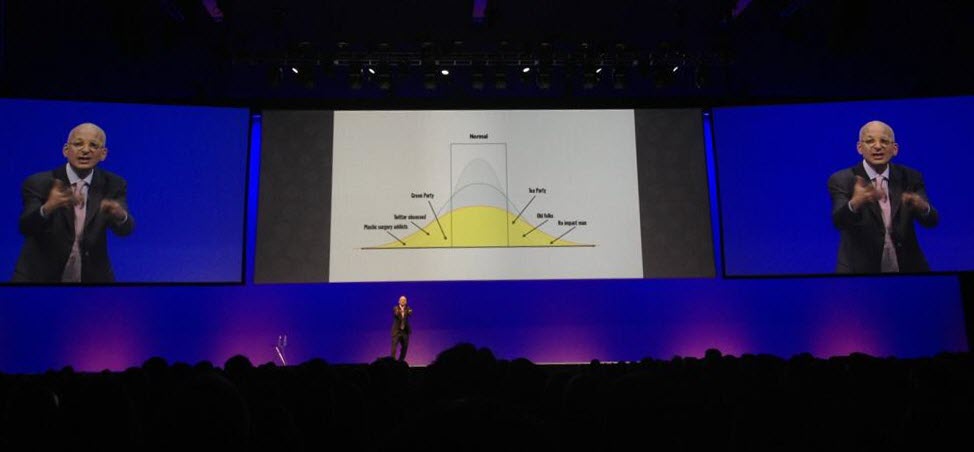






 It was a great evening on several dimensions, but I particularly want to compliment Larry Weber (right) on the masterful way he ran the dinner. I’ve attended many a business dinner over the years and few have been as adroitly handled as this one. Consider his lessons next time you arrange a networking event for a few of your colleagues.