Waiving Speaking Fee for Book Buyers

My book Social Marketing to the Business Customer with co-author Eric Schwartzman was released last month and is now available through Amazon, Barnes & Noble, Borders and other booksellers.  It’s the first book devoted exclusively to B2B social media, and the most comprehensive collection of best practices and case studies currently available in print.

B2B is hot topic these days as marketers look for applied wisdom and operational frameworks to help them integrate social media into their existing organizational outreach efforts.  Everyone seems to be interested in the concept of using social media to reach a focused, select group of individuals. If social media for business is on your mind lately, consider picking up a copy of the book, or downloading one of our B2B social media podcasts which we’ve been releasing over the last couple of weeks through On the Record…Online.

If you’re looking for speakers to address the subject of social media for business at your next conference or event, both Eric and I are waiving our fees now through June 1, 2011 with bulk book purchases of 200 of more copies. So if you’d like to have Eric or me present on B2B social media at your company or conference, we’ll speak and autograph your 200 copies in person.

Some of the topics we can address include:

  • Building the Business Case for B2B Social Marketing
  • Generating Qualified B2B Leads with Social Media
  • How the B2B/B2C Difference Applies to Social Media Strategy
  • Current and Future B2B Social Marketing Trends
  • Or challenge us with some aspect of social media specific to your interest

If you’re interested in having me present, please check my online calendar first. Note that I will be unavailable for personal reasons (expecting twins any day now!) through about the end of April, but any speaking engagements booked before June 1 qualify for this offer. Or if you’d like to have Eric speak your group, you can check his online calendar as well. We’d both be honored to talk your group about B2B social marketing specifically, or social media marketing in general. It’s a topic about which we are very passionate.

We look forward to hearing from you! Contact me at paul [at] gillin [dot] com.

I’m Just a Sucker for Believe It or Not!

I have been a hopeless Believe It or Not! addict since the age of 10. I’m so glad to see they’re keeping up with the times. I couldn’t find a static version of this e-mail pitch, so thought I’d share. pg
Technomazing! Unbelievable technology tales are featured in the new book from Ripley’s Believe It or Not! called Enter If You Dare! The book is an annual collection of unusual, unbelievable and amazing stories from around the world.

Enter If You DareSome of the book’s incredible tales of science and technology:

  • Eye Tech – pg. 222: Filmmaker Rob Spence from Toronto, Canada, has developed a camera to replace the eye that he lost as a child. Rob began working with engineer Kostos Grammatis to create the “Eyeborg,” and is now the proud owner of a wireless bionic eye made with one of the smallest digital cameras in the world, which is capable of recording and transmitting video directly from his eye socket.

Onion Power – pg. 223: To save electricity, some people have started powering up their MP3 players with onions. How? Soak it in an energy drink and then stick a USB cable into it – and by doing that they can charge their iPod for an hour.

  • Eye TechLiquid Vision – pg. 223: Professor Josh Silver of England’s Oxford University has invented inexpensive, fluid-filled eyeglasses that can be adjusted to anyone’s vision needs. The lenses contain circular sacs filled with fluid that are connected to a small syringe to increase or reduce the amount of fluid, thus altering the power of the lens.
  • Mechanical Insect – pg. 223: Scientists at Japan’s Tokyo University are creating a range of insect-machine hybrids by rebuilding their brains and programming them to carry out specific tasks. Already they have rewritten the brain circuit of a male Silkmoth to react to light instead of odor.
  • Steel Velcro – pg. 225: German scientists have developed a steel version of Velcro that is strong enough to support buildings. Using the same hook-and-loop fastening system as Velcro, Metaklett can bear loads of around 3.6 tons per sq ft (35 tonnes per sq m) at temperatures as high as 1,472°F (800°C).
  • Spy Tooth - pg. 226: The U.K.’s James Auger has devised a new concept in secret communication- an audio tooth implant. A surgeon implants a device into your tooth, the data is retrieved from a cell phone, radio or computer and the vibration resonates through your jawbone to you inner earbone, meaning that only you can hear the information.
  • Bionic Fingers – pg. 226: A company from Scotland has invented bionic fingers, which enable people with missing digits to pick up a glass, hold cutlery and even write. The $75,000-fingers are directly controlled by the brain and can write and grip, thanks to a special sensor that allows them to detect when they have closed around an object.
  • Warning Suit – pg. 229: To make people aware of the threat of skin cancer, a Canadian company has designed a two-piece bathing suit that changes color to warn women when the sun’s rays are too strong. The bikini is held together with pale decorative beads that turn dark purple if the UV rays reach dangerous levels.
  • Fatal Sting – pg. 228: Microscopic nanobees, made from perfluorocarbon – a material made from artificial blood – have been used by scientists at a university in St. Louis, Missouri, to kill cancer tumors by stinging them.

  • Emotional Robot – pg. 223: Scientists at Waseda University in Japan have developed a robot that can express seven different human emotions. The Emotional Humanoid Robot, named Kobian, uses motors to move its lips, eyelids and eyebrows into various positions and can also strike a range of poses to back up its expressions.

  • Robot Teacher – pg. 223: Children at a school in Tokyo, Japan, had a new teacher in 2009 – a robot called Saya. Beneath a humanlike face, Saya has a system of 18 motors that work like muscles to give her face expressions including surprise, fear, anger, happiness and sadness. She has a vocabulary of 700 words, has the ability to speak in any language and is programmed to respond to words and questions.

  • Illuminated Dress – pg. 222: British fashion student George Davis has designed a dress that lights up when the wearer’s cell phone rings. The right shoulder of the dress, which is connected to the phone by wireless technology, has translucent white scales that move and light up.

Please let me know if you would like to pursue any stories in the book or a story on the book itself.  Images are available, as well as interviews with people from Ripley’s or people featured in the book.

The book cover, as well as several pages and individual images, can be downloaded at http://www.ripleybooks.com/newsroom.

Gain Control By Giving It Up

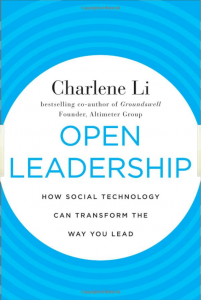
Open Leadership by Charlene LiCharlene Li’s new book will be out in a few weeks, and if you’re interested in how social media is transforming the way business gets done, you’ll want to pick up a copy.

The book is called Open Leadership, and I would classify it as the first of the post-social media books. By that I mean that it looks at the consequences of democratized communications rather than at the media itself. Expect to see a wave of similar books in the coming years. This is a very good first entry.

Open Leadership will make a lot of people uncomfortable because it proposes that the only way to govern effectively in a transparent business world is to give up control and trust people to do the right thing. Li makes a persuasive case by citing numerous examples of companies that have successfully done exactly that.

Li is a former Forrester Research analyst, founder of Altimeter Group and co-author of Groundswell, the breakthrough 2008 book that provided the first demographic profiles of social media users as well as a rigorous methodology for evaluating the ROI of social programs. In this book, she builds on some of the economic models first presented in Groundswell, but Open Leadership is more of a call to action than a financial exercise.

The premise is encapsulated in the title of Chapter 1: “Why Giving up Control Is Inevitable.” Li asserts that today’s business world is too complex and competitive to permit organizations to continue to manage the way they have since the Industrial Revolution. That top-down philosophy assumes that people are idiots who can’t accomplish tasks without instructions, rigid rules and constant oversight. That worked okay when companies had some control over their environment, but today too many factors are out of their hands. So one man’s story of how an airline broke his guitar and refused to fix it becomes a cultural sensation while the airline stands by helplessly and fumes.

Charlene LiLi (left) asserts that the only way to gain any level of control over today’s turbo-charged business environment is to give up as much control as possible. New business leaders set examples, demonstrate confidence and create cultures that tolerate intelligent, well-intentioned failure. And guess what? It turns out that when smart people are given the latitude to make decisions, they tend to make better ones than if someone else makes decisions for them.

Open Leadership provides some refreshing new examples of how this new management philosophy is working:

  • Meetup.com replaced a top-down approach to project management with one that requires stakeholders to persuade engineers to spend time on their projects. Productivity exploded;
  • BestBuy outlasted competitors in the brutal electronics retailing business in part by developing a culture that lets its employees guide customers toward the best decision, even if that means buying from a competitor;
  • Electronics distributor Premier Farnell distributed low-cost digital video cameras to every employee in the company so that they could document their best practices and share them on an internal network. Employees are more empowered and the quality of information is better.

Li is particularly inspired by John Chambers, the CEO of Cisco, which has undertaken a massive program to drive decision-making down to local levels. Chambers says the idea unnerved him at first but that Cisco is now a faster, more responsive and more innovative company as a result. And he’s working fewer hours. Chambers provides critical support for the concepts outlined in Open Leadership: He has the unwavering support of Cisco’s board of directors, which enables him to talk honestly about his own reservations and the mistakes he has made.

It is on the issue of mistakes that the author is most emphatic. Li stresses that businesses can only be innovative if they learn to accept the fact that failure is a necessary by-product of risk-taking. Companies that successfully practice open leadership evaluate decisions based upon the thought that goes into them rather than the results. Failure is an opportunity to learn and try again and the only unpardonable sin is making the same mistake twice.

Most businesses do a lousy job of this. They publicly declare a commitment to innovation, but privately punish employees whose ideas don’t succeed. Tolerance for failure is sometimes cited as the most important reason that Silicon Valley has outclassed every other region of the US in technology innovation. Reading Open Leadership, I get the impression that such tolerance is the only option for businesses that hope to lead in uncertain markets.

What Geocaching Taught Me About Social Networks

TI don’t go to the South by Southwest conference for the sessions as much as for the people. The most interesting conversations usually happen outside of the conference rooms. One discussion that stuck with me this week occurred after a presentation by MIT’s Andrew McAfee entitled “What Does Corporate America Think of 2.0?”

While I was waiting in line to introduce myself to Mr. McAfee, I eavesdropped on a conversation he was having with the young woman in front of me. She gave her age as 28 and said she had recently been hired to coordinate social media at a real estate company where her bosses were mostly in their 50s. She was clearly demoralized and frustrated.

The young woman had been brought on board to get the realty company up to speed in the new Web technologies. She understood that conversational marketing requires a culture change, but her management wasn’t interested. Her bosses, she explained, saw social technology as simply another way to distribute the same information.

For example, she had been ordered to post press releases as blog entries and to use Twitter strictly for promotional messages. She had been told to get the company on Facebook but not to interact with anyone on its fan page.Her communications with the outside world were to be limited to platitudes approved by management.

I felt bad for this young lady and also for her bosses, who will no doubt lose her in short order. I suspect they hired a social media director in the belief that she could create new channels for them, but they didn’t understand the behavioral change that was required on their part.

Open Leadership

A couple of nights earlier, I attended a dinner given by Altimeter Group, whose founder, Charlene Li, co-authored the ground-breaking book Groundswell. Charlene was handing out galley copies of her forthcoming book called Open Leadership. In it, she suggests that management strategies must fundamentally change in the age of democratized information. I’ve only read a third of the book so far, but I can already tell that it will cause considerable discomfort in corporate board rooms.

In the opening chapter, Charlene notes that “to be open, you need to let go of the need to be in control… you need to develop the confidence… that when you let go of control, the people to whom you pass the power will act responsibly.” This notion of leadership replacing management will shake many of our institutions to the core.

The traditional role of management has been to control and communicate: Managers pass orders down from above to the rank-and-file who are expected to do what they are told.

In the future, communication will increasingly be enabled by technology. Employees will be empowered with information and given guidelines and authority to do the right thing. Middle managers won’t be needed nearly as much as they are today. Organizations will become flatter, more nimble and more responsive because information won’t have to pass up and down a chain of command before being acted upon. This will result in huge productivity gains, but progress will only be achieved when top executives learn to let go of the need to control and to accept the uncertainties of empowered constituents.

No Pain, No Gain

The real estate company’s mistake was in believing that it could participate in a new culture without changing its behavior. It saw social media as a no-lose proposition; distribute the same material through new channels but don’t accommodate the reality that constituents can now talk back. Any company that takes this approach will fail to realize the benefits of the media. Once its customers realize that their opinions don’t count, they will stop engaging with the company. That doesn’t mean they won’t do business with the company any more, but the benefits of using the new media will be lost.

I have never advocated that all companies adopt social media. Each business has a different culture, and some adapt more readily to open leadership than others. If employee empowerment and institutional humility don’t fit with your style, then social media is probably not for you. You may do just fine for several years without changing your practices. But if you choose to play in the freewheeling markets enabled by customer conversations, then you’d better be willing to let go of control.

Over time, I believe all companies will have to give up the belief that they can control their markets, because interconnected customers are an unstoppable force. In the short-term, however, businesses need to do what feels right for them. If you work for a company that can’t adapt itself to the concept of open leadership, then start circulating your resume. These days, there are plenty of businesses that are eager to change.;sr=1-12″>The Joy  of Geocaching coverhe Joy Of Geocaching, a labor of love that my wife Dana and I have been working on seemingly since the Reagan administration, arrived at the publisher’s warehouse this week. This project began in July, 2008 and proceeded through many twists and turns – including the demise of our first publisher – before reaching the finish line.

Publication of a book is a good time to reflect on what you’ve learned and I realize now how much I learned about social networking from this project.

If you’re not familiar with geocaching, it’s an outdoor game played by three to four million mostly adults worldwide. Players hunt for hidden containers using global positioning receivers. The geographic coordinates of the containers – which can range in size from the tip of a pencil eraser to, in one case, a Nissan Pathfinder – are published at Geocaching.com. The photo shows an example of a particularly clever container.

Ingenious geocache containerAll containers must contain a paper log, but nothing more is required. The joy of geocaching is in the hunt and the reward of finding a geocache is nothing more than satisfaction. Geocaching.com recorded its one millionth active geocache placement early this week.

Sounds simple and maybe a little weird, right? I certainly thought so at first. But as Dana and I began to geocache and then talk to people who love the game, we found that an enormous social network had developed around it. People were forming new relationships, repairing old ones, improving their health and re-connecting with nature in ways that would have been impossible without technology.

Passion for Cachin’

We met people who have logged more than 35,000 finds over the last eight years. One small circle of friends drove 12,000 miles – and flew another 10,000 – in a mad dash to find a geocache in all 50 states in 10 days. Another team spent weeks planning a speed run that netted a record 413 finds in 24 hours. Their record was broken just five months later.

We met an elite group of “extreme geocachers” who pursue containers hidden under water, on abandoned railroad trestles, deep in mine shafts and at the top of 100-foot sheer rock cliffs. Then there are the people who hide caches. Some of them spend days constructing elaborate themed networks consisting of dozens of containers. Others concoct puzzles so devious that we didn’t know where even to begin to solve them.

The social network that ties this community together is a quirky website run by a rather reclusive for-nonprofit organization in Seattle called Groundspeak. The Geocaching.com website is basically a database with a few HTML pages and some query forms. It has almost none of the trappings of Web 2.0, not even photo tags. The only means users have to create content is its rigidly formatted description pages and comment forms.

Human Ingenuity

Yet despite those limitations, the geocaching community has done some wonderfully inventive things. Geocaching has its own language. More than 100 clubs and associations have sprung up in all 50 states and overseas. Geocachers arrange community cleanups, stage fund-raising events and help each other in times of need. They created “event caches” long before the concept of the unconference caught on. And they’ve done this without any prompting from above, using a simple website built around a simple game.

Here are some lessons I’ve learned:

There Is No Substitute For Passion. Groundspeak does almost nothing to market the game. It provides an online meeting place, a newsletter and some basic services in exchange for a $30 annual fee. Geocaching has spread to an audience of more than three million players entirely by word of mouth. The one million records in its database have each been meticulously reviewed by a team of volunteers.

It’s Not About Technology. The Geocaching.com website is five years behind the technology curve. It has some rudimentary Web 2.0 features, but few members use them. The website really does only one thing well, but that’s all its users ask it to do. Too much technology would actually complicate the experience.

People Basically Want To Do The Right Thing. Every community has its petty rivalries, but in interviews with more than 60 enthusiasts and casual conversations with many more, we encountered only one case in which a dispute resulted in the destruction of personal property (a geocache). In contrast, we heard dozens of stories about geocachers putting their personal safety in the hands of total strangers simply because the person was another geocacher.

Peer Recognition Matters. One of Groundspeak’s early innovations was to keep a running tally on its website of each member’s total hides and finds. This is a source of a constant friendly rivalry among players. Top geocachers not only know their own tallies but also the totals of those nearest to them in the hierarchy.The drive to be visible is an incredible motivator.

Simple Succeeds. I noted in a column last year the irony that Twitter, with its stripped-down simplicity, has been a social media mega-hit while the technically elegant but byzantine Second Life has faded into a niche. In the same ways, geocaching succeeds because it keeps the rules simple. This has enabled players to develop an incredibly rich variety of variations, and Groundspeak has commendably remained open to letting them take the game where they wish.

There’s so much more I could say (224 pages worth, in fact!) about this remarkable community, and I’m hoping to develop a presentation around this topic for business audiences. It will include lots of funny, scary and touching stories that we learned in our research and show how online connections can contribute to more meaningful real-world relationships.

I need a sponsor, though, so if your company or group is in terested in bringing me in for an entertaining and instructive one-hour session on how an online network can drive millions of people into the woods to re connect with nature, please drop me a line.


B-to-B Book Update: Need Expertise in Organization, Lead Gen

Research for the business-to-business social marketing book that Eric Schwartzman and I are co-authoring is coming together nicely, but there are a couple of areas where we still need advice and case studies. We’re looking for experts who are willing to spare an hour or so of their time for a phone interview in the following areas:

Organizing for Social B-to-B

  1. Empowering employees to speak
  2. Integrating social media with conventional marketing
  3. Reskilling the organization
  4. Optimizing the marketing department organization
  5. Building bridges to other departments

6. Lead Generation

  1. Building social media into the selling cycle
  2. Tools for different stages of the funnel
  3. Developing quality leads
  4. Case studies needed here!

If you have a good story to tell or tips to share, contact Paul or Eric at paul{at}gillin{dot}com (@pgillin) or eric{at}ericschwartzman[dot]c0m (@ericschwartzman).

One Measure of Success

Guy Kawasaki writes “I was in a Barnes and Noble tonight and saw a shelf labeled “Success Library.” Look at the books on it: they’re all about social media, Twitter, LinkedIn, and Facebook. Two years ago, this shelf would be filled with Good to Great, The Tipping Point, and the like. The world has sure changed.

See second shelf middle, right next to Twitterville and below Trust Agents. Good company!

UPDATED: Draft Outline B2B Social Marketing Book

Here s a first-pass topical outline for the book Social Marketing to the Business Customer, by Paul Gillin and Eric Schwartzman (John Wiley & Sons, late 2010). This outline attempts to define all the major issues to be addressed in a book targeted at business-to-business marketers. Your thoughts are welcome. Use the comments area to tell us what we’ve missed and where we should devote the most attention. And if there’s anything that shouldn’t be here, let us know that as well

Note: Practical advice will be interleaved with case studies, vignettes and quotes from practitioners. We are very interested in identifying candidates for case studies. If you have a good story to tell or tips to share, contact Paul or Eric at paul{at}gillin{dot}com or eric{at}ericschwartzman[dot]c0m.

Update: This outline was revised and reposted on March 3, 2010. The most recent revision appears below. Earlier revisions have been deleted. Many of the comments refer to items that appeared in earlier versions.

Update: This outline was revised and reposted on Jan. 5, 2010 based on earlier feedback

1. The Changing Rules of B-to-B Marketing

  1. Traditional media in decline
  2. Rise of the unofficial spokesperson
  3. Proliferating channels to customer or, from a marketers point of view, audience fragmentation.
  4. The importance of peer-to-peer communications: the impact of markets as conversations.
  5. Assessing most effective platforms for B2B social media marketing
  6. Contrasting b-to-c and b-to-b audiences
  7. Creating a strategic framework for platform assessment.
  8. Promoting responsible edge work through corporate social media policies. If there’s no formal policy in place empowering employees to do the edge work, why would they risk their jobs to engage?

    1. Assessing value of end-customer pull vs. business partner push
  9. Estimating staffing requirements

2. 10 Ways You Can Use Social Media for B-to-B Marketing

  1. When social media is and isn’t appropriate
  2. Risk/reward matrix
  3. Applying social media to the traditional sales cycle
  4. Researching audience needs

    1. Listening and engaging
    2. Inviting feedback
    3. Market research
  5. Shift from demographic to psychographic profiling
  6. Product development
  7. Customer/channel relations
  8. Peer-to-peer marketing
  9. Cost-saving opportunities
  10. Applications of crowdsourcing

3. Getting Buy-In and Resources -

  1. Explaining value to stakeholders
  2. Adopting the mindset
  3. Test and revise
  4. Overcoming popular objections

    1. Top 10 arguments to make with legal and HR
    2. Convincing the CIO

4. Organizing for Social B-to-B

  1. Empowering employees to speak
  2. Integrating social media with conventional marketing
  3. Re-skilling the organization
  4. Marketing department organization
  5. Building bridges to other departments

5. Protect Yourself: Creating & Enforcing Social Media Policies

  1. Defining “transparency”
  2. Coordinating with existing corporate policies

    1. HR code of conduct
    2. IT policies
  3. Social media Policies vs. Guidelines

    1. Legal issues to consider
    2. Do you need a policy?
    3. Start fresh or build on existing policies?
    4. Issues to address

      1. Disclosure
      2. Private vs. Business Personae
      3. Privacy and confidentiality
      4. Respectfulness, diplomacy and conflict resolution
      5. Crisis considerations
  4. Enforcement and penalties
  5. Regulatory considerations

    1. Tweeting through an IPO

6. Lead Generation

  1. Building social media into the selling cycle
  2. Stages of the funnel
  3. Quality vs. quantity leads

7. Getting Starting: Easy Low-Risk Opportunities

  1. Identifying high impact applications for quick results
  2. Demand pull vs. supply push
  3. Choosing tools
  4. Analytics and metrics
  5. Worksheets
  6. Selecting participants
  7. Campaign lifecycles
  8. Budgeting
  9. Allocating resources
  10. Beyond the first campaign – next steps

8. Listening to Customers

  1. Listening through filters
  2. Embracing popular language
  3. Dealing with negativity without losing your cool
  4. Going “off message” in search of relevant conversations
  5. Keyword research primer (contributed by Lee Odden)
  6. Keyword validation
  7. Quality vs. Quantity tradeoffs
  8. Conversions
  9. Advanced search
  10. Competitive analysis
  11. Research alternatives
  12. Ratings systems
  13. Assembling a rapid response team
  14. Policies and procedures
  15. Building internal feedback loops

9. A Customer Is Not a Transaction: Deepening Relationships

  1. Incorporating social media into customer care and support (Social CRM)
  2. 360° listening scenarios
  3. Building a listening dashboard
  4. Creating customer testimonials and endorsements
  5. Integrating social media and customer events
  6. Brand ambassador programs

10. Profiting From Customer Communities & Social Networks

  1. Value of communities
  2. Branded vs. public communities
  3. Public vs. private
  4. Where do branded communities make sense?
  5. Best practices for encouraging activity
  6. Do you need a dedicated community manager?
  7. Skills requirements
  8. Employee involvement in customer communities
  9. Platform selection

11. B-to-b Uses for Facebook, LinkedIn and Twitter

  1. Features and audiences
  2. Organizational versus individual value
  3. Using the platforms in combination with each other
  4. Behavioral standards and community values

12. A Non-Techie’s Guide to Choosing Platforms: Beginning, Intermediate & Advanced

  1. Securing the right infrastructure: Web 2.0, Licensed Software, Open Source and SaaS
  2. Matching platform to objective
  3. Overview of major platforms
  4. Public versus private platforms
  5. Selection grid and decision tree
  6. Examples of best practices
  7. Staff assignments and responsibilities
  8. Integrated campaigns
  9. Mobility (contributed by Christina Kerley)
  10. Risks: Data Portability, Back-up, Support, Service Level Agreements and Attention Siphons

13. Metrics and ROI

  1. How practitioners are approaching ROI
  2. Strength/weakness analysis of major metrics
  3. Working backwards from the goal
  4. Revision cycles
  5. Suggested ROI methodologies
  6. Multiplatform multiplier effect

14. What’s Next for B-to-B Social Media

  1. Expanding internal stakeholder involvement
  2. 2. Creating branded customer communities
  3. 3. Multichannel campaigns
  4. 4. Internal/external program integration
  5. 5. Creating a social media-aware workforce