Transforming P&G

When Stan Joosten first contacted me about joining Procter & Gamble’s Digital Advisory Board, I initially hesitated. The volunteer position would demand a few days of my time every year just as I was beginning to transition my focus to B2B and away from P&G’s consumer markets. But this was P&G, after all, and Stan, who is Innovation Manager for Holistic Consumer Communications, is a persuasive guy who had already signed up several people I respect. I said what the heck.

It was the best decision I’ve made in the last five years.

This week I sat in an auditorium at P&G headquarters in Cincinnati and heard CEO Bob McDonald talk about the centrality of one-to-one relationships to the company’s future and declare “We want to be the most digitized company in the world.”

Mark Pritchard, who heads global marketing, echoed the one-to-one theme, noting “Digital marketing is past. Brand building in the digital world is the future.” That’s an impressive statement coming from one of the world’s largest TV and print advertisers.

The fact that this week’s event was even going on was notable in itself. Organized in just seven weeks and spearheaded by John Battelle’s Federated Media Group, Signal P&G brought top executives from Google, Facebook, Yahoo, AOL, Microsoft, Coca-Cola and many other digital and consumer brands to talk about the future of marketing. About 300 P&Gers crowded the John G. Smale Tower Auditorium in Cincinnati and another 1,300 watched online. Most people in the room stayed till the very end.

From my conversations with employees and the discussions I overheard in the hallway, I came away convinced that this is a company that is successfully transforming both its culture and its approach to market. When you consider that P&G has nearly 130,000 employees spread across the world and marketing practices that have made it an icon of excellence for a century, that’s no small achievement.

New Measures of Success

P&G has been called the world greatest marketing company. Success can be a curse, though, and the maker of Crest, Tide and about 25 other billion-dollar brands has struggled to wean itself from a traditional focus on coupons and samples in favor of a culture of engagement.

It’s not that P&G doesn’t understand its markets. The company’s almost obsessive approach to research has marketers and engineers routinely visiting customers’ homes to spend hours watch people doing laundry, diapering their babies and brushing their teeth. P&Gers understand that the reason moms buy Tide goes far beyond clean clothes and gets to issues like self-esteem and peer acceptance. Its brand marketers are some of the savviest marketing pros I’ve ever met.

This deep understanding of customers was evident even in the Advisory Board’s earliest meetings with brand managers. What was missing was a sense of how to engage. P&G marketers create brilliant campaigns, but their success milestones have been defined by traditional metrics like impressions, coupons and trials.

Assumptions are breaking down, however, thanks to a willingness to change and the success of campaigns like last year’s Old Spice “The Man Your Man Could Smell Like,” which combined traditional TV advertising with a brilliant series of companion videos on YouTube. This week Federated Media showed off StyleUnited, a new P&G community for “want it all women” that logged one million page views in its first three months and is already driving new sales.

Support From the Top

More important, though, is the support shown by top executives like McDonald and Pritchard. They’re obviously keenly aware of the Innovator’s Dilemma, Clayton Christensen’s theory of how successful businesses destroy themselves by being unable to discard the tactics that made them successful. P&G’s revenues continue to be strong, but its traditional retail channels are under intense pressure, warehouse clubs are squeezing margins and Amazon wants to trump its brands. Consumer packaged goods companies today face the risk of being marginalized as commodities. Digital channels are the lifeline that can establish long-term connections with their customers. It appears to me that the key people at P&G understand that, and once a company of this caliber gets on board, entire industries change.

I’m not sure there’s much I can tell P&G marketers that they don’t already know at this point. While P&G has never paid me a fee, they have enabled me to connect with people I would never otherwise meet and to get the briefest of glances into how a great company stays on top of its game. It is been an amazing experience and I’m grateful to Stan, Tonia Elrod, Daniel Epstein and the others who have permitted me to be a part of it. If I can ever be of service, don’t hesitate to call.

Live Blog: Day 2 Kickoff Strikes Transformation Theme

Day Two of Lotusphere kicked off with a celebration of business transformation enabled by collaboration technology. Representatives from TD Bank Group and the author of a hot new book told stories of businesses that are rethinking the way business is done.

Wendy, Arnott, TD Bank Group

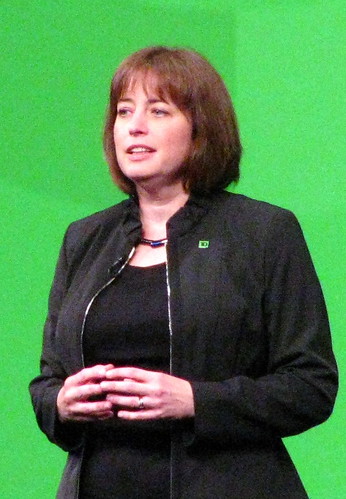
TD has grown to become North America’s sixth largest bank through acquisitions and a focus on listening to customers. A new social media team listens and responds to blogs, Facebook posts and tweets, the process “learning to be a better bank,” said Wendy Arnott (right, @Wendy_Arnott), VP for Social Media and Digital Communications.

The company has also transformed its internal communications using social networking technologies anchored by IBM Connections. Arnott ticked off the three key imperatives as aligning with core values, delivering real value and facing risks head on. To that end, the bank is endeavoring to involve employees in critical decisions.

Acknowledging the technical orientation of the Lotusphere audience, IBM also brought out TD’s CIO, Glenda Crisp (left, @GlendaCrisp) to talk about the importance of the IT-business partnership. Crisp said traditional project management was complemented by a collaboration steering committee that addressed issues like adoption barriers as well as technical problems like SharePoint integration.

The committed deemed it critical to make the shift to a shared platform as transparent as possible Single sign-on simplified access to Connections and Google search appliances were brought in to make enterprise-wide search seamless. Interviews with users also surface the importance of supporting mobile users of the bank’s dominant BlackBerry platform. “We made that a key factor in our selection criteria,” Crisp said.

The result of this active employee involvement was an adoption rate that exceeded expectations by a factor of seven. More than 50,000 users in Canada are up and running, and US deployment is expected to grow from 3,000 to more than 25,000 in less than a month.

Arnott ticked off success criteria:

  • Get executive leadership sponsorship.
  • Put a dedicated organization in place to oversee deployment.
  • Deal with resistance by “getting into weeds with business teams and helping them discover how social will help them address business challenges.”
  • Get employees involved on a volunteer basis and make sure their ideas count.

IBM next brought out Fast Company editor Bill Taylor (@practicallyrad) to address the need for business transformation. Taylor, whose new book is Practically Radical, asserted that in this age of commoditization, “The only way to stand out from the crowd is to stand for something special. Winning organizations today stand for new ideas,” he said. “The middle of the road has become the road to nowhere.”

Bill Taylor, Fast Company at LotusphereTaylor talked about the radical innovation embodied in the Henry Ford Health System in Detroit, which broke the mold when it built a new hospital in West Bloomfield, MI three years ago. Executives at the health care provider realized “they knew everything about surgery and pharmacology, but they knew nothing about what it took to make people feel right.”

Common Area, Henry Ford Health CenterHenry Ford Health recruited consultants from the hospitality and restaurant industries and conceived of a 160-acre facility that looks more like a resort (left) than a hospital. They created a file of more than 2,000 original healthy recipes that are in such demand that the hospital now books $1 million annually in catering revenues.

The result is “a business home run because the approach from day one was so unconventional,” Taylor said.

Taylor also sang the praises of USAA, an insurance company that solely serves military customers. The 10-week employee orientation process there is more like a boot camp than a training course, he said. New recruits wear 65-lb. backpacks to simulate the working conditions of a infantry soldier and eat military rations. “They want to immerse their people in are the lives and experiences of their customers, which creates bonds not only with customers but also between employees,” he said.

Bottom line: “As you think about making your business more memorable, also think about how you make it more social.”

This is one in a series of posts sponsored by IBM Midsize Business that explore people and technologies that enable midsize companies to innovate. In some cases, the topics are requested by IBM; however, the words and opinions are entirely my own.

McKinsey Research Again Validates Social Technology Benefits

Here are highlights from the fifth annual McKinsey study, “How social technologies are extending the organization” (registration required). McKinsey’s groundbreaking research in this area has consistently demonstrated that companies that leverage social technologies most aggressively see the payoff in market share gains, improved productivity and higher customer satisfaction. However, the research also indicates that becoming a fully networked organization is difficult, and remaining fully networked may be even harder.

Seventy-two percent of the respondents report that their companies are deploying at least one technology, and more than 40 percent say that social networking and blogs are now in use.

Executives at internally networked organizations note the highest improvement in benefits from interactions with employees; those at externally networked organizations, from interactions with customers, partners, and suppliers.

Executives at fully networked organizations report greater benefits from both internal and external interactions. Developing organizations [those with the lowest rate of social media adoption] report lower-than-average improvements across all interactions at their organizations.

Self-reported operating-margin improvements correlated positively with the reported percentage of employees whose use of social technologies was integrated into their day-to-day work.

Market share leadership in an industry, the final self-reported performance measure, correlated positively with the integration of social tools in employees’ day-to-day work.

Roughly half of the internally and externally networked enterprises slid back into the category of developing organizations; that is, they did not maintain the benefits of using social technologies that they had achieved earlier…It appears that it is easier to lose the benefits of social technologies than to become a more networked enterprise, which suggests that significant effort is required to achieve gains at scale.

The respondents affiliated with fully networked organizations are the likeliest to believe that greater process change will occur in their own organizations. In larger numbers than respondents in other clusters, they think that social technologies will lead their companies to adopt entirely new processes under current conditions and to do so even more aggressively if all constraints were removed.

They say that with fewer constraints on social technologies at their companies, boundaries among employees, vendors, and customers will blur; that more employee teams will be able to organize themselves; and that data-driven decision making will rise in importance.

Organization Type, Based on Social Media Benefits

Surveys Show ‘Social Business’ Concept Gaining Traction

A quartet of new research reports suggested that small and midsize businesses (SMB) are rapidly waking up to the potential of social media and cloud-based infrastructure to create new operational efficiencies and better engage customers – and that they may also be leading the US out of recession.

Fall 2011 Attitudes and Outlook Survey

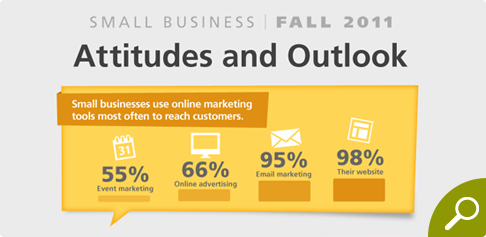
A recent survey of more than 2,000 small businesses by e-mail marketing provider Constant Contact found that 81% say they now use social media for marketing, up from 73% in the spring. Furthermore, a significantly larger percentage agreed with the statement that social media marketing is “easy to use,” “doesn’t take up too much time,” and “works with my customers” than did so in the spring. Facebook was identified as the most effective tool by a comfortable margin, but Twitter, LinkedIn and video sharing are all creeping up.

It should be noted that the majority of respondents to the Constant Contact survey were customers, which means they are already marketing online. Other research studies over more general populations have indicated that small businesses still lag far behind large enterprises in their adoption of social media tools.

It’s also worth noting that 81 percent of respondents use face-to-face interactions to connect with customers or prospects, underlining the fact that Facebook has its limits.


A new global study of chief marketing officers (CMOs) at midsize businesses released today by IBM shows that marketers are concerned about improving customer engagement but are unclear about how to proceed. More than seven in 10 respondents said they aren’t sure how to improve customer loyalty at a time when peer reviews and open sharing are making customers more informed, more critical and less loyal. Only 40% are taking the time to understand and evaluate the impact of consumer-generated reviews,  blogs and peer rankings on their brands.

The CMO research further reveals that 62% say they are unprepared to take advantage of the opportunities presented by mobile commerce and 72% say they don’t know how to cope with declining levels of brand loyalty that could result from easier comparison shopping. So while midsize firms may be using social marketing, they aren’t necessarily confident in the results.


There is no question that the concept of “social business,” which is being promoted by IBM and others, is gaining traction. Social business involves using tools both inside and outside the organization to unearth knowledge, improve business responsiveness and create new paths for engagement with customers. The concept has gained momentum in the form of “intranet 2.0″ platforms, which augment traditional intranets with Facebook-like features.

An IBM study of more than 4,000 Information Technology (IT) professionals from 93 countries and 25 industries found that adoption of the social business concept is erratic and geographically influenced. Indian companies were three times as likely to have embraced social business concepts as Russian companies. The US and China showed strong adoption rates, but both lag India by a significant margin. The research, which was conducted by IBM’s DeveloperWorks organization, also showed rapidly growing acceptance of cloud computing as a platform for application development and a swing toward developer preference for the Android mobile operating system.


If, as many people believe, small and midsize businesses are leading indicators of economic growth, then there’s also good news in survey of 1,295 small and medium business IT professionals conducted by Spiceworks. The study found that IT budgets grew 9% in the second half of 2011 compared to the first half. That’s the largest increase in two years. Nearly one third of SMBs said they are planning to hire new staff, which is also an improvement over the stagnant staffing rates of the past two years.

Disclosure: IBM’s Midsize Business organization is a client of Paul Gillin Communications.

The Wisdom of ‘We’

My column in BtoB magazine this month. Original here.

The manager of the Mansion on Peachtree hotel in Atlanta has it pretty good these days. The Mansion is the top-rated hotel in the city on TripAdvisor.com, with 163 reviews, nearly all of them five stars. The endorsement has enabled the Mansion to hold its premium prices and cut its acquisition costs. It’s also got the staff hopping to maintain the coveted top position.

“Social media is vital to our business today,” said Micarl Hill, the Mansion’s managing director. “But it also keeps us on our toes. People can tell everybody about a bad stay with the push of a button. What they say isn’t always fair, but we take it seriously.”

Recommendation engines like TripAdvisor, TravelPod, Google Places and Yelp are transforming the hospitality industry, and they’re coming to your town.

Mark Snider, owner of the Winnetu Oceanside Resort in Martha’s Vineyard, Mass., personally contacts every single customer who posts a complaint about his hotel on an online review site. Fortunately, it’s not a big job. Winnetu’s No. 1 rating on TripAdvisor drives so much business that Snider slashed his marketing budget this year.

If you think this trend is confined to consumer markets and small electronics, think again. Consider Spiceworks, a thriving community for IT professionals, where members have posted thousands of reviews of everything from computer servers to computer consultants. “When I’m looking at a vendor, I don’t Google it; I Spiceworks it,” wrote one forum member.

At Glassdoor.com, employees rate the companies they work for, review executive performances and swap salary information. How do you think the recruiting business will be changed by this?

And we’re still in the very early going. It’s only a matter of time before review sites pop up in every category of business, including B2B. Facebook and LinkedIn already make polling easy, and Quora is awash with questions about recommended vendors.

This is going to change the rules of marketing. People stopped listening to pitches some time ago, but they didn’t stop listening to each other. What you say about yourself now matters a lot less than what others say about you.

Marketers need to be tuned into these conversations 24/7, spot detractors and quickly try to turn them around. They also need to provide incentives for people to tell others about their positive experiences.

Start by discarding the “see no evil” mindset. Customers will share their opinions whether you want them to or not. You might as well be open about it. Southwest Airlines and Dell Computer encourage customers to lodge complaints on their company Facebook pages and address nearly every one. That’s called responsiveness, and it’s always been a good business practice. Today’s it’s life or death.

What a Hotel Manager Taught Me About the Future of Business

Wyndham Wingate Erlanger, KYScott Wright is the general manager of the Wyndham Wingate Hotel in Erlanger, KY, and in a 15-minute ride to the airport yesterday morning he taught me something about the future of business.

The fact that the manager of the hotel was driving me to the airport was unusual in the first place, but Wright makes it part of his routine. “I try to get out of the office at least a couple of times a week and connect with the customers,” he said. “I don’t ever want to be stuck in a back room shuffling papers.”

Wright’s attitude is one of the reasons the Wyndham Wingate has a 91% positive rating on TripAdvisor. He ticks of the two factors that most influence customer loyalty: “Cleanliness is number one by far. Customer service is number two. But you’d be surprised how forgiving people can be about customer service if the room is clean,” he says.

Scott Wright has no choice but to know what makes customers happy. Ratings on TripAdvisor and dozens of other evaluation sites have transformed the hospitality industry. The impact of open, online customer feedback on his business “is huge,” Wright says over his shoulder. The hotel’s policy is to contact online critics directly within 72 hours to address their complaints.

Many times those problems are more a matter of misunderstanding than mistake. One traveler recently posted a scathing review of the Wyndham because charges had appeared on her credit card despite the fact that she paid cash for her stay. Wright patiently explained that the practice was standard operating procedure for cash customers in the hospitality industry and that the charges were routinely reversed within a few hours. Another complained that the hotel wouldn’t let him cancel a reservation. Wright had to explain that the discount deal the customer had booked was clearly marked as nonrefundable.

These outreach sessions don’t fix the damage done by a negative rating. Few consumer feedback sites permit bad reviews to be reversed by anyone, so hotel managers are limited to posting responses, which Wright dutifully does. More importantly, though, the constant feedback cycle is driving he and others like him to become laser-focused on the customer experience. The terms of competition in that already brutally competitive industry have come down to one factor: quality.

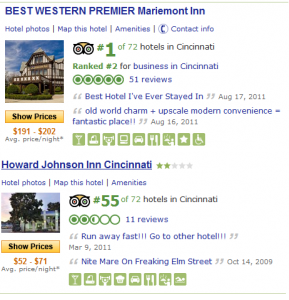
Cincinnati hotels - best & worstLook at the ratings of these two Cincinnati hotels on TripAdvisor. Scan the excerpted customer comments. If you’re the owner of the Howard Johnson Inn, how do you solve this problem? Certainly not with advertising. No, there are three options the owner of the Howard Johnson Inn has:

  • Cut prices and compete for low-margin budget travelers;
  • Invest what it takes to fix the problem;
  • Hang out a sign that says, “Under new management.”

None is very appealing, but a customer-driven market doesn’t permit the luxury of spending your way out of trouble.

Conversely, the owner of the Best Western Premier Marlemont can cut the advertising and direct mail budget because customers are doing a better job of promoting the hotel than any marketing could do. The owner can also raise prices because business travelers are less sensitive to cost than they are to a pleasant place to stay.

Fifteen years ago, America’s most-admired brands were those with the biggest marketing budgets: GE, Coca-Cola, General Motors, Microsoft. Today, the brands everyone wants to emulate are Apple, BMW, Southwest Airlines and Harley-Davidson. There are two things these brands all have in common: Neither has dominant market share and all are fanatically devoted to delivering delightful customer experiences. In the future, every successful brand will have to operate the same way.

For Scott Wright and others like him, the rules have changed, but his industry isn’t alone. It’s just a leading indicator of forces that will sweep through nearly every market as customers learn to organize and apply the new powers of influence. These forces will affect B2B and B2C businesses, nonprofits and government agencies. Businesses will have to serve customers better because there will be no choice. All our managers will drive the shuttle to the airport.

I’ve been telling audiences about how customer ratings are reshaping the hospitality industry for more than a year, but no one made that impact more real to me than Scott Wright. As I stepped out of the shuttle, I reached into my wallet and handed him a few dollars.

“Oh, not necessary,” he said, waving his hand.

“Take it,” I said. “It’s a consulting fee.”

Facebook Can Work for B2B Marketers, But You Gotta Know the Rules

In my work with B2B organizations, the question of how to use Facebook is invariably front and center. This Is despite the fact that numerous surveys have shown that Facebook is one of the least effective social networks for B2B marketing.

In a survey of marketers conducted by BtoB magazine last year, Facebook was ranked last in usefulness among the top five social networks, trailing blogs, LinkedIn, YouTube and Twitter, in that order.

Nevertheless, some B2B companies have mined gold out of Facebook’s audience, particularly for recruiting young college graduates. Let’s look at some examples of what they do well.

Storage maker EMC makes particularlyEMC page on Facebook good use of Facebook’s “Welcome” page. This is an under-utilized tool that enables companies to present an HTML page as their default front door. It’s done with an application called Static FBML (Facebook Markup Language) but there is little difference between FBML and HTML.
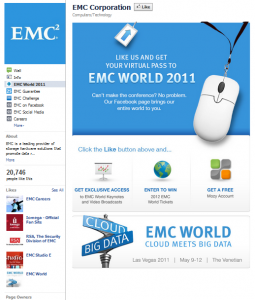
The advantage of a Welcome page is that you can use all the tricks of an HTML page, including hotspots, embeds and even forms. Buddy Media uses it to capture leads, as does e-mail marketing provider Infusionsoft. SAP plays inline videos. Use welcome pages to present an attractive and exciting introduction to your company.

EMC has several FBML pages, including a list of its other social media accounts and a game you can play only after liking the page. EMC doesn’t use Facebook’s wall to much effect, but its purpose seems more promotional than interactive. On that front, it hits the mark.

Other B2B companies that use their welcome pages well include VMWare, Lenovo, UPS and Intel. Fedex uses a cool Flash animation to link to its sub-pages. SocialMediaB2B.com has a nice roundup of Eight B2B Facebook Landing Pages

Conversation Equation

LinkedIn is all about efficiency, but Facebook is about generating discussion, even if it’s around trivial things.

For interactivity, it’s hard to beat Intel’s page, which has racked up nearly 2.7 million likes*. Intel uses its wall to great effect. Its language is perfect for the young Facebook audience, and its questions and challenges are often offbeat and fun.

It’s 2026…what are your devices able to do?” Intel asked last week. Nearly 1,100 people have responded. Wow. Earlier in the week it used an in-line poll app to ask “What content are you most excited to see on our Facebook page?” Interestingly, videos and product announcements topped the list.

Cisco is also terrific at generating discussion. A post on Monday offered fans the chance to win a Casio camera by telling how the Cisco Unified Computing System can benefit their business. That’s a great way to generate word-of-mouth, because posts are shared with people’s friends. Contests and giveaways work well on Facebook.

Cisco SuperFanCisco also has a clever concept called the SuperFan, which is a recognition awarded to their most active visitors. There’s no money involved: SuperFans get their name and face on the Cisco page, and that’s good enough for many of them. Here’s how it works.

Salesforce.com leverages Facebook to drive attendance to its many events. The company knows that its core audience is sales professionals, and it uses discounts, referral bonuses and contests to reach these individuals. Salesforce also post lots of photos of people, which reinforces the image that this is a company with a personal touch.

Desperately Seeking People

One of the most popular uses of Facebook for B2B companies is as a recruiting tool. Facebook has an app to support career postings on your page, but some companies take it to the next level.

UPSjobs goes beyond simply posting job opportunities. It makes the extra effort to quickly respond to inquiries from its fans, often within a few hours. As a result, UPS has turned the tables on traditional recruitment: People come to its page seeking jobs because they know they’ll get a rapid response. As a result, most of the wall comments are from people who want to work for UPS.

Microsoft celebrates its interns on its recruiting page, which is a smart move given the young demographics of the Facebook audience. Sodexo is a master of using social media for recruitment. It uses apps for Twitter, YouTube, Flickr and Foursquare to pull its content from other social networks into Facebook. This company’s entire recruiting effort  – it hires about 5,000 people in the US every year – is built on social media. Check out its impressive recruitment site, which lists the many social channels it uses. Other notable careers pages on Facebook include Shell, Hilton and Abbott Laboratories.

Takeaways

Now that we’ve looked at examples of Facebook best practices, what can we learn from them? Here are some of my takeaways:
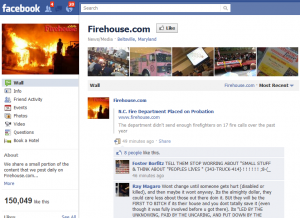
Firehouse.com on FacebookHave fun. I think of Facebook as the after-hours social network. The style that works best is relaxed, informal and a little edgy. Be personable and distinctive. No company does this better than M&M Mars, whose Skittles page is closing in on 19 million likes. Its style is unique: funny, unpredictable and tuned to generate response.

Respond. Facebook is a place for conversation, not publication. If people ask questions, you need to respond and quickly. One common mistake companies make with their Facebook pages is to launch them and leave them. Successful fan pages feature a constant stream of new posts by the company and quick response to visitor comments.

Be Colorful. Welcome pages are one of the big differences between Facebook and LinkedIn. They enable you to add a colorful and multifaceted dimension to your presence. The best welcome pages have lots of entry points and a vigorous, hip feel.

Share. One aspect of Salesforce.com’s Facebook presence that I particularly like is its willingness to share content from other sources that its audience may find useful. This not only makes the Salesforce.com fan page a resource but builds goodwill with the sources it links to.

Ask. Firehouse.com has built an impressive Facebook presence for its audience of firefighters and emergency medical technicians. “Is your department participating in National Night Out?” It asked earlier this week. It’s “Sunday Morning Roll Calls” sometimes generate hundreds of responses. Something as simple as asking people what they plan to do for the weekend can create interaction.


* I’m personally not a big fan of tracking page likes as a measure of success, particularly since Forrester has estimated that less than 15% of people who click that button ever return. What impresses me more about Cisco’s Facebook presence is the number of likes and comments that individual wall posts receive.


 

Two B2B Social Marketing Initiatives Worth Checking

A couple of notable B2B efforts have caught my eye recently that I wanted to share. One is Element14, a social community for engineers sponsored by an electronics distributor of the same name. I wrote in B-to-B magazine early this year about a Make magazine-like video series they started last fall that appeals to engineers’ passion for tinkering as well as for fun. Other new stuff that they’re doing (and this comes directly from the press release):

  • The industry’s first online design hub – the element14 knode – designed to help engineers accelerate design and development and bring products to market faster than ever before.
  • RoadTests – Allowing members to actually try out the latest new products for free and share their reviews with other engineers
  • Focused sub-groups – scores of technical forums ranging from LEDs, robotics, FPGAs, engineering student design teams, etc.
  • Over the last quarter alone, more than 500,000 people visited the online community, spending over 65,000 hours researching, collaborating and communicating with fellow engineers.

Element14 is trying to position itself as “Facebook for engineers,” and they’re doing a heckuva job. This is a commerce play, incidentally. The whole community is linked to an underlying catalog site. One of the innovative things about the Ben Heck Show is that each of his video hacks is accompanied by a parts list that you can order right on site.

When I first learned about Element14 a couple of years ago, it was a rather unremarkable document exchange engine. Over the last year, it’s evolved into a multimedia experience that bristles with value and fun. No doubt this wasn’t cheap, but it’s impressive to see a B2B community demonstrate this kind of ingenuity.

Update 12/6/11: Premier Farnell just announced that “The Ben Heck Show” has attracted more than three million views since its launch.

Also, check out Social Media Quickstarter, a tutorial site aimed at small businesses and launched just this week by Constant Contact. The site is organized in “chapters” by platform – Facebook, LinkedIn, Ratings and Reviews, QR codes and the like – and presents really useful tutorials in a step-by-step format, many including video. There are more than 70 chapters, all of which can be downloaded and printed.

There are several aspects of this ever that I like:

Minimal branding – Constant Contact intentionally keeps the focus on the content rather than its brand. In fact, the company name is in almost comically small type at the top of the home page. One smart move was to prominently note that the resource is “Powered by KnowHow,” which is a training service the company offers. It’s a low-key approach to branding that uses the quality of the content to validate the service.

Value – Constant Contact says it surveyed small businesses to discover that many didn’t know how to get started in social media, but you didn’t need research to figure that out. There is a crying need for this kind of basic education. The value of Social Media Quickstarter isn’t as much in the content itself as in the fact that it’s all in one place. You can Google around and find much of this advice elsewhere but the company has conveniently aggregated it in one spot.

Simplicity without Condescension – Quickstarter manages to walk that fine line between teaching basic skills and talking down to its audience. Quickstarter doesn’t pretend to be a resource for the digerati. It answers the basic questions that millions of small business owners are asking, and it does so in plain language with lots of pictures and video. It respects its audience.

Two impressive B2B social media efforts by two companies addressing very different audiences.

Linked In Overview, from Social Media Quickstarter from Social Media Quickstarter on Vimeo.

The Other Social Network

LinkedIn LogoHave you checked out LinkedIn lately? If you thought the world’s largest professional network was little more than a place to post your resume, you owe yourself another visit. LinkedIn is set to eclipse the 100 million member mark sometime this spring, and it is quickly becoming the social network of choice for B2B professionals.

LinkedIn gets none of the buzz of Facebook, and no one’s going to make a movie about it. Its format is austere, it has few third-party applications and it doesn’t support chat, photo libraries or videos. What it does have is lots of members who talk about serious professional issues, and some of its groups are becoming massive in scale. For business pros in industries like communications, manufacturing, retailing, financial services and even construction, LinkedIn groups are becoming vertical social networks in their own right.

This is the ideal B2B environment. There’s very little waste because members are there to seek professional opportunities, ask and answer questions and network with their peers. Spamming isn’t a problem, particularly in the moderated groups, and there’s none of the frat boy histrionics that you find on Facebook. It’s not surprising that in research conducted by B2B magazine last spring, marketers picked LinkedIn as their social network of choice by a substantial margin over Facebook.

LinkedIn has evolved far beyond its roots as a professional networking service. It hosts active groups for finance managers, telecom professionals, people in the construction industry, real estate pros, HR managers, pharmaceutical workers and film professionals. And those are just the ones with more than 40,000 members. If you’re in the hospitality industry, there are nearly 1,000 members in The Hospitality Forum. A group for medical doctors has more than 2,600 members. Stephanie Sammons posted some great tips on Social Media Examiner early this year about  how to make the most of LinkedIn groups.

And they’re busy. Someone asked the Sales Best Practices group a couple of months ago “What is YOUR Best Sales Advice — 20 words or less.” It has 532 responses. A recent discussion in the Cloud Computing, VMware, Virtualization and Enterprise 2.0 Group about whether IT organizations will start discarding their assets has more than 460 responses. Some LinkedIn members answer 300 or more questions every week.

It’s not about the numbers, though. In fact, many LinkedIn groups are kept intentionally small by administrators who want to maintain member quality. Just try to get into CIO Forum. Unless you’re an IT manager, you probably can’t. Facebook is about mass, but LinkedIn is about focus, which is one reason it rocks for B2B.

Here are a few ways B2B companies can leverage LinkedIn for prospecting and promotion:

"Swarm" is LinkedIn's version of a tag cloudAsk and Answer. Many of the questions posed within groups and in LinkedIn’s busy Answers section concern requests for expertise. You can subscribe to questions in your domain using an RSS reader, which ensures that you will never miss one that matters to you. If the technical gurus in your organization are intimidated by the prospect of blogging, urge them to instead answer five questions per week. As they grow their profile in the community, people will start seeking them out for business. That’s the reason Vico Software expects its sales reps to become active in construction-related groups in each of their territories. They’ll find out first about new construction opportunities in the forums.

Choose Open Groups. LinkedIn recently gave group owners the option of making their content public so that all activity from that point on would be visible to search engines. This is a good way to make your groups more visible. Also, if you plan to post regularly to groups in your field or industry, consider choosing open groups so that you get the additional Google love.

Promote in Groups. Cross-post new entries from the company blog or new presentations on SlideShare to appropriate groups of which you’re a member. Summarize your content and ask a question. Use a unique URL so you can track activity. You’ll often be surprised at the volume of response.

Use Company Profiles for Prospecting. LinkedIn has a unique approach to company profiles. They’re organized by the people who work there. Salespeople who are having trouble finding the right contacts in an organization can use these profiles as a virtual back door. LinkedIn shows you who works at the company and whether you have direct or indirect ways of contacting them. You might be able to do the same thing on Facebook, but it’s a lot more difficult.

Find People. One of LinkedIn’s great strengths is the choices it gives you for selecting members. You can filter by title, geography, group membership, company size and even years of experience. Some members reveal remarkably detailed public profiles of themselves. You can use this information to prepare for a meeting, find skills or identify prospects within a region. When I need to recruit speakers for a panel in Atlanta, for example, the first place I go is my LinkedIn contact list because I can so quickly identify prospects in the area.

Use LinkedIn Signal. One of LinkedIn’s little-known gems is Signal, a real-time search engine that’s listed as “Updates” on the search menu. Use it to monitor what people are saying about any topic. You can also filter by connection, date, company and industry. A search for “Chicago Marketing Jobs” returns 20 opportunities posted in the last 72 hours. You can also get updates on people and groups that interest you.

LinkedIn has recently revealed some visually cool and potentially very useful stuff coming out of its labs. Swarm is a different take on tag clouds that builds on recent company and title searches, jobs posted, blog entries and shared articles. InMaps lets you visualize your connection network. It’s still early-stage but shows promise.

What’s your favorite LinkedIn feature? Do you have a success story to share? Post it here.

CareOne Cashes In On Community

CareOne Debt Relief Services contends with a business climate that few of us (thankfully) have to face: Its industry has a terrible reputation.

That industry is debt relief, a field that many people associate with fast talking pitchmen on late-night infomercials. But there’s nothing underhanded about CareOne, a nine-year-old company with 700 employees and a philosophy that “There’s no reason to be ashamed of being in debt,” according to Social Media Director Nichole Kelly (right).

A busy online community has been a remarkably effective engine of growth. By enabling customers to freely exchange experiences, CareOne helps shatter suspicions that dissuade people in debt from seeking professional help. In fact, the conversion rate of prospects who have signed in to the CareOne Community is a remarkable seven times higher than that of non-members.

That claim, which is one of several ROI metrics cited in a summary of the company’s social media successes, sounded so extreme that I gave Kelly a chance to qualify the numbers when I spoke to her recently.

She would do no such thing. CareOne actually takes a disciplined approach to figuring ROI, she said, using control groups and thousand of data points. Not only do community members convert at dramatically higher rates, but the boost in sign-ups is only one of several business benefits CareOne has realized from its customer community. But more on that in a minute.

Happy Accident

CareOne Debt Relief ServicesThe 1.4 million member community was actually an accident. It was created five years ago as a way for CareOne employees to share advice about their own debt issues. A few outsiders stumbled upon the site and joined the conversation. It turned out that they were a prime source of prospects.
Debt is a touchy subject. Most people don’t like to admit to financial problems, but they crave solutions, often desperately. CareOne discovered that customers who engaged online were far more likely to seek professional help than cold-called candidates. “It’s real customers telling each other that the program works,” Kelly said.

CareOne’s approach is a good example of soft-sell marketing. The site features numerous articles, worksheets and video tutorials about debt reduction. A recently launched video series called Financially Fit TV interviews personal finance experts. About 30% of visitors who register and tap into the free advice never become customers and “That’s fine,” Kelly said. “If they can get out of debt on their own, we’re happy to help.”

But more than 60% of members aren’t customers, making them a lucrative prospect base. Word-of-mouth recommendations help drive inbound inquiries, and the presence of so much helpful information in the community lowers the barrier to conversion. It’s clear to casual visitors that CareOne is no fly-by-night operation.

Not that managing a community is easy. The number of active participants – or those who regularly contribute content – is in the sub-1% range. That’s not surprising for a topic that few people like to discuss publicly. However, lurkers invest a healthy five to 10 minutes per session and return frequently, indicating that the audience is engaged.

CareOne has invested time and money to encourage the minority who interact. Its busy Ask the Expert forums have certified credit counselors responding to inquiries. The experts are compensated for their time. A full-time four-person social media team manages the community and other social media programs, responding to questions, correcting misstatements and encouraging lurkers to come forth.

Active members are promoted and applauded. As in most online communities, a very small percentage of members contribute most of the content, but those people can become heroes to their peers. One popular blog, My Journey out of Debt, is written entirely by customers.

The Insight Dividend

In addition to the remarkable conversion rates for community members, CareOne has realized other benefits. For example, last year it detected a shift among its upper-income customers away from debt management concerns and toward debt settlement plans and adjusted its resource commitments accordingly.

Recently, “We noticed that a lot of our customers were one car breakdown or one illness away from bankruptcy,” Kelly said. “That changed the content we were delivering. We reduced our focus on frugality and began creating more content about dealing with life events.”

One of the more impressive aspects of the whole effort is the company’s focus on ROI metrics. Kelly ticks off her favorites: cost per conversion, cost per acquisition, customer value, customer profitability and retention rate. Nothing about hits, followers or comments. Those aren’t financial metrics.

CareOne is focusing on the right stuff. The section headlined “CareOne + Social Media: The Measurement” on the successes page devotes substantial attention to five challenges of measuring social media ROI. In all cases, it focuses on bottom-line drivers.

Customer communities aren’t for everyone, and in the age of Facebook and LinkedIn, you actually need a compelling reason to start your own. The ability to build detailed audience profiles, customize services for individuals and maintain a level of confidentiality were good reasons for CareOne to choose the path it did. The company clearly cares about bottom-line return, and by being able to track individual visitors through their various interactions with the company, it has shown some impressive results.


Jason Falls posted a profile of CareOne Community on Social Media Explorer at almost the same moment this post went live. He has a good deal of background on how the community came about and more extensive ROI data than I do.

You can also find a case study on Social Fresh.