Live Blog: Day 2 Kickoff Strikes Transformation Theme

Day Two of Lotusphere kicked off with a celebration of business transformation enabled by collaboration technology. Representatives from TD Bank Group and the author of a hot new book told stories of businesses that are rethinking the way business is done.

Wendy, Arnott, TD Bank Group

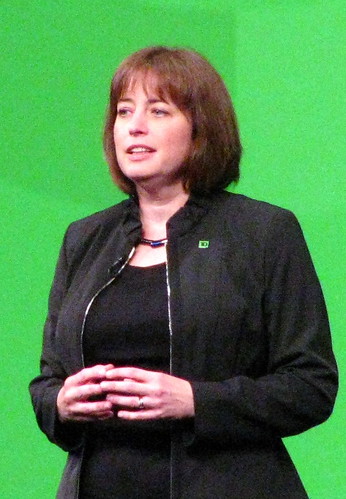
TD has grown to become North America’s sixth largest bank through acquisitions and a focus on listening to customers. A new social media team listens and responds to blogs, Facebook posts and tweets, the process “learning to be a better bank,” said Wendy Arnott (right, @Wendy_Arnott), VP for Social Media and Digital Communications.

The company has also transformed its internal communications using social networking technologies anchored by IBM Connections. Arnott ticked off the three key imperatives as aligning with core values, delivering real value and facing risks head on. To that end, the bank is endeavoring to involve employees in critical decisions.

Acknowledging the technical orientation of the Lotusphere audience, IBM also brought out TD’s CIO, Glenda Crisp (left, @GlendaCrisp) to talk about the importance of the IT-business partnership. Crisp said traditional project management was complemented by a collaboration steering committee that addressed issues like adoption barriers as well as technical problems like SharePoint integration.

The committed deemed it critical to make the shift to a shared platform as transparent as possible Single sign-on simplified access to Connections and Google search appliances were brought in to make enterprise-wide search seamless. Interviews with users also surface the importance of supporting mobile users of the bank’s dominant BlackBerry platform. “We made that a key factor in our selection criteria,” Crisp said.

The result of this active employee involvement was an adoption rate that exceeded expectations by a factor of seven. More than 50,000 users in Canada are up and running, and US deployment is expected to grow from 3,000 to more than 25,000 in less than a month.

Arnott ticked off success criteria:

  • Get executive leadership sponsorship.
  • Put a dedicated organization in place to oversee deployment.
  • Deal with resistance by “getting into weeds with business teams and helping them discover how social will help them address business challenges.”
  • Get employees involved on a volunteer basis and make sure their ideas count.

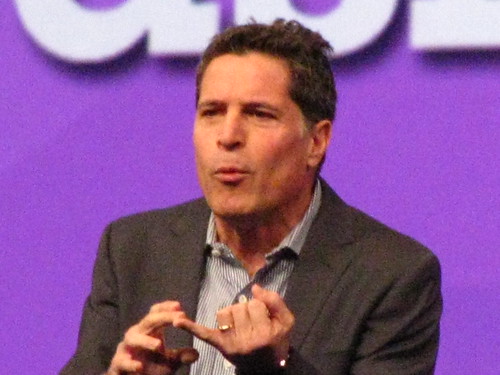
IBM next brought out Fast Company editor Bill Taylor (@practicallyrad) to address the need for business transformation. Taylor, whose new book is Practically Radical, asserted that in this age of commoditization, “The only way to stand out from the crowd is to stand for something special. Winning organizations today stand for new ideas,” he said. “The middle of the road has become the road to nowhere.”

Bill Taylor, Fast Company at LotusphereTaylor talked about the radical innovation embodied in the Henry Ford Health System in Detroit, which broke the mold when it built a new hospital in West Bloomfield, MI three years ago. Executives at the health care provider realized “they knew everything about surgery and pharmacology, but they knew nothing about what it took to make people feel right.”

Common Area, Henry Ford Health CenterHenry Ford Health recruited consultants from the hospitality and restaurant industries and conceived of a 160-acre facility that looks more like a resort (left) than a hospital. They created a file of more than 2,000 original healthy recipes that are in such demand that the hospital now books $1 million annually in catering revenues.

The result is “a business home run because the approach from day one was so unconventional,” Taylor said.

Taylor also sang the praises of USAA, an insurance company that solely serves military customers. The 10-week employee orientation process there is more like a boot camp than a training course, he said. New recruits wear 65-lb. backpacks to simulate the working conditions of a infantry soldier and eat military rations. “They want to immerse their people in are the lives and experiences of their customers, which creates bonds not only with customers but also between employees,” he said.

Bottom line: “As you think about making your business more memorable, also think about how you make it more social.”

This is one in a series of posts sponsored by IBM Midsize Business that explore people and technologies that enable midsize companies to innovate. In some cases, the topics are requested by IBM; however, the words and opinions are entirely my own.

How Will Computers Serve Us in 2020?

Live-blogging from the IBM Watson University Symposium at Harvard Business School and MIT Sloan School of Management. Additional coverage is on the Smarter Planet Blog. .

Panel discussion: What Can Technology Do Today, and in 2020?

Moderator: Andrew McAfee – MIT Sloan, CDB

Panelists: Alfred Spector, Google; Rodney Brooks, MIT, Heartland Robotics, David Ferrucci,IBM

Alfred Spector, Google

Spector: We focused in computer science for many years on solving problems where accuracy and repeatability was critical. You can’t charge a credit card with 98% probability. We’re now focusing on problems where precision is less important. Google search results don’t have to be 100% accurate, so it can focus on a bigger problem set.

When I started in computer science, It was either a mathematical or an engineering discipline. What has changed is that the field is now highly empirical because of all of that data and learning from it. We would never have thought in the early days of AI how to get 4 million chess players to train a computer. You can do that today.

The Next Big ThingThis is one in a series of posts that explore people and technologies that are enabling small companies to innovate. The series is underwritten by IBM Midsize Business, but the content is entirely my own.

Brooks: Here at MIT, all students take machine learning because it’s that important.

McAfee: Was there a turning point when you decided the time was right to take these empirical approaches?

Brooks: It was in the 90s. The Web gave us the data sets.

Ferrucci: Watson was learning over heuristic information. Plowing through all those possibilities through sheer trial and error was too big. You have to combine inductive and deductive reasoning.

Brooks: It’s easy to get a plane to fly from Boston to Los Angeles. What’s hard is to get a robot to reach into my pocket and retrieve my keys.

McAfee: Why does the physical world present such challenges?

Brooks: In engineering, you have to set up control loops and you can’t afford for them to be unstable. Once a plane is in the air, the boundaries of differential equations don’t change that much. But when reaching into my pocket, the boundaries are changing every few milliseconds.

McAfee: The things that 2-year-old humans can do machines find very difficult, and the things that computers can do humans find very difficult.

Rodney Brooks, MIT

Rodney Brooks, MIT

Brooks: One thing we have to solve is the the object recognition capabilities of a two-year-old child. A child knows what a pen or a glass of water is. There is progress here, but it’s mainly in narrow sub-fields. Google cars are an example of that. They understand enough of road conditions that they can drive pretty well.

Spector: We’re looking to attack everything that breaks down barriers to communication. Example: With Google Translate, we eventually want to get to every language.

Another is how to infer descriptions from items that lack them. How do you infer a description from an image? We’re at the point where if you ask for pictures of the Eiffel Tower, we’re pretty good at delivering that.

A third thing is to make sure that information is available always from every corpus, whether it’s your personal information, information in books or information that’s on the Web. We want to break down those barriers while also preserving property rights. How many times have you searched for something and you can’t find it? I turns out it’s in a place where you weren’t looking. When you combine that with instantaneity of access, you can be on the street and communicate with someone standing next to you in the right language and the right context. You can go to a new city where you’ve never been before and enjoy that city no matter where it is.

McAfee: You think in five years I’ll be able to go to Croatia and interact comfortably with the locals?

Spector: Yes.

Brooks: We think manufacturing is disappearing from the US, but in reality there is still $2 trillion in manufacturing in the US. What we’ve done is go after the high end. We have to find things to manufacture that the Chinese can’t. What this has led to is manufacturing jobs getting higher tech. If we can build robotic tools that help people, we can get incredible productivity. The PC didn’t get rid of office workers did; it made them do things differently. We have to do that with robots.

We can take jobs back from China but they won’t be the same jobs. That doesn’t mean people have to be engineers to work. Instead of a factory worker doing a repetitive task, he can supervise a team of robots doing repetitive tasks.

My favorite example is automobiles. We’ve made them incredibly sophisticated but ordinary people can still drive.

Spector: It’s machines and humans working together to build things we couldn’t build separately. At Google, we learn how to spell from the spelling mistakes of our users.

Ferrucci: This notion that the collaboration between the health care team, the patient and the computer can result in a more effective diagnostic system as well as one that produces more options. Everyone is well informed about the problems, the possibilities and why. I think we’re capable of doing that today much better than we did in the past. This involves exploiting the knowledge that humans use to communicate with each other already. This gets you as a patient more involved in making better decisions faster. It’s collaborating better with the experts.

McAfee: Don’t we need to shrink the caregiver team to improve the productivity of the system?

Ferrucci: The way you make the system more productive is to make people healthier. Does that involve a smaller team? I don’t know, but I do know you get there by focusing on the right thing, which is the health of the patient.

Andrew McAfee, MIT Sloan

Andrew McAfee, MIT Sloan

McAfee: If you could wave a wand and get either much faster computers, much bigger body of data or a bunch more Ph.D.’s on your team, which would you want?

Brooks: Robotics isn’t limited by the speed of computers. We’ve got plenty of data, although maybe not the right data. Smart Ph.D.’s are good, but you’ve got to orient them in the right direction. The IBM Watson team changed the culture to direct a group of Ph.D.s the right way. I think we’d be better off if universities were smaller and did more basic research that companies like IBM would never do.

Spector: When many of us in industry go to the universities, we’ve often surprised that the research isn’t bolder. Perhaps that has to do with faculty reward issues. We envision that there’s going to be need for vastly more computation. I’m sure Google data centers will continue to grow. If you stay anywhere near Moore’s law, these numbers will become gigantic. The issues will relate to efficiency: Using the minimum amount of power and delivering maximum sustainability.

With respect to people, there’s a tremendous amount of innovation that needs to be done. Deep learning is a way to iteratively learn more from the results of what you’ve already learned. Language processing is a way to do that. We learn from the results of what we do. Finally, data is going to continue to grow. We bought a company with a product called Freebase where people are creating data by putting semantic variables together. Just learning the road conditions in New York from what commuters and telling us is crowdsourced data, and that’s enormously useful.

David Ferrucci, IBM Research

David Ferrucci, IBM Research

Ferrucci: We need all three, but in order, it’s researchers, data, machines. Parallel is processing is important, but it’s less important than smart people.

McAfee: Do computers ultimately threaten us?

Brooks: The machines are going to get better, but for the foreseeable future we’ll evolve faster. There’s a lot of work going on in the area of putting machines into the bodies of people. I think we’re going to be merging and coupling machines to our bodies. A hundred years from now? Who the hell knows?

Spector: There will be more instantaneity, faster information. We can embrace that, like we did central heating, or reject it. I think we’re on a mostly positive track.

Audience question: What’s the next grand challenge?

Ferrucci: I think the more important thing is to continue to pursue projects that further the cause of human-computer cooperation. We tend to go off after new projects that require entirely different architectures, and that hurts us. I’d rather we focus on extending and generalizing architectures we’ve established and focus on applying it to new problems.

Brooks: I’d like to see us focus on the four big problems we need to solve.

  • Visual object recognition of a 2-year-old
  • The spoken language capabilities of a four-year-old
  • The manual dexterity of a six-year-old. Tying shoelaces is a huge machine problem
  • The social understanding of an eight-year-old child.

How to Promote an Event with Social Media

How to Promote Your Event With Social Media

As a frequent speaker at events of all sizes, I’ve had a chance to observe some of the best practices conference organizers used to promote their events through social media. In most cases, these efforts cost little or nothing more than your time.

Here are some suggestions for leveraging social channels for event promotion. I’m sure I haven’t covered all the possibilities, so please contribute your ideas as comments. We’ll look first at tactics the can work for any event, then I’ll propose a few ideas for large conferences covering multiple days and many speakers.

Events of all sizes

  • Set up a unique landing page for each event. You need a single Web address that people can refer to in their social channels. Use this page to describe and “sell” the event, not to gather registrations. Send visitors to a different landing page to register. If there are several events in the series, create a unique landing page for each.
  • EventBrite is a great service, but I recommend against using it as your event landing page. Use a page under your own domain and use EventBrite (or similar services) for registrations.
  • Publish an announcement on Yahoo’s Upcoming or Eventful. They help you publicize to a local community. Also consider professional associations, which may give you a calendar entry for free.
  • Regardless of the size of the event, set up a Facebook page or create a dedicated event sub-page under your Facebook page. It costs nothing and gives you access to the extended social networks of registrants and potential registrants. When people “like” your page, that action is shared with everyone in their network. The average Facebook member has 130 Facebook friends. That amplifies your message pretty quickly.
  • Create a Twitter hashtag and promote it to your colleagues and registrants. Ideally, the hashtag should be unique to the event (#AcmeForum11), but it’s OK to use your organization’s hashtag if your main goal is to build your brand.(#AcmeForums). Use the hashtag in all your communications and always link to the event landing page.
  • Schedule Twitter promotions to go out at different times of the day, including on weekends. Free clients like Tweetdeck, Seesmic and HootSuite make this easy. If you’re trying to attract an international audience, don’t forget to schedule some promos to go out during the local work day in those areas. If you can customize to the local language, that’s even better.
  • Ask registrants for a Twitter address and then follow them on Twitter. Retweet their messages from time to time. They’ll notice you and are more likely to follow you and retweet your event-related messages.
  • Use a unique tracking code with each promotion and make sure to use a different code for Facebook, Twitter, LinkedIn and e-mail. You want to know which sources are sending traffic to your landing page so you can better focus your resources.
  • Link to the event page from your e-mail signature line. Make sure others on your team do this, too.
  • Create short-code URLs using a service like Bit.ly. Many services let you customize the short code to something that’s easy to remember, like your event name or hashtag (for example, bit.ly/AcmeForum). Do that.
  • Your speakers and fellow organizers are your best sources of social media promotion. Make it easy: Create suggested messages for them to use in each medium (For example, “Come see the latest in Acme widgets. Special discount if you use this URL http://bit.ly/AcmeForum“). It’s better that they use your message than create their own. Create a couple of short messages for Twitter and a longer one for a blog or Facebook. Limit Twitter messages to 120 characters to allow for retweeting.
  • Provide a suggested tag for attendees to use when posting photos or videos from the event. This enables you to assemble photo galleries by stitching together tagged content from a variety of sources.
  • Create an event badge (right) that speakers can embed in their blog sidebars or on their websites. Link to your landing page using a custom URL. Don’t send speakers an image, but post the image on your site and send them an embed code. This enables you to tell who’s sending you traffic. It’s a good idea to offer speakers a special discount code they can share with their friends and followers.
  • Something that’s rarely done but worth trying is to customize discount codes and offer a rebate to attendees who successfully recruit other registrants. All you have to do is give each badge-holder a unique registration code to promote, and then track who sends you customers. Then refund promoters a percentage or fixed amount.
  • Create SlideShare and YouTube channels for your event. Post all appropriate pre- and post-conference materials there. SlideShare is a particularly good place to post speaker presentations as a way of raising awareness about follow-on events. Be sure to point to your event site from the SlideShare and YouTube profile pages. Embed media from your SlideShare and YouTube channels on your event website.
  • Content from past events is your best promotion for future events. Record as many presentations as possible and post them as podcasts or video podcasts. Be sure to provide an RSS feed so that potential attendees can subscribe to new content as it’s posted. If you can’t record the sessions, set up brief interviews with selected speakers and post them as podcasts.

Large events

  • Set up a branded Twitter account specifically for the event. This enables registrants to follow you to learn about developments in the program and it also creates a channel for post-event follow-up.
  • Use the Twitter account to promote announcements such as new speakers, sessions, sponsors and parties. Ask staff and speakers to retweet these messages in order to gain followers. Don’t forget to include the Twitter hashtag!
  • Create an event blog. Ask speakers to contribute posts of 300-500 words. Space out entries so that there’s a constant stream of new content. Focus speakers on writing about the topic of their presentations, not promoting their businesses. Promote each new entry on Twitter and your Facebook page. Post a description and link in relevant groups on LinkedIn.
  • Create an e-mail newsletter with frequency of at least every other week. Make it easy for website visitors to sign up for the newsletter, even if they don’t register for the event. Promote a newsletter sign-up page on Twitter, Facebook and LinkedIn. Be sure to post the content of each newsletter on a page on the conference website so that people can link to it.
  • Create a series of pre-event audio and/or video podcast interviews with speakers. You can use VOIP services like Skype and inexpensive recording software like Pamela to capture this audio. Post the podcasts on the conference blog and on a dedicated multimedia page on the conference website.
  • Create a page to aggregate news media coverage of the event and/or topic of your event. An easy way to do this is to use Delicious link rolls. Embed a small piece of Javascript code on your Web page and whenever you bookmark an article on Delicious with the designated tag, the headline and link post automatically to your page.
  • Create a “buzz page” that monitors mentions of your hash tag and automatically posts them to a comment stream. Here’s an example.

Post-Event

  • Send a summary e-mail to all attendees with referrals to conference materials on SlideShare and YouTube. Send people to a page on your event website that hosts that embedded content. The landing page should include calls to action to register for future events. A “repeat attendee” discount is a good idea.
  • Set up a survey form to capture evaluations from attendees. Google Documents supports simple forms at no charge. Publish the best comments as validation of the quality of your content. Here’s a simple form I use to gather feedback on my presentations. It took 10 minutes to set up.
  • Continue to use the Twitter account to update attendees and provide fodder for future promotion.

What did I miss? Tell me what works for you and for conferences you’ve attended.

Got a Cause? Pen a Poem. Win 10 Grand.

It’s tough raising nickels and dimes
In even the most prosperous times
One new course of action
That might get some traction
Is pitching nonprofits in rhymes

Heart and Soul Foundation Grant ProgramOK, so I didn’t miss my calling as a poet. But if you’re a nonprofit organization in the U.S., U.K. or Canada, and if you can tell your story poetically, you can win up to $10,000 from the CTK Foundation’s Heart and Soul Grant Competition.

You only have four weeks to compose your masterpiece, but that’s enough time for a four- to eight-line poem, right? Here’s how it works:

Submit an original poem that reflects the work and/or mission of your nonprofit organization. Just about anyone can write it, but it’s got to be original. They’re Googling to be sure. You have until March 28.

Winners will be selected by an international panel of independent artists and producers. In addition to getting a briefcase full of money, you’ll be invited to a gala evening event on April 14th in Austin, Texas. I recommend you put the money in the bank before heading to the event.

  • First place award is a cash grant of $10,000. Your poem will also be made into a song by written and recorded by a man who’s got an incredible story to tell.
  • Second place award is a cash grant of $5,000 and no song.
  • There’s also a Blogger’s Choice Award, whereby a randomly selected blogger who helps promote the program (like me) gets to choose an applicant to receive a $1,000 cash grant. There’s no song with this award either, but the blogger might hum a few bars for you.
  • Two steel-stringed guitars, signed by all members of Los Lonely Boys, will be awarded for use in for auction and fund raising. I recommend you avoid shipping them on United Airlines.
  • Up to 20 technology grants, valued at $10,000, to nonprofits that indicate an interest.

Are there more details? Sure. Select the CTK Foundation tab located on the www.communitytech.net website. The video has more. You can also follow #ctkgrant on Twitter.

Waiving Speaking Fee for Book Buyers

My book Social Marketing to the Business Customer with co-author Eric Schwartzman was released last month and is now available through Amazon, Barnes & Noble, Borders and other booksellers.  It’s the first book devoted exclusively to B2B social media, and the most comprehensive collection of best practices and case studies currently available in print.

B2B is hot topic these days as marketers look for applied wisdom and operational frameworks to help them integrate social media into their existing organizational outreach efforts.  Everyone seems to be interested in the concept of using social media to reach a focused, select group of individuals. If social media for business is on your mind lately, consider picking up a copy of the book, or downloading one of our B2B social media podcasts which we’ve been releasing over the last couple of weeks through On the Record…Online.

If you’re looking for speakers to address the subject of social media for business at your next conference or event, both Eric and I are waiving our fees now through June 1, 2011 with bulk book purchases of 200 of more copies. So if you’d like to have Eric or me present on B2B social media at your company or conference, we’ll speak and autograph your 200 copies in person.

Some of the topics we can address include:

  • Building the Business Case for B2B Social Marketing
  • Generating Qualified B2B Leads with Social Media
  • How the B2B/B2C Difference Applies to Social Media Strategy
  • Current and Future B2B Social Marketing Trends
  • Or challenge us with some aspect of social media specific to your interest

If you’re interested in having me present, please check my online calendar first. Note that I will be unavailable for personal reasons (expecting twins any day now!) through about the end of April, but any speaking engagements booked before June 1 qualify for this offer. Or if you’d like to have Eric speak your group, you can check his online calendar as well. We’d both be honored to talk your group about B2B social marketing specifically, or social media marketing in general. It’s a topic about which we are very passionate.

We look forward to hearing from you! Contact me at paul [at] gillin [dot] com.

Five Lessons From the Web 2.0 Summit

I had a chance to attend the recent Web 2.0 Summit in San Francisco and hear from some of the business leaders of the new Internet, including the CEOs of Google, Facebook, Yahoo! and Twitter. Here are five key insights I took away.

1. Make Marketing a Service to Customers - I didn’t write down who said this, but the comment stuck with me long after the conference was over. The traditional role of marketing has been to create an image or deliver a message. Service had little to do with it. But in the new world of tuned-out customers, the only way to get make an impression is to be helpful, entertaining or memorable. This is one reason we’re seeing a race by B2B marketers in particular to give away tactics and information that were once their source of competitive advantage. It’s the only way to get prospects to pay attention. Marketers need to ask themselves a new question: “How can I help?”

2. You Need a Mobile Strategy, and Faster Than You Probably Thought. Forrester Research now predicts that smart phones will be the dominant Internet access device in the US within three years. Mary Meeker of Morgan Stanley sees smart phone shipments surpassing PCs in 2012 (Here’s the video of her terrific presentation). In countries like China, the PC was never even much of a factor. The speed at which this shift is occurring is breathtaking. Smart phones have eclipsed all other electronic devices in their rate of adoption (see chart below).

Smart Phone Growth

Google’s Eric Schmidt made an interesting point: smart phones are actually more useful than PCs because they know more about the user, including location, and can deliver a more personal level of utility.

This doesn’t mean PCs are going away. Rather, the plunging price of flat-panel displays will make PCs more of a dashboard for a user’s business and entertainment needs. However, the browser will be only one of several ways people will access the Internet.

On the smart phone, that access will be by applications. Apple opened the iPhone to developers only three years ago, and already more than a half-million apps have been delivered. Other platforms are just ramping up their own app ecosystems.

There is a huge free-for-all coming in mobile apps, and nearly every business needs to be thinking about how to participate. Consider item 1 above. How can you use a mobile app to provide service to the customer? Whether it’s a coupon, shopping tip, reference source, comparison engine or something else, you’ll need to address the needs of this rapidly growing mobile audience.

Mark Zuckerberg at Web 2.0 Summit3. Social Is the Killer App. While you’re pondering question 2, consider this one. Mark Zuckerberg was poised and mature in a nearly one-hour interview with John Battelle and Tim O’Reilly. The Facebook founder acknowledged that great power carries great responsibility and pledged to be more responsive to the privacy concerns of members.

One memorable point he made is that “social” is a powerful feature of software. Several Facebook applications, like photo albums, were functionally weak in their early versions but were a huge hit with members because they were easily shareable, he noted. This is an important point to remember. Loading up on features quickly reaches the point of diminishing returns. Adding the ability to share, reuse, mash up and comment creates a whole different level of value.

BTW, Zuckerberg reminded me of a young Bill Gates in looks, mannerisms and the clarity with which he sees complex issues. Like Gates, he has an uncanny ability to find a logical path to a decision or point of view. It will be interesting to watch his star rise.

4. Simulations Are A Powerful Incentive To Engage. Did you know that 320 million people have played a Zynga game and that the company now employs 1,300 people? Have you ever even heard of Zynga? If you’re a B2B marketer, you probably haven’t, but I’ll bet your kids have. Farmville is a mega-hit on Facebook and Zynga has nine other social gaming applications based on classic games like poker and Battleship. Founder Mark Pincus said the company has peak usage of more than three million concurrent users. Yow.

Why should you care? Because simulation games are not only a great way to learn but also an excellent tool for modeling business processes. Consider Cisco’s myPlanNet, a game that challenges players to build a business as the CEO of an Internet service provider. It has racked up more than 75,000 Facebook fans and 50,000 downloads for what is essentially a B2B training and marketing tool. Check out the wall posts on Facebook. It’s not the usual gaming trash talk. Players are learning how the Internet works.

IBM recently released CityOne, a game that simulates sustainable urban planning.  These are tools that put real problem-solving scenarios in a gaming context and they are having enormous success. Can a sim fit in with your digital marketing plan?

Steven Berlin Johnson at Web 2.0 Summit5. Everything on the Web. Steven Berlin Johnson gave a brief but provocative talk about the rate of change in publishing. “For the first time in 20 years, the link and the URL are losing market share,” he said, noting that there is no standardized way to link to the page of a digital book.

Johnson proposed an idea he called “Web redundancy:” Every digital content asset should have a corresponding linkable version. “Unless [publishers] embrace Web redundancy as a strategy, all those extraordinary words will continue to live in the remote continents of the unlinkable,” he said.

I was reminded of all the press releases I continue to receive by e-mail that have no online corollaries. This is old-media thinking. Why ask the reporter to rewrite your words when it’s simpler to link to them? Why forego the search engine optimization benefits of an inbound referral, especially when tweets and links are the means by which people increasingly publish information?

This year’s Web 2.0 Summit was streamed in its entirety. The conference, which is in its seventh year, is a great way to tap into the trends that will define the next 12 months. If you can’t fork over the $4,200 (and thanks to John Battelle and my friends at Procter & Gamble, I didn’t have to), it’s worth tuning in to the YouTube archive or watching the streamed coverage from next year’s event.

I had a chance to attend the recent <a href=”http://www.web2summit.com/web2010/”>Web 2.0 Summit</a> in San Francisco and hear from of the business leaders of the new Internet, including the CEOs of Google, Facebook, Yahoo! and Twitter. Here are five key insights I took away.

<strong>1. Make Marketing a Service to Customers -</strong> I didn’t write down who said this, but the comment stuck with me long after the conference was over. The traditional role of marketing has been to create an image or deliver a message. Service had little to do with it. But in the new world of tuned-out customers, the only way to get make an impression is to be helpful, entertaining or memorable. This is one reason we’re seeing a race by B2B marketers in particular to give away tactics and information that were once their source of competitive advantage. It’s the only way to get prospects to pay attention. Marketers need to ask themselves a new question: “How can I help?”

<strong>2. You Need a Mobile Strategy, and Faster Than You Probably Thought.</strong> Forrester Research now predicts that smart phones will be the dominant Internet access device in the US within three years. Mary Meeker of Morgan Stanley sees smart phone shipments surpassing PCs in 2012 (<a href=”http://www.youtube.com/watch?v=7yL9yrttESI”>Here’s the video of her terrific presentation</a>). In countries like China, the PC was never even much of a factor. The speed at which this shift is occurring is breathtaking. Smart phones have eclipsed all other electronic devices in their rate of adoption (see chart below).
<p style=”text-align: center;”><a href=”http://gillin.com/blog/wp-content/uploads/2010/11/Meeker_Smartphones.png”><img class=”aligncenter size-full wp-image-2432″ title=”Meeker_Smartphones” src=”http://gillin.com/blog/wp-content/uploads/2010/11/Meeker_Smartphones.png” alt=”Smart Phone Growth” width=”500″ /></a></p>
Google’s Eric Schmidt <a href=”http://www.youtube.com/watch?v=AKOWK2dR4Dg&amp;p=2737D508F656CCF8″>made an interesting point</a>: smart phones are actually more useful than PCs because they know more about the user, including location, and can deliver a more personal level of utility.

This doesn’t mean PCs are going away. Rather, the plunging price of flat-panel displays will make PCs more of a dashboard for a user’s business and entertainment needs. However, the browser will be only one of several ways people will access the Internet.

On the smart phone, that access will be by applications. Apple opened the iPhone to developers only three years ago, and already more than a half-million apps have been delivered. Other platforms are just ramping up their own app ecosystems.

There is a huge free-for-all coming in mobile apps, and nearly every business needs to be thinking about how to participate. Consider item 1 above. How can you use a mobile app to provide service to the customer? Whether it’s a coupon, shopping tip, reference source, comparison engine or something else, you’ll need to address the needs of this rapidly growing mobile audience.

<strong><a href=”http://farm5.static.flickr.com/4087/5186226125_66e1323508.jpg”><img class=”alignright” style=”margin-left: 9px; margin-right: 9px;” title=”Mark Zuckerberg at Web 2.0 Summit” src=”http://farm5.static.flickr.com/4087/5186226125_66e1323508.jpg” alt=”Mark Zuckerberg at Web 2.0 Summit” width=”299″ height=”199″ /></a>3. Social Is the Killer App. </strong>While you’re pondering question 2, consider this one. Mark Zuckerberg was poised and mature in a <a href=”http://www.youtube.com/watch?v=CRUOl03nZIc&amp;p=2737D508F656CCF8″>nearly one-hour interview with John Battelle and Tim O’Reilly</a>. The Facebook founder acknowledged that great power carries great responsibility and pledged to be more responsive to the privacy concerns of members.

One memorable point he made is that “social” is a powerful feature of software. Several Facebook applications, like photo albums, were functionally weak in their early versions but were a huge hit with members because they were easily shareable, he noted. This is an important point to remember. Loading up on features quickly reaches the point of diminishing returns. Adding the ability to share, reuse, mash up and comment creates a whole different level of value.

BTW, Zuckerberg reminded me of a young Bill Gates in looks, mannerisms and the clarity with which he sees complex issues. Like Gates, he has an uncanny ability to find a logical path to a decision or point of view. It will be interesting to watch his star rise.

<strong>4. Simulations Are A Powerful Incentive To Engage</strong>. Did you know that 320 million people have played a <a href=”http://www.zynga.com/”>Zynga</a> game and that the company now employs 1,300 people? Have you ever even heard of Zynga? If you’re a B2B marketer, you probably haven’t, but I’ll bet your kids have. <a href=”http://www.farmville.com/”>Farmville</a> is a mega-hit on Facebook and Zynga has nine other social gaming applications based on classic games like poker and Battleship. <a href=”http://www.youtube.com/watch?v=81F1qSOq3cs&amp;p=2737D508F656CCF8″>Founder Mark Pincus said the company has peak usage of more than three million concurrent users</a>. Yow.

Why should you care? Because simulation games are not only a great way to learn but also an excellent tool for modeling business processes. Consider <a href=”http://www.cisco.com/web/solutions/sp/myplannet/index.html”>Cisco’s myPlanNet</a>, a game that challenges players to build a business as the CEO of an Internet service provider. It has racked up <a href=”http://www.facebook.com/pages/Cisco-myPlanNet/153538644090″>more than 75,000 Facebook</a> fans and 50,000 downloads for what is essentially a B2B training and marketing tool. Check out the wall posts on Facebook. It’s not the usual gaming trash talk. Players are learning how the Internet works.

IBM recently released <a href=”http://www-01.ibm.com/software/solutions/soa/innov8/cityone/index.html”>CityOne</a>, a game that simulates sustainable urban planning.  These are tools that put real problem-solving scenarios in a gaming context and they are having enormous success. Can a sim fit in with your digital marketing plan?

<strong><a href=”http://farm5.static.flickr.com/4131/5181217508_9e1c9f2be7.jpg”><img class=”alignleft” style=”margin-left: 9px; margin-right: 9px;” title=”Steven Berlin Johnson at Web 2.0 Summit” src=”http://farm5.static.flickr.com/4131/5181217508_9e1c9f2be7.jpg” alt=”Steven Berlin Johnson at Web 2.0 Summit” width=”250″ /></a>5. Everything on the Web. </strong><a href=”http://stevenberlinjohnson.typepad.com/about.html”>Steven Berlin Johnson</a> gave a <a href=”http://www.web2summit.com/web2010/public/schedule/detail/15397″>brief but stimulating talk</a> about the rate of change in publishing. “The the first time in 20 years, the link and the URL are losing market share,” he said, noting that there is no standardized way to link to the page of a digital book.

Johnson proposed an idea he called “Web redundancy:” Every digital content asset should have a corresponding linkable version. “Unless [publishers] embrace Web redundancy as a strategy, all those extraordinary words will continue to live in the remote continents of the unlinkable,” he said.

I was reminded of all the press releases I continue to receive by e-mail that have no online corollaries. This is old-media thinking. Why ask the reporter to rewrite your words when it’s simpler to link to them? Why forego the search engine optimization benefits of an inbound referral, especially when tweets and links are the means by which people increasingly publish information?

This year’s Web 2.0 Summit was streamed in its entirety. The conference, which is in its seventh year, is a great way to tap into the trends that will define the next 12 months. If you can’t fork over the $4,200 (and thanks to John Battelle and my friends at Procter &amp; Gamble, I didn’t have to), it’s worth tuning in to <a href=”http://www.youtube.com/user/OreillyMedia”>the YouTube archive</a> or watching the streamed coverage from next year’s event.

10 Tips For Moderating a Great Panel

Panelists at YaltaThis topic is a little different from my usual fare. It’s about moderating panels, a function that many of us are called upon to perform at events from time to time. When these sessions go badly, it’s usually because the moderator either hasn’t prepared the speakers or fails to stay in control.

A lot of people treat panel moderation as a chore, but I enjoy it enough to have done it at least 50 times over the last 15 years. The reward of a successful panel is seeing the audience interact both during and after the event, and hearing that all your panelists enjoyed the experience.

Here are some tactics I’ve learned to make a panel session successful and memorable. Please embellish these tips with your own comments.

Before the Event

1. Know your place. Moderating a panel is akin to conducting an orchestra. Like conductors, good moderators do their work in advance to bring out the best performance from the speakers. I say “performance” because that’s what a panel really is. Every participant demonstrates his or her expertise at the appropriate time without overwhelming the ensemble. Improvisation is encouraged but kept within limits. Musicians will tell you that good symphony orchestras actually improvise a lot, but they only do so when everyone knows the time is right. A panel is no different.

2. Convene a pre-event meeting. I can’t emphasize enough the importance of this preparatory session. A conference call enables all the panel members to get comfortable with each other. It also establishes the ground rules that everyone must live by. Keep the call brief – a half hour if you can manage it – and cover these key points:

  • Restate the topic and modify it if necessary;
  • Define the audience;
  • Describe what the session will and won’t cover (don’t forget the won’t);
  • Go over the format: How much time is available? Are prepared presentations permitted? How long can each panelist speak? How will audience questions be handled?
  • Summarize questions you plan to ask. Note that those questions may change based upon the flow of the event;
  • Ask the panelists if there are any questions they want you to ask. Take these as suggestions, not requirements;
  • Confirm a time to meet just before the event to go over last-minute issues.

Take notes during this meeting and send them to all panelists, whether they attended or not. Minimize surprises on stage.

On Site

3. Spend a few minutes one-on-one with each speaker before the event. This is your chance to establish familiarity, answer last-minute questions and learn something that may be useful during the panel. Ask what your speakers have been doing lately in the topic area. I often get anecdotes from these three-minute discussions that I can use in introductions.

4. Be in control. You are the conductor, the ringmaster and the emcee. Your job is to control the flow of the session. If you piss off one of your speakers in the process, that’s okay, as long as you’re fair to everyone. It doesn’t matter how rich or famous your panelists are; there should be no question that you are the boss.

5. Keep introductions brief. Experienced speakers know the discomfort of sitting to the side while a person they’ve never met reads a 500-word introduction in a monotone. Your audience deserves better. Three sentences, that’s it. And don’t read from the bio; instead, paraphrase the bio and include a personal comment if you can. in general, reading from a podium is a bad idea.

6. Be a time Nazi. Time is the most precious resource you’ve got on stage, and when you squander it by starting late or letting participants waste it, you do a disservice to everyone. I personally prefer to forego opening statements whenever possible. If you have to use them, I limit remarks to three-to-five minutes and don’t let responses to questions run over 90 seconds. You can set whatever limits you want as long as you communicate them in advance and enforce them on stage.

What to do about speakers who don’t listen to you? I start by shooting them a glance when their time is almost up. If they keep going past the cutoff point, I stand and walk purposefully toward them. If they still don’t get the message, I interrupt at the first opportunity with a good-humored comment and take back the stage.

Be fair to everyone. If you let one person run over, you penalize everyone else. You can even make a game of it. I was once asked to moderate a Power Panel at Comdex during its heyday. I had five panelists and a controversial topic that would stir up a good deal of discussion. I told the speakers in advance that I was going to bring a bell and gong them if they went over time. I did that and even staged a fake wrestling match for the mike with one passionate speaker. The audience and the panelists enjoyed the theatrics and the session was a success.

7. Maintain constant eye contact with your panel. Your speakers should be able to tell you with a glance that they want to address a question or follow up on someone else’s comments. Don’t be afraid to call on them directly. Bridge the discussion whenever you can. Look for opportunities to create a segue, such as “Sarah, John just said we should do X. Do you agree?”

8. Go off script. Never stick to a prepared set of talking points or questions if a good conversation is developing along other lines. Make sure your panelists know in advance that you retain the right to go off script. Keep a notepad in front of you at all times and jot down points to bring up later when the time is right. It’s great when you can say, “Michael, you said a few minutes ago that that we should do Y. In light of what Stephanie just said, do you still believe that?”

9. Be ruthlessly fair. Group discussions tend to be quickly dominated by a few strong personalities. Your role is to equalize. If one or two panelists start hogging the microphone, direct questions to others for a while. Remember that not everyone has to answer every question. My rule of thumb is to permit two panelists to speak unless others indicate they want to get in.

10. Control the audience. We’ve all attended question-and-answer sessions at which an audience member stood up and delivered a sermon or diatribe disguised as a question. I have little patience for this. When a question exceeds 30 seconds in length, I may interject with, “Get to the question, please,” or the somewhat more acerbic “Is there a question in here?” People who abuse Q&A sessions are rude. You sometimes have to be rude right back to get them to restore order.

If some of these tactics sound a little heavy-handed, I don’t apologize for them. Good panels really are like orchestral performances: They work best when everyone contributes to making each other look their best. Your satisfaction is to see smiles on the faces of your panelists and your audience as the session ends and to have people walk up and tell you, “That was great!”

How to Calculate Social Marketing ROI

This is a draft of chapter 10 of Social Marketing to the Business Customer by Paul Gillin and Eric Schwartzman. This chapter focuses on how to calculate ROI of social media and Internet marketing programs in general. I’m particularly interested in your feedback on this chapter because it presents some new ideas I’ve been playing with about how to calculate the ROI of almost anything. My biggest concern is that these ideas are overly simplistic. They do assume that a company has a rich set of historical data to work with, which is often not the case.


Please ignore the typos and grammar flaws that invariably appear at this stage.

We’ve told you about a few companies that have achieved a notable return on investment (ROI) from their social marketing initiatives. They include Indium Corp., whose blog-driven search strategy yielded a six-fold increase in leads in just one quarter, and Clickable, whose Gurus drove a 400% one-year growth in billings.

These numbers are impressive, but in our experience, they’re more the exception than the rule. In conversations with hundreds of marketers over the last few years, we’ve observed that few of them closely track the ROI of their social marketing programs. In fact, many of the most successful marketers aren’t that concerned with ROI at all. Rather, they invest in social marketing because they believe that the benefits – customer engagement, market awareness, continuous feedback and professional development – are good for

any company, regardless of the financial impact. They measure like crazy, but they rarely translate the benefits of engagement into hard dollar figures.

Most of these early adopters work for companies with adaptive, change-oriented management. That’s good if you can get it, but the reality is that most top executives are still wary about social marketing. ROI is typically the number one or two most cited concern we hear from the people who work for these companies.

B2B Social Media Metrics

We’re conflicted about the whole ROI debate. On the one hand, we believe that businesses should make decisions based on sound reasoning rather than vague promises or impulse. ROI analysis enforces rigor that leads to better decisions. On the other hand, we believe ROI objections are often used to avoid decisions that executives don’t want to make for other reasons, such as fear of losing control. Few people want to admit that they’re afraid, so they fall back on convenient stalling tactics, of which ROI is a primary one.

The reality is that businesses make decisions without applying hard ROI criteria all the time.  Much of the money that B2B marketers have poured into direct mail campaigns, trade show exhibitions and trade print advertising for the last 50 years has questionable returns. The only reason we make these investments is that these practices are established and businesses are accustomed to them. “ROI calculations don’t work well for social media and they don’t work well for marketing in general,” says Benjamin Ellis, a UK-based serial entrepreneur who now specializes in social marketing.

What’s the return on landscaping, an expensive conference room table or free bagels on Fridays? It may be possible to calculate a payback through extensive customer perception or employee satisfaction analysis, but why bother? We know these investments make people feel better.  If your employees feel better, they do a better job and your customers feel better.

EMC Corp. has been known to charter jets to fly technicians across country in the middle of the night to take care of a customer whose computers are down. Do you suppose the storage giant conducts an ROI analysis before making that decision? Of course not. EMC is a premium-priced provider whose philosophy is to always go the extra mile to take care of the customer. In the aggregate, the company may be able to justify its practices in the form of higher customer satisfaction and repeat sales, but we doubt the support manager who charters the midnight express is required to justify the added expense in advance.

That said, we understand the ROI justification is a hurdle many marketers must clear to get their social programs off the ground. We believe that many social marketing programs can be justified, but the process requires discipline and careful documentation. After all, the Internet is the most measurable medium ever invented. If you can isolate variables, establish correlations and apply a little creativity, it’s remarkable what you can do. In this chapter, we’ll suggest some approaches.

Defining ROI

A lot of marketers would probably like to be in Susan Popper’s shoes. The VP of marketing communications at SAP was recently asked by B-to-B magazine how she is measuring ROI on marketing efforts. Her response: “When [our target audiences comes] to our site, they watch the videos and they are engaging with the content on the site. Our impression-to-visit ratio (as measured by click-through rates) doubled this year versus last year.” That’s an impressive result, but it isn’t a return. In order to compute return, you need to think in financial terms.

According to Wikipedia, ROI is “the ratio of money gained or lost (whether realized or unrealized) on an investment relative to the amount of money invested.” There are two important variables in this equation: Return and Investment. There’s also a third vital term: Money.

Return is payoff as measured in revenue generated or costs avoided. There are other ways to measure return (for example, improvement in customer satisfaction scores), but unless those outputs can be measured financially, they really don’t qualify as considerations in ROI. We believe many of these intangibles actually can be translated into financial terms, and we’ll cover that later in this chapter.

But for now, let’s look at a couple of basic examples. A simple one is an ROI analysis of the impact of hiring a new sales representative. Let’s say the new rep carries a fully loaded cost of $100,000 and delivers $2 million in incremental annual sales revenue at a 10% net profit. In that case, the first-year ROI of hiring the salesperson is 100%, expressed as profit divided by investment:

Cost of sales rep

$100,000

Revenue generated by rep

$2,000,000

Profit margin

10%

Net profit

$200,000

ROI ((net profit – cost)/cost)

100%


We can apply the same type of analysis to cost avoidance. That’s what Pitney Bowes did when a 2007 Postal Service rate increase prompted 430,000 calls from customers. The mailing service provider launched an online forum to deflect some of the most common questions and tracked 40,000 visits in six weeks. Pitney Bowes was able to correlate savings in call center costs and estimate that the forum more than paid for its first-year costs in just a short time.

Let’s say we implement a customer self-service portal as a way to reduce support costs. We assume that the portal will require half of one full-time equivalent (FTE) employee to administer, that the fully loaded cost of that employee is $70,000 and that the portal will enable the company to eliminate one support position at a fully loaded cost of $70,000. Let’s further assume that efficiencies will enable us to reduce administrative support costs to one-quarter of an FTE the second year and 10% the third year. At the same time, the value generated by the community will enable us to cut an additional one-half customer support position each year.

Here’s what the analysis would look like:

Year

Item

Annual

Cumulative

1

Administrative costs

$           35,000

$                    35,000

Savings

$           70,000

$                    70,000

ROI

100%

100%

2

Administrative costs

$           17,500

$                    52,500

Savings

$          105,000

$                  175,000

ROI

500%

233%

3

Administrative costs

$             7,000

$                    59,500

Savings

$          140,000

$                  315,000

ROI

1900%

429%


The portal looks like a good investment, yielding a positive first-year ROI and blowout value in the third year. The cumulative value is also very strong. Even if our annual savings estimates are off by 50%, we’d still get nearly a 10-fold return on operating costs in year three.

These are two simple examples, but they both require confident forecasting based upon accurate historical data. For many companies, that’s far from simple. In the case of the sales rep, we must be able to predict with reasonable certainty that the person can generate $2 million in incremental business in year one. There are a lot of factors underlying that assumption. For example, we assume predictable growth in the overall market and in our growth rate relative to the market. We must be confident that there is $2 million in new business out there to find. In niche B2B markets with a small number of potential customers, that assumption may be optimistic. And then there are unforeseen circumstances: The bankruptcy of a major competitor could move that revenue goal higher, while the emergence of new competition might force us to trim our forecasts.

There are also nuances of calculating net present value, inflation, opportunity cost, return on capital and other fine points of finance that we won’t try to cover here for the sake of simplicity. ROI calculations are rarely a precise science to begin with.

History and Correlation

Good ROI analysis almost always requires accurate historical information, which few companies have, in our experience. Capturing and analyzing historical data requires time and discipline. It’s easy to cast aside analytical tasks when everyone is focused on generating revenue. However, you can’t forecast the future without understanding the past. Historical data also sets a baseline for measuring change. That change can then be measured and compared to actions that may have caused it. If you can correlate action to impact, then you can calculate ROI.

In the example below, lead activity appears to correlate positively with traffic to a company blog. The positive correlation is indicated by the change from baseline, which appears to correspond with the upward movement in blog traffic. Even then, a definitive correlation can’t be established until other factors are eliminated from consideration, such as a promotion or a new advertising campaign.

Positive Correlation of B2B Blog and SalesIdentifying correlations can be a time-consuming process, requiring new variables to be introduced independently of each other so that change can be isolated. However, you don’t necessarily have to test only one variable at a time. With split testing, you can try two different experiments, each targeting a different segment of your customer base.

Suppose you license e-mail marketing services to customers on a subscription basis. For the last three years, your renewal rate has been about 40% annually, so you can reasonably expect that trend to continue. This gives you a baseline from which to test new tactics.

You’re going to try out two new incentives this year to increase renewal rates. One provides a 10% discount on the annual fee to each customer that renews more than one month ahead of deadline. The other provides access to six customer-only educational webcasts during next 12 months for all customers who renew, regardless of timing. Each eligible customer gets one incentive or the other. This should give you a sound indication of ROI because you can compare your results to historical data.

It turns out that both programs are equally successful in boosting renewal rates, but the webcast promotion has a better ROI. That’s because 40% of the renewing customers who were offered the discount renewed before the one-month deadline, which incurred a higher discount obligation. Not only was the webcast promotion more cost-effective, but it carried a predictable cost of about $1,500 per webcast, compared to the variable cost of the discount. The webcast is probably the smarter incentive to offer.

Historic

With 10% discount

With webcast

Expiring customers

100

100

100

Average subscription cost

$             5,000

$                      5,000

$           5,000

Renewal rate

40%

60%

60%

Profit margin

20%

20%

20%

Profit from renewing customers

$           40,000

$                    60,000

$          60,000

Incremental profit from incentive

N/A

$                    20,000

$          20,000

Cost of incentive

N/A

$                    12,000

$           9,000

ROI

N/A

67%

122%


This example presupposes that the company has good data about past renewals, but many companies lack the systems to capture complete data in the first place. A good CRM system is essential. Many excellent solutions are now available on a software-as-a-service basis today, including Salesforce.com, RightNow Technologies and NetSuite. You can find a complete directory at Saas-showplace.com. But choosing the tool isn’t nearly as important as knowing how to put it to work.

Effective CRM requires discipline to capture every customer contact from initial website visit through sale and continuing with ongoing support. That means involving more than just the sales force in the process. To calculate the ROI on social marketing, you need to understand every dimension of the customer relationship, beginning with the action that creates the first contact. It’s not enough to begin tracking when the lead is generated. Marketing should have the systems in place to identify the action that created the lead, whether that’s a search query, e-mail link, customer referral or some other event. Most CRM systems are good at tracking customer activity after leads come in. The difficult job for marketing is figuring out the sequence of events that brought them there.

We can’t emphasize this enough: Being able to predict the future means knowing a lot about the past. If you can’t establish effective baseline expectations, then your forecasts are little more than educated guesses. In order to do ROI right, you need to track every customer contact, not just interactions with the sales force.

Metrics

Web analytics today deliver unprecedented insight about online interactions. The basic features of the free Google Analytics service match the capabilities of products that cost thousands of dollars just a few years ago. Premium services like Webtrends build in sophisticated behavioral and sentiment analysis and can track offsite activity such as a prospect’s comments on Twitter or use of a mobile application. They can even trigger customized e-mails or tweets when a person’s behavior matches certain predefined patterns.

With all this rich data now available, it’s remarkable how many marketers still use the basic metrics of traffic and unique visitors to measure success. We’re not big fans of these measurements; it’s easy to generate spikes of valueless traffic by posting celebrity photos or top-10 lists, for example. In Chapter XX, we listed some common metrics you can use and how they relate to different business goals. We think richer measures such as referring keywords, top content, bounce rate, average time spent on site, pages-per-visit and content analysis yield more actionable insight that will only get better.

The best way to select relevant metrics is to work backwards. Start with sales trends, match them to Web activity and look for the metrics that correlate most closely. Those are the metrics that are most meaningful to you. For example, if an increase in session time spent on site appears to correlate with registrations for a webcast, then that indicates that webcasts resonate with the audience.

You also shouldn’t confine metrics to those which can be measured online. One of the most popular indications of customer satisfaction is the Net Promoter Score (NPS), introduced in 2003 by Fred Reichheld of Bain & Co. Obtaining an NPS requires asking customers a single question on a 0-to-10 rating scale: “How likely is it that you would recommend our company to a friend or colleague?” This simple tactic has been adopted by big B2B companies like General Electric and American Express as a key performance indicator.

You can also choose to monitor classic metrics that have nothing to do with the Internet. These include press mentions, speaking invitations and performance on customer satisfaction surveys.  Metrics also vary by objective. For example, the success of a blog set up to generate leads may be measured by inquiries, time spent on site and to repeat visitors, while one targeted at search optimization may be evaluated based on keyword rankings and inbound links.

For ROI purposes, though, the choice of metrics is less important than your ability to correlate behavior to results. In other words, if certain page views are more valuable than others, then an increase in traffic and session time could be a good starting metric for evaluating ROI. Just be aware that they are imperfect indicators of visitor engagement.

One thing you absolutely need to know, however, is how people reach your site. Unique URLs are a way to measure that. We’re astonished at how many e-mails we still get from brand-name companies that don’t make use of this simple tactic, which enables a marketer to specify a web address that is unique to the e-mail, tweet, wall post or any other message.  Unique URLs use a simple server redirect function to identify the source of an incoming click. They look like this: http://mycompany.23.com/public/?q=ulink&fn=Link&ssid=5155.  Everything after the word “public/” is a unique code that tells where the visitor came from.

Unique URLs enable your analytics software to track inbound traffic from each source separately so you can determine the ROI of each channel. Without unique URLs, visits are simply classified as “direct traffic,” meaning that the source could be a forwarded e-mail, bookmark or an address typed into the browser.

A simple example of how you might use this information is to measure traffic to a landing page and analyze the number of visitors who fill out a registration form according to the referring source. This would show you, for example, that registration rates are twice as high from a newsletter as from a tweet. The value of those registrants divided by the cost of the newsletter is an ROI metric. Unique URLs are also valuable to split testing; you can try out two different invitation messages in the same email and use a different URL for each to measure response to each message.

PUTTING IT ALL TOGETHER

Let’s apply all the factors we’ve described above to two B2B social marketing scenarios. First, we’ll compare the ROI of webcasts to white papers. Start with historical data. What is the conversion rate of webcast viewers versus people who download a white paper? What is the lifetime value of an average customer? Compare the outputs and divide by costs to assess ROI:

Formula for Calculating B2B Social Media ROI


Let’s assume the following:

·       The average lifetime value of a customer is $50,000 at a 10% profit margin.

·       The average cost of delivering a webcast to 100 registered viewers is $3,000; viewers convert at a 2% rate;

·       The average cost of delivering a white paper to 500 registrants is $10,000; registrants convert at a 1% rate.

Our ROI analysis looks like this:


Webcast

White paper

Audience size

100

500

Conversion rate

2%

1%

Lifetime profitability

$           10,000

$                    25,000

Cost of acquisition

$             3,000

$                    10,000

ROI

233%

150%


The webcast ROI is superior, but not by much. Armed with this data, we might choose to promote the webcast more aggressively to leverage its stronger ROI. However, another option would be to focus on improving the white paper’s conversion rate. In fact, doubling the rate would drive ROI to 400%, making this a potentially higher return action.

Let’s look at one more example in which we use a blog for lead generation. We know that performance will be slow during the first few quarters until search engine traffic kicks in. Based upon the experience of others, we believe that lead growth will improve steadily as traffic builds. We expect to be at 50 leads per month by the end of the first year and 160 per month by the end of the second. Our historical data tells us that a lead is worth $100. We further estimate our editorial costs at $2,000 per quarter during the first year, doubling to $4,000 during the second. Here’s our analysis of quarterly and cumulative ROI.


Leads

Lead value

Cost

Quarterly ROI

Cumulative ROI

Y1Q1

10

$          1,000

$     2,000

-50%

-50%

Y1Q2

25

$          2,500

$     2,000

25%

-13%

Y1Q3

35

$          3,500

$     2,000

75%

17%

Y1Q4

50

$          5,000

$     2,000

150%

50%

Y2Q1

75

$          7,500

$     4,000

88%

63%

Y2Q2

100

$        10,000

$     4,000

150%

84%

Y2Q3

130

$        13,000

$     4,000

225%

113%

Y2Q4

160

$        16,000

$     4,000

300%

144%

This gives us a firm foundation to make the case for investing in the blog. If leads aren’t coming in as quickly as we had estimated, we can adjust costs downward to improve ROI by setting up content-sharing arrangements.

Measuring Intangibles

The trickiest aspect of ROI analysis is accounting for intangibles. These include factors like customer satisfaction, customer loyalty, brand reputation and market influence. Many social marketing projects are justified for these reasons but the outputs are never measured, either because it’s not worth the effort or because the measurements aren’t in place.

In fact, all of these outputs can be measured and have been for years using some of the following tests:

Value

Measurement

Customer satisfaction

Customer surveys; renewal rates; referrals; incremental business; testimonials; Net Promoter Score

Customer loyalty

Renewal rates; incremental business, response rates, event attendance; testimonials; Net Promoter Score

Customer engagement

Newsletter subscriptions; online community activity; response rates; event attendance; testimonials; feedback volume

Reputation

Market share research; awareness research; media citations; analyst research

Market influence

Market share research; lift studies; media/social media citations; speaking invitations; analyst research

Leadership

Attitudinal research; growth rate; media citations; copycat competitors


However, research statistics aren’t sufficient. You have to find a way to translate these measurements into dollars and cents. That’s where creativity comes in handy. Many of the metrics on the right can be mapped to business outcomes, but only if historical data is available to correlate to those changes.

For example, you can calculate the business value of customer loyalty by comparing the revenue derived from customers at different longevity levels, such as five-plus years, three to five years and less than three years. Then look at the support and sales costs allocated to these same customers. You’ll probably find that long-term customers are cheaper to support and have lower sales costs than newer customers. Comparing the ratio of revenue to expense for each longevity segment should give you an idea of where to invest.

What is the business value of reputation? There’s a lot of research to indicate that B2B customers weigh this factor heavily when making buying decisions. A simple telephone survey can identify who these customers are. You can then see where they rank in order of value to your business. If they are near the top (and we believe they will be) then that is compelling evidence that investment in reputation pays off. You can compare the average profitability of these customers versus those who don’t value reputation as highly and see which has more investment upside.

You can even quantify, to some degree, factors that are almost impossible to measure. For example, suppose that a publicity campaign results in five million impressions in mainstream media. By conducting pre- and post-campaign “lift” studies, you can measure changes in awareness. Then drag out the record books to compare previous increases in awareness to corresponding changes in the business, such as lead quality and conversion times. You can quantify the value of those outputs to calculate ROI.

Once again, these analyses require accurate historical data. If you can’t segment your customers according to criteria like these, the justification process is far more difficult. That doesn’t mean it’s impossible, though. Analyst estimates, industry averages and ratios derived from analyzing your competitors and those in other industries may yield similar insights.

How does this all relate to social marketing? We believe it’s critical. The ROI objection is the roadblock you’re most likely to encounter in selling a social marketing initiative. You need to speak the language of your inquisitors. Social marketing has also introduced new cost variables into the business. For example, press tours used to be a standard tactic for increasing market awareness, but today a blog may do the same thing at a much lower cost. In order to understand the true value of these new tools, you need to have a baseline for comparing them to past practices. Get your Excel skills in order, because you’re going to have some explaining to do.


Sidebar –  Valuing Twitter Followers

When marketers get up on stage to describe their social marketing successes these days, they invariably refer to follower and fan totals. On Twitter, follower counts have become a sort of merit badge, despite the fact that anyone can quickly run up that number by simply auto-following everyone who follows them. There are even paid services that inflate follower totals.

What is the true value of a Twitter follower? There is no industry standard to calculate that number, but if you have the right metrics in place, you can do that for your own organization. Here’s how:

Look at the total number of clicks to your site from Twitter in any given month and divide that by the number of tweets you posted. This gives you the average visits per tweet. Once you have this number in hand, you can look at the behavior of visitors who arrive from Twitter and compare it to those who find you from other sources. Look at page views per visit, time spent on site and visitor paths to identify what percentage of Twitter visitors become leads or customers. Using your standard qualifying metrics, you should be able to determine the average value of a Twitter visitor.

For example, if 1,000 visitors arrived from Twitter in a given month as a result of 20 tweets, that yields an average of 50 visits per tweet. If you know that 5% of Twitter visitors register for a download or newsletter, and that the value of an average registrant is $50, then you can calculate that Twitter delivers $2,500 in business value, or an average of $125/tweet. If you have 5,000 followers, then you can also calculate that an average follower is worth 2.5 cents.

This formula is overly simplistic, of course. Not all Twitter followers are created equal. If you want to dive deeper into the mechanics of influence, services like TweetReach.com and Twinfluence.com can calculate the total reach of your followers or tweets according to so-called “second-order followers,” or those who follow the people who follow you. These metrics can also be used to estimate the value of retweets by certain popular members.

This same approach may also be applied to finding the value of Facebook fans, LinkedIn connections, SlideShare followers and the like.

End sidebar


Weinberger Wisdom

David WeinbergerMy definition of a good speech is one in which the speaker tells you something you already know in a way that you’ve never considered before. That’s why David Weinberger is one of my favorite speakers.

Here are my notes from David’s presentation this morning to the Mass. Tech Leadership Council’s Social Media Summit. These are adapted from my tweets from the event, but hopefully are self-explanatory. They’ve been cleaned up and expanded for clarity:

  • The Web has always been social. The only difference with Web 2.0 is that it’s easier to build a presence.
  • The page-centered Web paradigm has yielded to a people-centered one.
  • Apple is about art. Google is about scale. We don’t know yet what Facebook is about. That’s unsettling, because Facebook is to the social Web what Google is to the Web.
  • Media is frequently mis-characterized as publishing. The definition of media is that which  mediates between parties. Media isn’t content.
  • We are the media. We recommend knowledge to each other. New media transforms as it moves, unlike traditional fixed media like TV. Telegraphs are a fixed medium for sending messages. The Internet sends messages but it isn’t fixed. It changes every second.
  • We take on properties of our media and our behavior comes to reflect the media we use. For example: The phone is intermittent, interuptive communications driven by a reason to make a call. The Web is rolling sets of instantaneous, always changing fragmented networks. These networks may be transient or last a lifetime. This is a completely different model than traditional media.
  • Network sociality is more like a party than a phone call. Telephones are interruptive; the Internet is distractive. People interact with the medium differently.
  • In the days of broadcast, markets were abstractions created by advertising. Now they are real and social.
  • Transparency is now an imperative. For example, on Wikipedia you can always find out why an item of information is there. The entire process is open. More businesses will operate like this.
  • We are getting comfortable with fallibility. The most popular stuff on YouTube is about humans screwing up. This doesn’t embarrass us as much as it used to. This acceptance of our own weaknesses will change the way organizations operate.
  • People don’t buy drills or holes. They buy a nice place to hang towels to impress their relatives. Abstract to the level of basic human needs in order to understand behavior. This also works in marketing, BTW.
  • There are four types of transparency critical to Social Media: sources, self, humanity, interest.
  • Newspapers traditionally provided a curated mix of content reflecting a professionally derived combination of what we wanted to know and what we needed to know. News about Sudan is an “eat your broccoli” story. We don’t like it, but we need to know it. It’s not clear where we will get that kind of information in the future.
  • The social media generation now expects important information to find them. That’s a dangerous attitude.
  • Diversity is important but uncomfortable. Without shared interests, it’s hard to converse. When you have a truly diverse group, you get smalltalk because people don’t have a common platform for conversation. Nevertheless, diversity is important. We must fight the tendency to stick with people like us. Diversity requires conscious discomfort. We want to interact with like-minded people.
  • Media is increasingly an echo chamber in which we choose to listen to people who share our views. Echo chambers are bad for democracy and culture, but marketers like them because they say what marketers want to hear. Echo chambers aren’t necessarily bad, but if that’s the only place you ever talk, you’ll never hear other points of view.

Great Events This Week

There are a couple of events coming up in the Boston area this week that I hope you’ll attend.

On Thursday, June 3, the Mass. Technology Leadership Council is hosting its second annual Social Media Summit. We’re bringing together a lot of smart practitioners from the area who are putting social marketing to work in real business scenarios.

David Weinberger

David Weinberger (right) kicks it all off as our keynote speaker. If you’ve never heard David speak, don’t miss this opportunity. He’s sharp-witted, insightful, and about five years ahead of the rest of the world. I can’t wait to hear about his next book.

Alan Belniak of PTC will be there showing the great suite of tools he uses to listen to conversations;

David Crosbie and Amy Black will talk about overcoming resistance, which is still a huge topic;

Novell’s Frank Days and others will look ahead to what we do next now that everybody is on Facebook;

I’m pairing up with Kip Bodnar to cover lead generation;

If you’re in financial services, health care or another regulated industry, you’ll want to hear what David Harlow and Michael Weissmann have to say about using social media there.

Sign up here.


The evening before MassTLC is the 7th Annual MITX Technology Awards. This worthwhile program spotlights technology innovators in New England and gets them the visibility they need to acquire capital and customers. Here’s a list of past winners.

New England’s high-tech community is a perpetual also-ran to Silicon Valley despite our concentration of great educational institutions and a record of IT innovation that stretches back to Jay Forrester. MITX has done a lot to nurture New England technology talent and get entrepreneurs the recognition they deserve. Supporting the MITX awards is casting a vote for this region.

Sign up here.