
Archive for the “businessblog” Category

Jenny Rohrs of Craft Test DummiesI met a woman this week at the Supergenius conference  who’s quietly making her mark on the giant crafting business. If I was writing a book, I might even call Jenny Barnett Rohrs a New Influencer.

Jenny is a professional music therapist who put that career aside for a few years to care of her kids. But the artistic instinct didn’t die amid the PBJ sandwiches and homework. The Lakewood, Ohio mom continued her passion of crafting and nearly two years ago launched a blog under the clever name of Craft Test Dummies.

Jenny was urged on by husband Jeff, who works at ExactTarget, an e-mail marketing term. Jeff knows a thing or two about digital promotion, and he urged Jenny to sweat the basics in organizing her site, writing good headlines and tagging all content. Jenny further promoted her own brand by volunteering to write for CraftCritique.com, a popular reviews site. Her Facebook fan page is a cornucopia of advice and offers. There’s a Ning community. And she’s on Twitter because, well, who isn’t?

The result: Craft Test Dummies is now the number nine result on Google for the keyword “crafting,” beating out even very large retail enterprises. Imagine that. In a population of hundreds of millions of crafting enthusiasts worldwide, this blogger has reached search nirvana in less than two years all by herself. Now Jenny gets hundreds of daily visitors, invitations to speak and samples from crafting supply makers around the country who hope to get one of her coveted reviews. She gets paid to demonstrate at trade shows and craft fairs and recently signed a contract to consult for an online retailer.

Jenny Rohrs is successful because she took care of the basics:

  • The blog is polished and well-organized. Categories are selected with care. Entries are thoroughly tagged;
  • The site is optimized for search. One trick: nearly every page title contains the word “craft” or “crafting;”
  • Jenny’s a good member of the community. She links to crafters she respects and they return the favor;
  • She uses every platform to her advantage, and the cross-links create more search awareness;
  • Most importantly, Jenny writes good stuff. Her entries are conversational, friendly and easy to read. They’re also full of ideas and advice. Not only does this appeal to crafting enthusiasts, but Google is tuned to love that kind of content.

With so many millions of blogs out there, you might fear that it’s too late to get into the game. But look at the results that this recent entrant has achieved. The secret is to deliver good content in an accessible format and to spread the word through as many channels as possible. The total cost of all the social media platforms Jenny Rohrs uses is $0. Her time may be invaluable, but the tools are cheap.

[Slashdot] [Digg] [Reddit] [del.icio.us] [Facebook] [Technorati] [Google] [StumbleUpon]

Comments No Comments »

From yesterday’s BtoB magazine NetMarketing Breakfast in New York, here are some facts and figures from Adam Christensen, Social Media Communications Manager at IBM, about Big Blue’s use of social media tools:

Internal blogs: 17,000

Members of the Beehive social network: 60,000

Daily page views on IBM’s internal wiki: 1,000,000

Participants in its four Innovation Jams: 500,000

IBMers on Twitter: 3,000

IBMers on Facebook: 52,000

IBMers on LinkedIn: 198,000

For a company with 400,000 employees, those numbers are pretty impressive. They’re all the more remarkable when you consider that, 20 years ago, IBM had one of the most buttoned down command-and-control cultures of any company on the planet.

Adam works on strategy and standards for IBM’s global social media activities. Follow him on Twitter.

[Slashdot] [Digg] [Reddit] [del.icio.us] [Facebook] [Technorati] [Google] [StumbleUpon]

Comments 6 Comments »

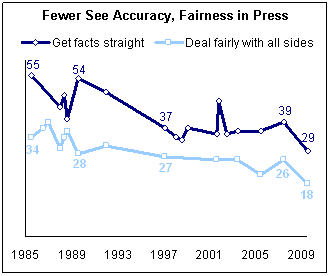
Media Trust by Pew ResearchIn my BtoB magazine column earlier this year, I suggested that office-supply giant Staples should take advantage of the collapse of mainstream publishing industry to become a trusted media source for small business. Staples hasn’t yet taken the plunge, but a number of other brands have, and I think it’s worth looking at the trend.

Here’s the premise: Mainstream media is collapsing. This is creating what I call a “trust gap” in the market. Not only are the institutions themselves disappearing but trust in mainstream media at a 20-year low (see Pew Research chart at right).  Social networks can fill some of the void, but not all of it. There is room in the market for new trusted sources to emerge and there is no reason why businesses and institutions, using the tools of new media, can’t step in.

Early Adopters

Let’s look at a few examples of what big brands are doing in this area:

  • Bank of America is targeting small businesses with its Small Business Online Community. This operation is heavy on user-generated content, the idea being that small business owners are eager to help each other. Judging by the amount of activity, the site is doing pretty well. Most articles that are more than six months old have several thousand page views. Top contributors are rewarded with a points system that elevates their standing in the community. This is an effective incentive.
  • Not to be outdone, American Express is also going after small businesses with Open Forum. Amex is taking a different approach from Bank of America by relying more heavily on assigned articles from professional writers and business innovators and less on community contributions, although there is room for user generated content. The editors have spotlighted a few frequent contributors and designated them as experts. There’s also a service that helps visitors find small businesses by specialty. That’s a nice incentive to get their target audience involved. Finally, there’s an impressive collection of videos of successful small-business owners who are, naturally, also Amex cardholders.
  • Office Depot covets small businesses, too (see a pattern here?). However, it’s taken an entirely different approach with a Survival of the Smartest, a website that features consumer promotions, contests and discounts. The initiative is an experimental alternative to the hundreds of millions of dollars the retailer spends on circulars Sunday newspaper circulars, according to a recent article in MediaPost. Two video hosts provide an umbrella of entertainment and coupons and promotions help close the deal. There’s also a desktop widget that alerts visitors to new specials.
  • Barnes & Noble Review logoOne interesting initiative that has flown under my radar for some time is Barnes & Noble Review. This elegant looking site has published more than 1,200 book reviews over the last two years and also features columnists and author interviews. It’s a beautiful sight, which I’m sure is no accident. Its design is reminiscent of the Sunday book review sections that have been hacked out of many daily newspapers over the last two years.

  • Perhaps the most direct attack on the traditional media space and I’ve seen this year comes from PepsiCo, which hired a group of bloggers and video podcasters to report on the Internet Week conference last June. In a BrandWeek interview last spring, entitled “Pepsi Sees a Chance to Fill Newspapers’ Void,”  Pepsi social media guru Bonin Bough said the soft drink maker saw opportunity in the demise of traditional media. Pepsi was openly advertising jobs for unemployed journalists and journalism students prior to Internet Week.

I think this is the tip of the iceberg. Once big brands get over their addiction to increasingly ineffective conventional marketing channels and take advantage of the chance to build new audiences, they will flock to these new opportunities. Advertising is one of the most expensive ways to build customer affinity. In contrast, trusted media brands enjoy customer loyalty that extends for decades. Why would you not want to get a piece of that?

[Slashdot] [Digg] [Reddit] [del.icio.us] [Facebook] [Technorati] [Google] [StumbleUpon]

Comments 2 Comments »

Ghost ShipIn Blogging Blunders Part 1 and Blogging Blunders Part 2, we looked at problems like failure to interact or to publish distinctive content. Let’s wrap up with the most frequent and frustrating blogging problem that I encounter: Failure to persist.

Perhaps I’m unusual, but the first thing I look for when visiting a blog is the date of the most recent entry. This tells me a lot. Knowing whether the essay I’m about to read is one week or three years old can make a huge difference in its relevance to me. But it also tells me a lot about whether the author is committed to the blog.

Too many business blogs suffer from lack of attention. The same pattern appears again and again: There’s a burst of early activity followed by a gradual decline in the frequency of updates and eventual abandonment. But nothing ever dies on the Internet, so these blogs drift along like ghost ships. They’re monuments to good intentions gone awry.

I don’t think many people start blogging with the intention of failing at it. Most are tripped up by one of four scenarios. See if you can avoid them.

Nothing More to Say – This happens when the blogger chooses a topic that lacks staying power. The subject is hot for a while, but then public interest wanes or the news value recedes. Any blog about a newsy or trendy issue is at risk of this fate. To avoid it, choose big issues that have staying power. For example, instead of writing about Blu-ray, write about the bigger issue of next-generation video formats.

Too Busy – So are we all, so think about that going in. It takes about an hour a week to contribute two brief new insights to a blog. You need to put some thought into developing and supporting a theme for a few hundreds words. If you don’t think you have that kind of time, don’t start. Twitter is an ideal alternative for people who are too busy to blog. The 140-character limit is actually a welcome restriction that forces them to keep their comments brief.

Nobody Came – This is a self-fulfilling prophecy. New bloggers put all kinds of effort into their work for six months and find that traffic still numbers in the few dozens per day. There are several reasons for this. One is that the topic they choose is highly competitive and their approach undifferentiated. If that happens to you, then look at ways to approach your topic from a distinctive angle or with a unique voice. Another common problem is that bloggers fail to promote themselves. This can be addressed via some basic outbound e-mail and sharing tactics (contact me if you want ideas). A third is that they simply don’t give the project enough time. It’s rare for a blog to catch fire during its first six to nine months. You need to build visibility with people who have traffic to send your way. If you’re persistent, then you should see rewards by your first anniversary date. But don’t be disappointed if it takes that long. Word of mouth isn’t always fast.

Turnover – This is a huge issue with business blogs. The internal sponsor leaves the company or gets reassigned and there’s no succession plan in place. This is why I encourage clients to view blogs as a business-wide initiative. Support has to come from the top and a backup plan must be in place to continue the conversation if the product champion leaves. A branded business blog is no place for cowboys. You need a team commitment to sustain the momentum.

Those are my candidates for the most common factors that derail business blogs. What are yours? Post your comments here and let’s discuss.

[Slashdot] [Digg] [Reddit] [del.icio.us] [Facebook] [Technorati] [Google] [StumbleUpon]

Comments No Comments »

Part 2 of a series on common business blogging mistakes. Part 1 is here.

Blogs are a new form of communications medium but many marketers still are stuck in the old one-way mode. To really appreciate the value of blogging, you have to approach it as a conversation. That means listening as well as talking. Here are some common mistakes:

Failure to link – Links are online currency. Not only do they enable more efficient communication than that available with the printed word (see my earlier post” “What You Probably Don’t Know About Links”), but they’re an acknowledgment that someone else has published something of value. Bloggers covet links. Links improve their search performance and drive traffic that leads to business opportunities. Mentioning someone else’s work without linking to it is considered rude.

Too often, novice bloggers fail to observe this simple protocol. They cite but don’t link. It takes only a few seconds to add links to your copy and it has all kinds of benefits. Linking engenders goodwill with the source of the information. That may lead to a reciprocal link, which improves your own traffic. It can also start a dialog with a person whose work you respect. You don’t have to agree with people to link to them, but you should always acknowledge that their work had value to you.

Here’s another reason to sweat this detail: failure to link can actually make you enemies. Thanks go Google Alerts, people now know instantly when their name pops up somewhere else online. If that mention doesn’t include a link, they’re going to be annoyed. So linking isn’t an option; it’s a necessity to maintaining good relations with people you respect.

Treating the blog as a wire service – Don’t use your blog to distribute press releases. That’s missing the point of this two-way medium. Blogs are a way for people to connect with each other. They’re a conversation, not a channel. If you treat your blog as another way to deliver a templated mass mail, then readers will abandon you faster than they’d flee a flaming building.

There’s nothing wrong with posting the occasional news release on your blog, but always add a personal message to frame its importance. Even better: link to the release and comment about why it’s significant. Humanize the interaction.

Being irrelevant – Shortly after the stock market crashed last fall, I visited 15 prominent corporate blogs. To my astonishment, only one even mentioned the most perilous financial crisis in two generations. Most were filled with marketing happy talk. These bloggers failed to address a critical customer need for information. Worse, they looked clueless. touch. Imagine if Wells Fargo had used the opportunity to educate its customers about why the markets were in turmoil. Instead, it posted a travel video. What a missed opportunity.

One of the great advantages of blogs is that they’re fast and easy to update. Use them to comment on current events that affect your customers. You don’t have to run afoul of regulatory guidelines to explain something. Educate and inform. Become a trusted source.

Turning off comments – According to some estimates, about 20% of business blogs don’t accept comments. Those companies are missing the point. A blog is a basis of discussion, not a TV program. Turning off comments is the same as saying you’re not interested in what your constituents think. What an insult.

The reason people most often cite for banishing comments is that they fear negativity. Those companies shouldn’t be blogging in the first place. Occasional negativity is part of the fabric of good discussion and it should be embraced as part of the feedback process.  If you’re worried about inappropriateness, then enable comment moderation and filter responses. However, you should never delete a comment simply because it’s negative. The writer will simply take his gripe somewhere else.

[Slashdot] [Digg] [Reddit] [del.icio.us] [Facebook] [Technorati] [Google] [StumbleUpon]

Comments 2 Comments »

Notice Those Ads on Blogs? Regulators Do, Too – NYTimes.com

The National Advertising Review Council is calling for clear disclosure from bloggers who are paid for product reviews or whose work is sponsored by companies they blog about. However, some people think the guidelines go too far. For example, they would require a blogger to disclose in a product review that the product had been provided free by a vendor. Such disclosure has never been practiced by traditional media companies.

You are SO unfollowed! – Scobleizer

Robert Scoble un-follows 106,000 people in one shot and says he’s relieved. Perhaps we’re beginning to see the backlash against social media over-exposure. We shouldn’t become a victim of the need to constantly communicate.

Managing beyond Web 2.0 – McKinsey Quarterly

What happens when consumers’ shared experiences are more interesting than anything your marketing department can provide? Marketers have to learn the tools of interaction in order to adapt to conversations going on outside of their control. Those consumer experiences can also yield valuable ideas for marketing programs that reflect what the audience really wants to talk about.

The article cites the experience of GlaxoSmithKline, which dealt with consumer confusion over its Alli weight-loss drug  by setting up the My Alli community site to support discussion, videos, FAQs and a membership plan to aid in weight loss. This wrapped useful information (and a marketing message) in a warm and friendly environment.

Four useful tools for social networkers – Strominator

David Strom reviews four online services that increase the productivity of active contributors to social media. I particularly like Pixelpipe and Tr.im.

Beware Social Media Marketing Myths – BusinessWeek

BusinessWeek’s Gene Marks skewers some common misconceptions about social networks. They’re not free, he says. In fact, they require a significant investment of time. And you won’t necessarily find customers there. He also advises business owners not to spread themselves too thin. If you find a platform that works, put your efforts behind that one. Good advice, if not necessarily groundbreaking.

Pepsi Sees a Chance to Fill Newspapers’ Void – BrandWeek

BrandWeek interviews Bonin Bough, PepsiCo’s new social media director. He’s spearheading a broad and deep push into all kinds of channels that enable customers to interact with the company and create their own content. PepsiCo is actually sponsorsing bloggers to cover some trade shows, effectively setting the company up as a competitor to newspapers. Bough has some nice sound bites. “If you really think about it, it’s the largest broadcast network in the world, and in such a short amount of time, too. People are willing to share if they are given a structured opportunity to do so.”

The One Word You Can’t Say: Campaign – MediaPost

“The word ‘campaign’ has become the pariah of social marketing,” says MediaPost. “Preferred alternatives include terms like ‘program,’ ‘initiative,’ or even ‘conversation.’” This article speaks truth. The old 13-week campaign doesn’t work in a conversational medium. You need to build relationships, and that takes times. The good news? Relationships can last for many years.

Still, this new reality challenges conventional thinking and standard operating procedure. For one thing, agencies are paid to create campaigns with defined beginnings and ends. How do you compensate the agency for open-ended conversations? Also, the beneficiaries are likely to extend beyond the marketing department, which means that organizations need broad-based buy-in to make social media “campaigns” successful.

[Slashdot] [Digg] [Reddit] [del.icio.us] [Facebook] [Technorati] [Google] [StumbleUpon]

Comments No Comments »

First in a three-part series on better blogging.

Your last entry is dated April 17. Most of your entries are press releases. Your headlines are dull as dirt. Your articles are devoid of links. And you wonder why no one comes to your blog.

Fail Blog photo (http://failblog.org)

Fail Blog photo (http://failblog.org)

I’ve done many content audits of clients’ blogs over the last two years and found the same shortcomings cropping up again and again. Most businesses don’t use blogs to their full potential. Often, they treat them as just another channel to distribute information they’re distributing by other means. It’s not surprising nobody comes.

A successful business blog uses the unique characteristics of the medium and engages in a discussion, not a speech. Pay attention to details and give it some time. Over the next couple of entries I’ll look at the most common failings of business blogs and how to avoid them.

Let’s start with three big mistakes:

Handing it off to PR — When businesses start a blog, they often designate the corporate communications/PR department to maintain it. This almost never works. Communications professionals are skilled at delivering messages, not promoting conversations. When presented with another channel, they tend to use it to push out a message. In the worst cases, these messages are nothing more than press releases. Lacking interactivity and insight, they fail to generate any reaction. Worse, they make the company look clueless about the medium.

Communication professionals should be actively involved in a company blog, but mostly on an advisory basis. Contributors should be the experts within the company. They are most likely to be the ones who will have meaningful dialogue with the audience. The communications people should focus on big picture issues like voice, topic selection and quality of writing. They should also sweat details like copyediting. Like orchestra conductors, their role is to bring out the best from the individuals in the ensemble.

It’s All About Me — A publishing mentor once recommended that editors find a picture of someone to represent their target reader and paste it on the wall of their cubes. The purpose was to constantly remind them that they were working on behalf of somebody else, not themselves.

Blog contributors would do well to heed this advice. Too many blog entries are self-serving and egotistical. They talk about awards, sales wins and accomplishments as if somebody actually cares. In reality, few people do.

What attracts people to your blog is useful information. The key word is “useful.” You should constantly ask yourself what insights or valuable information your visitors will take away. Blogging is a “give to get” strategy. The more information you share, the more goodness will come back to you in the end. If you don’t believe that, don’t start blogging. If you’re just looking to push out a PR message, here’s a list of free PR services you can use.

A Look That’s Boooooooring! – Blogger, WordPress and TypePad all offer small selections of default templates for your blog. Ignore them. It’s difficult enough to distinguish yourself from the millions of sites that are already out there. Don’t make it worse by looking just like them.

All the major services support third-party templates. There are literally tens of thousands of free templates for WordPress alone. Pick one that’s distinctive. If you’re willing to spend a few hundred to a couple of thousand dollars, you can get one designed to your specifications. I strongly recommend a custom design if your blog is tied to a company website.

While you’re at it, get rid of the default wording and links that these services impose on your site. There’s nothing like scrolling down a blog page and finding links to the WordPress developers forum. This just indicates that the blogger isn’t paying attention to details, which doesn’t do wonders for your credibility.

These are just three of the most common mistakes business bloggers make. In the next entry, we’ll look at links, multimedia and other frequently overlooked features.

[Slashdot] [Digg] [Reddit] [del.icio.us] [Facebook] [Technorati] [Google] [StumbleUpon]

Comments 5 Comments »

By now, most companies have got a pretty good handle on what happens on their website.  At the very least, they use a tool like Google Analytics or the simple and easy StatCounter to track total visits, referring URLs, visitor paths and time-spent-on-site.  It’s intriguing and fun to see where people are coming from and what they’re doing.  It’s also increasingly irrelevant.

The website as we know it is becoming a relic of the first 15 years of the Internet.  Sure, websites will always be important, but the action that takes place around a company, brand or individual is moving into a complex web of stateless conversations.  Some of these take place on corporate websites, but many of them don’t.  Consider Facebook, whose 200 million members are the world’s largest ready-made audience.  Some brands have more active communities of customers on Facebook than they do on their own websites.  In fact, their own websites may not even enable community at all.  Perception of their brand is defined in a community that they host but can’t control.

Locationless

Our personal activities now take place in many locations.  Look at Twitter, for example.  While there’s a Twitter website, conversations take place in the ether. People who use TweetDeck, Twhirl, TwInbox or one of the other dedicated Twitter clients may never visit the Twitter website. In fact, the Twitter feed may easily be displayed on any website you like.

Steve Rubel, a public relations social media visionary whom I profiled in New Influencers, recently announced that he’s abandoning his blog in favor of a lifestream. Steve is at the extreme edge of social media activity, so his experience isn’t typical, but I think his point bears considering.  He’s saying that the action now takes place in so many nooks and crannies of the Internet that a website is, at best, a place to pull them all together.  Our own activities are too expansive to be confined to one place.

This presents some immediate problems.  It seems that just as we’ve succeeded in getting a pretty good handle on what happens on our websites, the action has moved elsewhere.  In many cases, we have no insight into what’s happening there. Facebook, for example, offers only rudimentary reporting on activity within its profiles and forims. There is simply no way to determine how many people have seen a message on Twitter. Sites like Flickr, YouTube or SlideShare can tell you how many people have watched your presentation or video but not where they came from or how long they spent there. Our window on online activity around our brand is actually becoming more opaque with time.

Not Dead Yet

Does this mean websites are dead? No, but they are changing. The website’s role will increasingly be to present a persons or organization’s view of things in hopes of enticing conversations back to that controllable and measurable forum.  It will be the home base for everything we do online, kind of our own organizational lifestream. But marketers must face the new reality that online success has many faces, even if we can’t measure all of them very well.

This also means that businesses should take a new look at hosting their own communities.  Facebook is training wheels for the bigger goal of building branded communities that become the primary destination for customers and business partners.  If you can build and measure those, you can gain a lot more insight about what motivates customers.  If you can’t, well, try to send people back to your trusty old website for your point of view.

[Slashdot] [Digg] [Reddit] [del.icio.us] [Facebook] [Technorati] [Google] [StumbleUpon]

Comments 3 Comments »

Four useful tools for social networkers

David Strom reviews four online services that increase the productivity of active contributors to social media.

Beware Social Media Marketing Myths – BusinessWeek

CPA Gene Marks throws a big bucket of cold water or what he calls social media marketing myths.  Social media is neither free nor cheap, he says, and the customers you want to reach probably aren’t hanging out on k Faceboowaiting to hear from you.  If there is action in social network land, it’s probably in the boring advisory sites that help people to run their businesses better. I think he’s mostly right

Pepsi Sees a Chance to Fill Newspapers’ Void

The soft drink company actually paid to have bloggers “cover” a recent trade show and its online marketing programs increasingly look like publishing.  Perhaps Pepsi sees something that a lot of people haven’t yet: the rapid decline of big media is creating a trust gap into which commercial companies can step.  Sure its unconventional, but they give Pepsi credit for not just following the herd.

The One Word You Can’t Say: Campaign

Campaigns have distinct endpoints, while conversations may last for years.  That’s one reason conversational marketing is so difficult for many marketers to internalize.  An advertising campaign may run its course in 13 weeks, but a social media conversation is just getting rolling by then.  Marketers need to twist their thinking a little differently to accept this change in approach.

How to Get a Professional Corporate Blogging Job

Yehuda Berlinger is that rarest of corporate marketers: a professional business blogger.  In this extensive how-to article, he describes the unique characteristics of a business blogging job and offers some ideas on how to land such a position.  There still aren’t many job titles like that out there, but if you’re trying to get one, you could do worse than turn to this article for advice.

[Slashdot] [Digg] [Reddit] [del.icio.us] [Facebook] [Technorati] [Google] [StumbleUpon]

Comments No Comments »

swiss_army_knifeI had to laugh last week when I heard the keynote speaker at a public relations conference refer to the conventional wisdom that blogs are “so yesterday.” Maybe it’s because I spend two to three hours daily tending to my own blogs and others, or maybe it’s just general frustration with trend-chasing, but blogs are more relevant today than they’ve ever been, and they’re growing more useful as options proliferate.

The blog is the Swiss army knife of social media. Simple to use and easy to update, it accommodates every type of media: words, images, video and sound. Blog entries can be of Twitter-like brevity or can go on for thousands of words. Content can be displayed in a wide variety of formats and designs. Visitors don’t have to register to read.

Blog content is automatically syndicated via RSS feeds, making it simple for the owner to republish information through other outlets. A blog can also act as a catch-basin for the owner’s other social media activities. All of a person’s tweets, Yelps, Flickr PhotoStreams and YouTube creations can be aggregated and displayed in one place.

Content can be automatically reformatted for display on devices ranging from text readers to mobile devices. A countless variety of useful widgets can be added to entertain and inform visitors. Web analytics can show detailed information about where visitors originated, what they read, how long they stayed and where they went next. Blogs can even incorporate order forms. Last but not least, blogs rock on search engine performance.

Not Perfect

It’s true that there are a few things blogs don’t do well. They’re not as quick and easy to update as Twitter or the Facebook status message. And they lack interactivity. While visitors can comment on individual entries, they can’t comment on the overall theme of the blog, and even threaded comment strings can be difficult to follow. There are also limits to what you can do with the simple reverse chronological format, although innovators like Brian Gardner are managing to make WordPress do things I never thought possible.

For businesses, blogs provide a critical element of control. They’re the social media equivalent of speaking to an audience. The author retains control over subject matter, tone and direction while offering interaction around subjects of his or her choosing. Businesses that shrink from the unpredictability of unmediated discussion can take comfort in the fact that blogs give them a healthy dose of control.

For business-to-business applications, blogs are the overwhelming tool of choice. That’s because b-to-b professionals often don’t have the time or patience to fill out profile forms, answer friend requests or join groups. Blogs are simply a fast and easy way to share information with very little overhead.

Blogs are the building block of nearly every form of social media. They are the tool you need to master in order to understand the rich nuances of other media that are available to you.

[Slashdot] [Digg] [Reddit] [del.icio.us] [Facebook] [Technorati] [Google] [StumbleUpon]

Comments 3 Comments »